Every day moments in your Florida preschool are full of clues about each child’s learning. This short guide helps child care providers and directors use quick, simple checks during play, snacks, and transitions. Use these ideas to make assessment part of the day —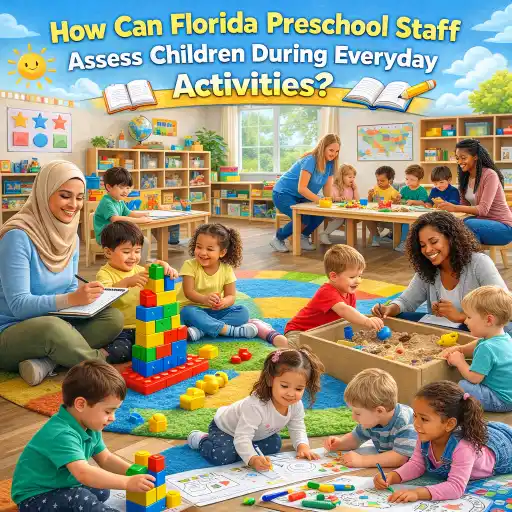 not extra work. You will find easy steps, tools, and tips for sharing results with families and for knowing when to screen or refer.
Why it matters: Small, regular checks help you see real growth, plan better lessons, and act early if a child needs extra help. They also build trust with families when you share facts and simple next steps. For ways to watch with purpose, see How do we observe with purpose in early childhood assessment?.
Quick note: state requirements vary - check your state licensing agency. Use these steps in your # preschoolers' room to keep notes short, useful, and kind.
What everyday moments are best for watching children?
2) Small groups: Circle time and teacher-led activities show following directions, attention, and early literacy or math skills. Use short checks during these times as suggested in How can teachers observe children's development effectively?.
3) Transitions & routines: Handwashing, snack, lining up, and clean-up show independence and self-regulation. Watch how children respond to cues. The article What should Florida child care providers observe... gives examples.
- 😊 Free play: look for talk, sharing, and persistence.
- 🎯 Small groups: note who answers, follows two-step directions, or needs extra prompts.
- 🔁 Routines: watch daily tasks (coat hooks, snack choices) for independence.
- 📸 Work samples: a drawing or stacking photo tells a story over time.
Why this focus helps: it keeps observation quick and tied to real classroom goals like language, social skills, and motor development. For a helpful list of what to watch, see ChildCareEd's checklist.
How can I record useful observations without extra work?
Follow these easy numbered steps:
- 📌 Pick one focus (example: naming colors or sharing).
- ⏱ Watch for 5–10 minutes during a routine or play time.
- ✏️ Write one factual sentence: who, what, when, where (no labels or reasons).
- 📷 Add one photo or work sample with family permission and date it.
- 🔁 Repeat weekly and add notes to the child’s file or portfolio.
Tips to stay objective:
- 🔍 Use exact actions and quotes. Write "stacked 6 blocks," not "good at blocks." See examples in Observe with purpose.
- 👥 When possible, have two staff compare a short note to reduce bias — training resources are in Preschool Assessments & Observations
 Buy Now $24.00. For information on Florida-specific staff qualifications, approved trainings, and Department of Children and Families requirements, see Florida credentialing resources.
 - 📂 Keep forms simple, so staff will use them. For record ideas, see How we can document child progress effectively?.
State rules matter for records and photos, so state requirements vary - check your state licensing agency. Use short routines and your team will keep documentation doable. Tag this work with #observation and #assessment to remind your team of the purpose.
How do we turn observations into goals and share them with families?
Try this numbered plan:
- 📑 Summarize: Write one short paragraph with date, setting, and exact example.
- 🎯 Create 1–3 small measurable goals (example: "Will name 3 colors during art time in 3 of 5 tries").
- 🛠 List 2 teacher supports that fit daily routines (model language, offer choices, short games).
- 🔁 Re-check in 2–4 weeks and note progress; update the plan.
Share with families in a positive way. Start with strengths, show one concrete example (note or photo), and invite parent input. For ideas on inviting families, see Inviting Families into Observation & Assessment and ChildCareEd’s family communication tools at Communicate a child's progress (see site resources).
Why this matters to families: clear examples build trust and let parents use the same goals at home. Use the hashtags #families and #development when noting plans so your team remembers to include family voice.
When should we screen or refer for extra help?
Monitor and screen when observations show repeated delays or no progress after supports. Use multiple quick measures (notes, checklists, photos) before deciding. ChildCareEd recommends steps in Observe with purpose and screening guidance in Preschool Assessments & Observations Buy Now $24.00.
Steps to follow:
- 🔎 Monitor: Collect 2–4 short observations over 2–6 weeks.
- 📊 Screen: Use a brief screening tool or a program like the DRDP for preschool ideas (DRDP (2015)) or check CDC milestone resources.
- 🤝 Talk with family: Share facts, show examples, and ask about home concerns. See family partnership tips at Inviting Families....
- 📞 Refer: If screening suggests a delay, contact your state early intervention program. Find contacts at the CDC page Early Intervention Contact Information.
For behavioral supports, use strategies from CSEFEL (CSEFEL practical strategies). For Florida program standards, check the Division of Early Learning standards at Florida Early Learning Standards. Remember: state requirements vary - check your state licensing agency before formal referrals.
Conclusion
Small, regular checks during play, routines, and transitions make assessment doable and powerful. Use short tools, factual notes, and one-photo evidence to build a clear story about each child. Turn notes into 1–3 simple goals, share strengths with families, and monitor progress.
- 📌 Do 3 short observations this week: one free play, one small group, one transition.
- ✏️ Write one factual sentence and add a dated photo with permission.
- 🎯 Make one small goal and two classroom supports; re-check in 2–4 weeks.
- 📞 If worried, use CDC early intervention contacts and follow Florida standards.
FAQ (quick):
- Q: How often to observe? A: Short daily notes and one deeper check monthly works well.
- Q: Who writes notes? A: Staff who know the child best; add a second observer when possible.
- Q: How to keep records? A: One child file + classroom binder or secure digital folder; follow privacy rules.
Use the steps above in your # preschoolers' room to make assessment simple, fair, and useful. Keep supporting each child's #development and celebrate progress with #families. Your careful watching is one of the best tools you have for helping children grow.
Keep recording fast and factual. Use 1–2 simple tools that fit your day: anecdotal notes, a checklist, time sampling, or a quick photo for a portfolio. ChildCareEd has templates and examples at How can we assess child progress in simple, helpful ways? And how do I run effective classroom observations (Checklist included)?.1) Free play: Blocks, dramatic play, sensory areas, and art show language, problem-solving, and social skills. See guidance in What should Florida child care providers observe during play, learning, and transitions?.Make observations useful by making a small plan. ChildCareEd shows step-by-step ways to move from notes to goals in Observe with purpose and Document child progress effectively.
- 45 Hour Child Growth and Development
- CDA Home Visitor Subject Area 3 Part 3 Birth to 5
- 45 Hour Preschool Methods and Materials
- Tracking Progress, Shaping Futures: Observation & Assessment Skills
- 45 Hour Infant and Toddler Methods and Materials
- 45 Hour School Age Methods and Materials
- Texas Director Credential
- 45 hour Growth and Development Birth-age 12 ONLINE
- Every Moment Matters: Schedules and Transitions
- Your Path to a CDA Certification in Florida: What You Need to Know to Get Started
- Navigating Early Childhood Credentialing in the Sunshine State of Florida
- Fast-Track Your Childcare Career with a CDA Certification and its Benefits
- Investing in CDA Certification is Investing in Quality Childcare
- ❄️ ¿Qué actividades al aire libre funcionan bien para los niños de Illinois en cada estación? 🌷🍂
- State-Approved Trainings in Florida: A Complete Guide for Child Care Professionals
- Pascua En El Aula: Actividades Sencillas Para Aprender y Celebrar Con Seguridad
- Actividades de Fiesta para Niños de Preescolar y Primaria
- Regulaciones de Cuidado Infantil en Maryland para Centros y Hogares de Cuidado Infantil Familiar
- Proporciones de Cuidado Infantil y Tamaños de Grupo por Edad en Maryland (Guía Rápida para Centros y Hogares)
- Proporciones de Cuidado Infantil y Tamaños de Grupo por Edad en Nueva Jersey (Guía Rápida para Centros y Hogares)
- Proporciones de Cuidado Infantil y Tamaños de Grupo por Edad en Virginia (Guía Rápida para Centros y Hogares)
- Cómo Celebrar el Día Nacional del Kindergarten
- Consejos de Supervisión Activa para Salones de Preescolar y el Juego al Aire Libre
- How can Florida preschool staff assess children during everyday activities?
- Calabazas, hojas y manzanas: actividades de otoño para preescolares
- Celebrando la amistad en el cuidado infantil durante el Día de los Mejores Amigos
- Canciones, juegos y preguntas de círculo para niños
- Cómo simplificar la capacitación para sus empleados de daycare
