Repetitive text turns a simple farm-animal book into an inviting opportunity for children to notice, say, and remember new words. Explore practical ways to make a predictable “I see…” reader interactive, and consider the Classroom Tools for Emergent Literacy course  Buy Now $16.00 for additional strategies with read-alouds, vocabulary tools, and print-rich classroom materials. It can help you strengthen everyday literacy practices while deepening your professional knowledge.
Why does repetition help children learn farm-animal words?
When children hear the same sentence structure repeatedly, they can devote more attention to the changing word and picture. In a reader such as I See: Farm Animals Buy Now $1.75, the recurring “I see…” frame keeps the language familiar while each page introduces a different animal. Children can anticipate the pattern, join in, and connect a spoken name—such as cow, pig, or chicken—to its image.
For providers, this approach is especially useful when children are still building confidence with spoken language or are new to the topic. Keep the experience warm and conversational: the goal is not to test children, but to help them make meaningful connections. Invite a response in any form—speech, gesture, pointing, a sound, or a communication device—and build from what the child offers.
How should you prepare for a farm-animal read-aloud?
Preparation can stay simple. Choose a small set of animals to emphasize, review their names and sounds, and make sure children can see the pictures clearly. Before reading, take a brief picture walk: pause over each illustration, name what you see, and let children share anything they recognize. Some children may know the animals from books, toys, family experiences, or a visit to a farm; invite these connections without assuming every child has had the same experiences.
Choose a manageable vocabulary focus rather than trying to teach every detail at once. For example, emphasize five animal names and add one useful descriptor or action word, such as “woolly sheep,” “pink pig,” or “the horse trots.” A few carefully repeated words make it easier to notice children’s responses and extend their understanding.
- Position children so everyone can see the pictures and the printed words.
- Point to each word as you read when appropriate, showing that print carries the message.
- Use animal figures, photos, or simple gestures to connect words with concrete references.
- Allow children to participate by speaking, pointing, signing, acting, or using AAC.
- 📚 Keep the book available afterward so children can revisit it independently or with a peer.
How can you make each repeated reading interactive?
Begin by reading the complete text naturally, preserving the rhythm and allowing children to enjoy the story. On a second reading, pause briefly before the animal name: “I see a…” Then wait. Some children will fill in the word; others may point to the picture, imitate the animal, or watch closely. Treat all of these as meaningful participation, and supply the word gently when needed: “Yes, you found the goat. I see a goat.”
As children become familiar with the pattern, invite them to take more of the reading role. Let them turn pages, point to the animal, or say the repeated phrase together. Keep questions open and purposeful. “What do you notice about this chicken?” or “What might the pig be doing?” encourages observation and conversation, while repeated quiz-style questions can make the experience feel like a test.
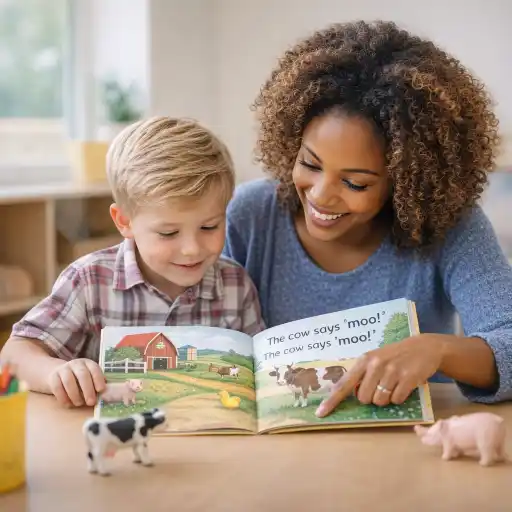
Re-reading also creates room to expand language beyond the printed sentence. If a child says “horse,” you might respond, “Yes, I see a brown horse. The horse has a long tail.” This models a richer phrase without requiring the child to repeat it. Research on classroom vocabulary instruction highlights the value of offering words and language in meaningful interactions and routines (Teaching Vocabulary in Early Childhood Classroom Routines).
- Read once for enjoyment, then revisit to notice target vocabulary and print.
- Use a short pause to invite children to complete the predictable phrase.
- Expand children’s attempts with one or two relevant details.
- Balance talking with wait time; children need space to respond.
How can farm vocabulary extend into play and daily routines?
Children are more likely to make words their own when they meet them in several meaningful settings. After reading, place animal figures, a small barn, and a few safe props in dramatic play or a literacy center. Model language as children play: “The sheep is in the barn,” “The cow is eating,” or “Let’s find the little chick.” Follow children’s ideas rather than directing every move. Their pretend scenarios provide natural reasons to name, describe, compare, and tell what happens next.
Farm vocabulary can also connect with art, movement, songs, and observation. Children might color an animal from the reader, move like a horse, sort animal pictures, or make a class book with dictated sentences. A farm-themed activity can encourage early literacy in multiple ways, including listening, sequencing, rhyming, and storytelling, as illustrated in these farm literacy center ideas.
Keep the language accurate but age-accessible. If children show interest, add words such as “hoof,” “feather,” “wool,” “stable,” or the name for an animal’s young. Explain unfamiliar terms briefly and connect them to a picture or prop. Use family contributions, home-language animal names, and bilingual books where available, recognizing children’s linguistic knowledge as an asset.
- Set up a small farm pretend-play area with figures and picture labels.
- Invite children to draw, dictate, or act out a favorite page.
- Repeat target words during transitions, outdoor observation, and conversation.
- Ask families about farm experiences, songs, or animal names used at home.
How can you adapt the activity and notice children’s learning?
One book can serve children with different language, attention, and participation styles. Shorten the reading for children who need a briefer experience, repeat a favorite page for those who benefit from predictability, and offer a choice of two animal pictures when open-ended responses feel difficult. Visuals, gestures, real objects, and home-language words can make the meaning clearer. A child does not need to say a word aloud to show understanding; pointing to the animal, matching a figure, or using an animal sound can also communicate recognition.
Observe informally as children engage. Notice whether a child looks toward the named animal, matches a word to an image, anticipates the repeated phrase, attempts a new word, or uses vocabulary spontaneously during play. These observations help you decide what to repeat or extend next. Avoid treating one quiet read-aloud as a definitive measure of a child’s language knowledge; familiarity, comfort, and context all influence participation.
Common pitfalls are easy to avoid. Do not rush through pauses, insist that every child repeat a word, or introduce a long list of animal facts at once. Avoid correcting every pronunciation in a way that interrupts communication. Instead, model the word clearly, affirm the child’s attempt, and continue the shared activity. If you document progress or plan formal training, remember that state requirements vary - check your state licensing agency.
What are the main takeaways for providers?
Repetitive text offers children a secure language pattern they can join, while changing farm-animal words give them meaningful vocabulary to notice and use. Prepare a small set of target words, read with expression, pause to welcome children’s contributions, and revisit the vocabulary through play and everyday conversation. Extend children’s language with accurate, responsive models rather than turning a favorite book into a quiz.
Most of all, treat participation broadly and recognize the strengths children bring: a word, a gesture, a sound, a home-language connection, or a story about an animal can all be valuable. A predictable farm reader is a modest resource, but thoughtful interactions around it can support vocabulary, print awareness, and joyful engagement with books. For more structured professional learning, explore the Classroom Tools for Emergent Literacy course Buy Now $16.00, which covers practical strategies and materials for emergent literacy in early childhood settings.
- 45 Hour Child Growth and Development
- Moving About the Classroom: Effective Transitions for Everyday
- CDA Home Visitor Subject Area 3 Part 3 Birth to 5
- The ABCs of Behavior: Turning Challenges into Learning Opportunities
- Birth to Five CDA Credential with Portfolio Review
- Setting the Stage: Story Time
- Pediatric RSV First Aid & CPR/AED
- Working Together: Teachers & Preschoolers
- Texas Director Credential
- 💛🧩 ¿Cómo puedo hacer que mi enseñanza sea inclusiva para los niños con autismo?
- 🚌❄️ Ideas de excursiones en Dakota del Norte
- Curso Gratis De Cuidado Infantil Con Certificado
- Celebra El Cumpleaños de Dr. Seuss En Tu Guardería Con Actividades Fáciles y Divertidas!
- 10 Ejemplos de Cómo la Cultura Influye en el Desarrollo Infantil
- Reglas de Cuidado Infantil en Illinois
- Proporciones de Cuidado Infantil y Tamaños de Grupo por Edad en Nueva Jersey (Guía Rápida para Centros y Hogares)
- Proporciones de Cuidado Infantil y Tamaños de Grupo por Edad en Virginia (Guía Rápida para Centros y Hogares)
- Cómo Trabajar en el Cuidado Infantil en Carolina del Norte: Requisitos y Pasos
- Celebrando la amistad en el cuidado infantil durante el Día de los Mejores Amigos
- Canciones, juegos y preguntas de círculo para niños
- Cómo simplificar la capacitación para sus empleados de daycare
- Why Is Wild vs. Farm Animal Sorting a Favorite Preschool Activity?
- How Do Repetitive Sentence Patterns Build Early Reading Confidence?
- How Can Predictable Ocean-Themed Text Build Reading Confidence?
- How Can Repetitive Text Introduce Farm-Animal Vocabulary?
- How Can Animal Vocabulary and Repetitive Sentences Help Preschoolers Become Confident Readers?
- How Can Word-Finding Games Strengthen Preschoolers’ Animal Vocabulary?
- How Can Farm-Animal Games Build Listening and Vocabulary?
- How Can We Explore Animal Habitats Beyond Farm-and-Wild Labels?
