Fall animal play can turn a child’s quick “big tail” into richer language about length, width, texture, and what makes two animals alike or different. The Language Development in Early Childhood  Buy Now $16.00 course offers practical strategies for supporting children’s verbal and nonverbal communication; explore it to strengthen your classroom practice while trying the playful ideas below. A simple matching invitation can open the door to thoughtful conversations—and to words children can carry into stories, routines, and play.
Why does comparison language matter during animal play?
Comparing animal features gives children a real purpose for describing what they see. As they inspect a fox’s tail, a squirrel’s tail, or a bird’s tail, they can notice differences in length, width, shape, and texture. Words such as long, short, bushy, smooth, narrow, and wide help children communicate those observations with increasing precision.
This kind of conversation supports more than naming. Children make observations, connect features to familiar knowledge, and explain why a piece may belong with a particular animal. They also hear and practice comparative forms such as “longer than,” “shorter than,” and “both have bushy tails.” A playful setting lets providers model these words without turning the activity into a vocabulary quiz.
Comparison play can also connect language with early math and science. Children classify by visible attributes, consider more than one possible grouping, and revise their thinking when they notice new evidence. As the NAEYC resource Reinforcing Language Skills for Our Youngest Learners notes, adults can support language by naming and describing objects and extending children’s contributions in everyday interactions.
- Children practice describing observable features, not only naming animals.
- They connect new words to concrete examples and shared experiences.
- They build #vocabulary, #comparison, and #reasoning through conversation and classification.
- Providers gain natural opportunities to notice children’s ideas and communication strengths.
Keep the focus on curiosity. A child’s unexpected match may reflect a thoughtful rule or a different experience—not simply an error to correct.
How can you set up a tail-matching invitation?
Use the Missing Tails Teaching Guide: Animal Tail Matching and Comparison Activity Buy Now $1.75 as a ready-made starting point. The guide includes animal-body templates, oversized tail pieces, matching mats, and crayons. Children match tails to bodies by looking closely at visual features, then compare tails that may be long or short, broad or narrow, smooth or bushy.
Before the activity, choose a small set of familiar animals and introduce a few comparison words in context. Show a tail piece and say, “This tail is long and narrow.” Then place a shorter piece beside it: “This one is shorter and wider.” Let children handle the pieces, examine the pictures, and make choices. For young children, use only a few animals at first; add more options as their interest and confidence grow.
- Invite children to match each tail to an animal body and describe the clue they noticed.
- Place two tails side by side and ask, “Which one is longer? How can you tell?”
- Sort tails by one feature, such as length, shape, or texture shown in the picture.
- Ask children to invent an imaginary animal and choose a tail that fits their idea.
- Offer crayons or drawing materials so children can add details or illustrate a new creature.
Use images and materials large enough for safe handling, and supervise closely. Adjust the number of choices and the size of the pieces to match children’s ages, abilities, and safety needs. The goal is meaningful observation and communication—not completing every match quickly.
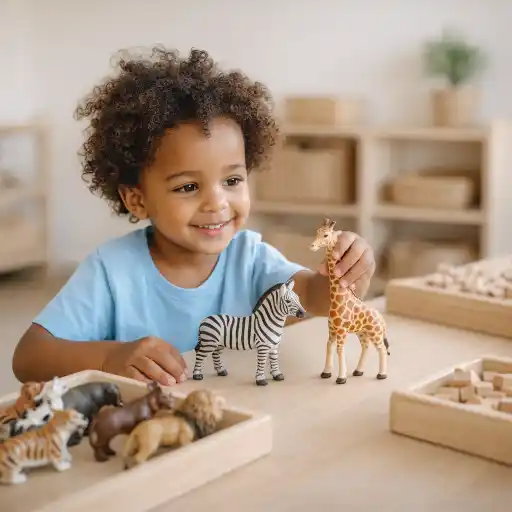
Which prompts help children compare and explain?
Open prompts invite children to share their thinking instead of guessing what the adult wants to hear. Begin with observation: “What do you notice about these tails?” Then invite a comparison: “How are they alike? How are they different?” If a child points or gives a one-word answer, acknowledge it and model a slightly fuller phrase. “Yes, this tail is long. It is longer than the rabbit’s tail.”
Use one question at a time, then pause. Children may need time to look, process, and communicate—through speech, gesture, pointing, sign, or an augmentative communication tool. Respond to the idea first, and expand language naturally rather than asking the child to repeat a sentence on demand.
- “Which tail looks bushy? What do you see that makes you think so?”
- “Can you find a tail that is shorter than this one?”
- “What is the same about these two tails? What is different?”
- “Which tail would you choose for your imaginary animal? Tell me about it.”
- “Could we sort these tails another way?”
Model precise but accessible terms: “You chose the broad tail,” or “These tails are both long, but one is smooth and one looks bushy.” If a child calls a tail “fluffy,” you can affirm the observation and introduce another word: “It does look fluffy—some people might describe that as bushy.” These responsive exchanges make #language part of the play itself.
How can you make the activity inclusive and engaging?
Children bring different language experiences, motor skills, sensory preferences, and ways of communicating. Keep the learning goal—observing and comparing—while offering varied routes into the activity. A child can match by pointing, choosing between two pictures, placing a piece with support, describing a feature, or using a communication board or device. Participation does not depend on speaking aloud or handling every piece independently.
For children learning more than one language, welcome animal names and describing words from home languages. Families may share words or animal experiences that add meaningful context. Pair spoken language with clear pictures, gestures, and examples; reduce visual clutter or the number of choices when that helps a child focus.
- Use fewer animal choices or compare just two tails to start.
- Provide larger images, nonslip mats, or supported placement when helpful.
- Offer pointing, signing, home-language words, and communication devices as valid responses.
- Invite children to work with a partner or in a quieter small group.
- 🦊 Let children act out how an animal might move its tail, then describe what they noticed.
Stay flexible about categories. A tail might be described by more than one feature, and a child may choose an imaginative match. Ask for the child’s reasoning before redirecting. Responsive teaching protects confidence and can reveal an opportunity to introduce a new word or idea.
How can you observe learning and extend the conversation?
Observe the process, not only whether the child makes the match you expected. Notice whether the child attends to a feature, uses a comparison word, identifies a similarity, changes a choice, or explains a decision. Record brief, objective notes that capture what happened and what support was available. For example: “Matched three tails to animal bodies; described one as ‘long’ independently and used ‘bushy’ after the provider modeled it.”
Use what you notice to plan a next step. If children readily name features, invite them to compare two attributes or create their own sorting rule. If they are just beginning, repeat a small set of words with clear pictures and side-by-side examples. Avoid interpreting one activity as a complete measure of language ability; children’s responses vary by familiarity, context, and comfort.
Carry the vocabulary into the rest of the day. Revisit long, short, and bushy during a fall read-aloud, animal movement game, drawing activity, or pretend-play center. The NAEYC guidance on language reinforcement encourages adults to describe what children are doing and build on their words as interactions unfold. You might say, “Your squirrel drawing has a long, bushy tail,” then pause to invite the child’s response.
Common pitfalls include rushing children to answer, introducing too many new words at once, and correcting a surprising match before hearing the child’s idea. Keep the activity conversational, playful, and responsive. If using the experience for staff learning or documentation, state requirements vary - check your state licensing agency.
Conclusion: How can fall animal play grow comparison language?
Fall animal play builds comparison language when children can look closely, handle or point to clear examples, hear useful words, and share their own reasoning. Start with a few tails and accessible terms such as long, short, bushy, and smooth. Use open prompts, allow wait time, and welcome speech, gestures, home-language words, and other communication modes.
The Missing Tails guide provides a practical activity structure, while your responsive conversation helps children carry new vocabulary into other parts of the day. Observe children’s strategies, adapt materials for access, and treat unexpected ideas as invitations to learn together. To deepen your professional understanding of early communication strategies, explore the Language Development in Early Childhood Buy Now $16.00 course. Related English-language courses include Building Vocabulary Buy Now $16.00, Early Mathematics Through Play Buy Now $24.00, Building Bridges for Dual Language Learners Buy Now $16.00, and Inclusive Lessons for Preschoolers Buy Now $16.00.
- Recognize, Respond, Respect: Supporting Diverse Learners
- CDA Subject Area 2
- What Makes Me Special: An Overview of Autism and ADHD
- Using AI Language Models for Trainers
- Language Development in Early Childhood
- Play, Learn, Grow
- What Makes Me Special: An Overview of Autism and ADHD: For Workforce Solutions
- Building Vocabulary
- Building Bridges for Dual Language Learners
- Montessori Cultural Activities: Exploring the World Through Play and Learning
- 10 Ejemplos de Cómo la Cultura Influye en el Desarrollo Infantil
- Actividades de Otoño Fáciles para Preescolares esta Temporada
- Celebrando la amistad en el cuidado infantil durante el Día de los Mejores Amigos
- Canciones, juegos y preguntas de círculo para niños
- What’s Happening Outside? Fall Science Adventures for Preschoolers
- Can You Build It With Fall? Nature-Based Building Challenges for Preschoolers
- Can You Build a Leaf Bridge? Fall STEM Challenges for Pre-K
- How Can Fall Nature STEM Activities Spark Preschoolers’ Scientific Thinking?
- How Can Outdoor Fall Activities Support Children’s Development?
- How Can Simple Fall Activities Support Kindergarten Readiness Through Play?
- How Can Child Care Providers Teach Fall in Warm Climates Without Red Leaves or Cold Weather?
- What Can Preschoolers Learn by Watching Trees Change Throughout the Fall?
- How Can Five Visits to the Same Tree Become a Preschool Investigation?
- How Can You Create a Fall Listening Walk for Toddlers?
- Why Does This Leaf Have Holes? How Can Preschool Questions Become Fall Investigations?
- How Can Preschoolers Tell Evergreen Trees from Trees That Change Color?
- How Can Fall Animal Play Build Children’s Comparison Language?
- How Can Cozy Animal Bedtime Play Teach Preschoolers Sequencing in Fall?
- Who Walked Through Our Pretend Forest? How Can You Create a Fall Footprint Investigation?
- How Can Woodland Mail Make Fall Dramatic Play a Meaningful Writing Experience?
