When preschoolers have a real reason to send a message, marks on paper become communication, connection, and play—not a worksheet. Create a woodland animal post office that invites children to draw, dictate, or write kind notes while practicing print knowledge and turn-taking; for a deeper foundation, explore ChildCareEd’s Understanding Print Knowledge in Preschool  Buy Now $16.00 and Science of Reading Foundations in the Pre-K Classroom Buy Now $16.00, which offer practical early-literacy learning for your classroom.
Why does purposeful woodland writing matter?
Writing becomes meaningful when children can imagine who will receive their message and what it might say. A note from a fox to a bear, a postcard from an owl, or a delivery for a squirrel gives drawing and early marks an audience. As ChildCareEd explains in its article on giving children a meaningful reason to write, children can communicate through drawings, scribbles, letter-like forms, copied names, dictated words, or conventional writing. The goal is expression, not perfect spelling.
This play also introduces print knowledge: children notice that names, labels, and symbols carry meaning and help mail reach a recipient. They listen, explain ideas, make choices, and imagine another animal’s perspective. These are connected experiences in language, early literacy, social interaction, and creative thinking.
Fall offers a vivid story world. Children may already be curious about changing leaves, animal homes, and how woodland creatures prepare for colder weather. A dramatic-play invitation can build on those interests without requiring a scripted lesson. Keep the central purpose simple: make a message, match it to a recipient, and deliver it kindly. A short conversation about what a friend might enjoy can turn a pretend letter into a thoughtful act of classroom belonging.
How can you set up an inviting woodland post office?
Start with a small, accessible space where children can move from composing to sorting and delivery. A basket, shoebox, or set of low bins can serve as the mail station. Add a few stuffed or picture-card animals, name-and-picture recipient cards, envelopes or folded paper, crayons, markers, and a simple mailbag. Include leaves, pinecones, or woodland images as decoration, keeping small objects age-appropriate and supervised.
Use readable labels and picture supports. A child can match an animal picture to the same picture on an envelope or mailbox; another may recognize a name or first letter. Offer a few word or phrase cards—such as “Dear,” “Thank you,” “Hello,” and “From”—as optional models rather than required copywork. This resembles the approach in a ChildCareEd turn-taking guide Buy Now $1.99, which includes the Animal Post Office Teaching Guide for matching, turn-taking, and kind messages.
- Prepare envelopes, blank cards, writing tools, and recycled paper.
- Make recipient cards with animal pictures and names; pair symbols and print as useful.
- Set out a “mail to deliver” basket and a separate “delivered” area.
- Keep the setup flexible so children can add roles, routes, and new animal characters.
Use safe, clean materials and follow supervision practices for the group. State requirements vary - check your state licensing agency.
What can children write if they are not writing words yet?
Every child can author a message at their current developmental level. A child may draw a leaf for a deer, make a line of marks, copy the first letter of a friend’s name, or dictate a complete sentence. When you write down a child’s words, preserve their meaning and read the message back: “You said, ‘I hope you find a cozy nest.’ I’ll write those words on your card.” This makes the connection between spoken language and print visible while keeping the child in charge of the idea.
Invite, rather than quiz. Try open prompts such as “Who would you like to send this to?” or “What might make your animal friend smile?” If a child wants support, point to the recipient card, model a simple greeting, or offer a choice of drawing materials. Avoid correcting every invented spelling or asking children to produce identical notes. The ChildCareEd overview of print knowledge in preschool describes how environmental print and meaningful opportunities to write can help children notice how print works.
Children may communicate in a home language, through gestures, pictures, sign, or assistive communication. Welcome these ways of making meaning. A message does not become less purposeful because it is not written in conventional English or alphabetic spelling. When children are ready, names, labels, and familiar words can help them attend to letters and the relationship between symbols and meaning.
- Accept drawing, scribbling, dictation, copying, and independent writing.
- Ask before reading a child’s message aloud; respect privacy and choice.
- Keep word cards available as supports, not as a test or checklist.
How do mail routines build print knowledge and social skills?
A simple mail routine gives children a meaningful sequence: create a message, identify a recipient, match a symbol or name, and deliver the letter. Each step offers opportunities to notice that print and pictures carry information. Children may look for the first letter in a name, compare two animal cards, sort mail by recipient, or ask how to find a mailbox. These actions connect early literacy with categorizing, memory, and problem-solving.
Turn-taking is equally important. Children can rotate roles as writers, postal workers, sorters, and recipients. Model language such as “May I deliver this next?” and “Let’s check the picture so it goes to the right friend.” If several children want the same role, use a visual turn card or a short rotation. The Animal Post Office Teaching Guide is designed around matching, turn-taking, and kind messages; the resource can help you organize a structured invitation while leaving room for children’s ideas.
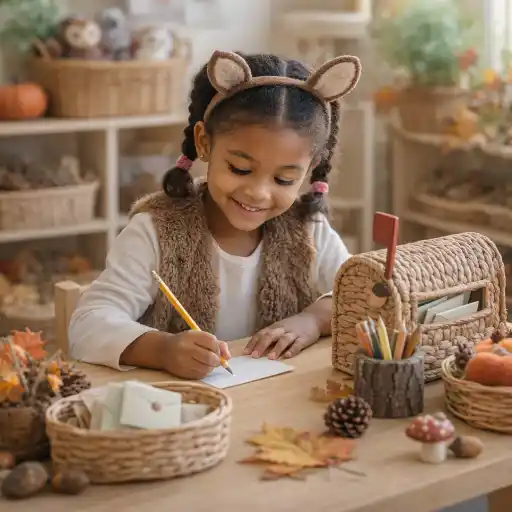
Make inclusion part of the system. A few children may receive many notes while others receive none, so offer class-wide messages, a rotating animal recipient, or an invitation to write to a mailbox that has not received mail yet. Do not require children to exchange personal messages or share private content. Children can opt to send a drawing, deliver a class note, or simply observe until they feel ready.
- 📬 Rotate roles so children have opportunities to compose, sort, and deliver.
- Use photos and matching symbols to support access and independent participation.
- Build in kind-message norms: friendly, respectful, and optional to share.
How can educators scaffold the play without taking it over?
Prepare the environment, demonstrate one brief example, then let the children’s storyline lead. You might write “Dear Owl,” place the note in the mailbag, and show how the animal picture helps the carrier find the right home. After that, watch and listen. Are children negotiating who delivers the mail? Are they using names, asking what to write, or inventing a forest route? Their play tells you which small adjustment may be useful.
Scaffolding can be a timely question, a new prop, or a descriptive comment—not a prescribed script. “How will the mail carrier know where this goes?” may prompt children to use a picture card. “The squirrel has a letter, but the mailbox is full—what could we try?” creates a playful problem to solve. Follow children’s interests and keep the activity open-ended, a principle emphasized in ChildCareEd’s guidance on using dramatic play to support learning.
Observe without turning the center into a formal test. Note whether a child chooses a recipient, uses a symbol, dictates a message, takes a turn, or responds to a peer. These brief records can guide next steps: add more name cards, offer larger writing tools, include bilingual labels, or extend play with a woodland read-aloud. Avoid over-directing, correcting every mark, or expecting every child to perform the same skill. Keep materials accessible and adapt them for motor, sensory, language, and communication needs.
How can you extend the theme and reflect on learning?
Let children’s questions shape what happens next. If they wonder where a fox lives, add a forest map or make a “delivery route” between animal homes. If they want to send mail outside the pretend center, invite them to create a class postcard with drawings and dictated words. Bring in fall colors, leaf shapes, or children’s observations from an outdoor walk; seasonal details can enrich the story without distracting from the purpose of communication.
Pair the post office with picture books about woodland animals, mail, friendship, or autumn. During a read-aloud, briefly notice the cover, title, or a printed word that connects to the play. Then let children return to their own messages. Print knowledge develops through repeated, meaningful encounters, not through a single themed activity. For more fall inspiration, the fall leaves and trees planning ideas include ways to bring seasonal materials into dramatic play; woodland animal ideas are also available in this forest animals planning resource.
Reflect as a teaching team: Which children initiated writing or dictation? What supports helped them participate? Did the routine provide fair turns and meaningful recipients? Use observations to adjust the center rather than judging children by how many letters they wrote. As a next step in professional learning, ChildCareEd’s [course options] can deepen staff understanding of early literacy. State requirements vary - check your state licensing agency when determining whether training meets a specific requirement.
Conclusion: How does woodland mail make writing purposeful?
A woodland post office gives preschoolers a reason to create and share messages: an animal friend is waiting to receive one. With simple props, picture-and-name supports, flexible ways to compose, and predictable turn-taking, educators can connect emergent writing and print knowledge with language, kindness, and belonging. Children’s drawings, dictated sentences, marks, and early letters all count as meaningful communication.
Keep the experience child-led: make materials accessible, model briefly, invite kind and optional exchanges, and observe what children do. Then respond with one thoughtful adjustment—perhaps a new mailbox, a home-language label, or more time for delivery play. The central question is not whether every child can write a conventional letter, but how each child can use marks, pictures, words, or other communication to reach a woodland friend.
More ChildCareEd learning:
- Understanding Print Knowledge in Preschool Buy Now $16.00
- Science of Reading Foundations in the Pre-K Classroom Buy Now $16.00
- Language and Literacy Foundations in Pre-K Buy Now $16.00
- Reading Aloud and Storytelling Buy Now $16.00
- Assessment of Language and Literacy Skills Buy Now $24.00
References
- How Can a Classroom Mailbox Give Children a Meaningful Reason to Write?
- Literacy-Rich Dramatic Play: Post Office & More Setup Ideas
- Preschool Post Office Lesson Planning Ideas
- Post Office Theme for Preschool
- How Can Dramatic Play Be Used to Support Learning?
- Understanding Print Knowledge in Preschool
- Taking Turns Together: A Guide to Turn-Taking and Conversation Buy Now $1.99
- How Can Child Care Providers Create Print-Rich Early Childhood Environments?
- Importance of Print Knowledge
- Developing Print Awareness Through Everyday Activities
- Early Literacy e-clip: Five Predictors of Early Literacy
- Preschool Writing Activities Interest Center
- How To Make Your Writing Center Fun and Engaging!
- Preschool Leaves and Trees Lesson Planning Ideas
- Preschool Forest Animals Lesson Planning Ideas
- Fun Fall Animal Activities for Preschoolers
- Supporting Pre-Writing Skills in Preschool
- 45 Hour Child Growth and Development
- CDA Home Visitor Subject Area 3 Part 3 Birth to 5
- CDA Home Visitor Subject Area 2 Part 3 Birth to 5
- 45 Hour Infant and Toddler Methods and Materials
- Pediatric RSV First Aid & CPR/AED
- 45 Hour School Age Methods and Materials
- Creating Engaging and Meaningful Learning Experiences
- Texas Director Credential
- CDA Certification en Español: Recursos y Consejos para Educadores Bilingües
- 💛🧩 ¿Cómo puedo hacer que mi enseñanza sea inclusiva para los niños con autismo?
- 😫🧸 ¿Qué hacer cuando un bebé no quiere dormir la siesta en el aula?
- Actividades de Motricidad Gruesa que Desarrollan el Equilibrio, la Coordinación y la Fuerza
- 10 Ejemplos de Cómo la Cultura Influye en el Desarrollo Infantil
- Proporciones de Cuidado Infantil y Tamaños de Grupo por Edad en Virginia (Guía Rápida para Centros y Hogares)
- Actividades de Otoño Fáciles para Preescolares esta Temporada
- Cómo Trabajar en el Cuidado Infantil en Carolina del Norte: Requisitos y Pasos
- Cómo Trabajar en el Cuidado Infantil en Wisconsin: Requisitos y Pasos
- Celebrando la amistad en el cuidado infantil durante el Día de los Mejores Amigos
- Diversión fresca de verano: actividades del Día Nacional del Helado para niños
- Canciones, juegos y preguntas de círculo para niños
- Cómo simplificar la capacitación para sus empleados de daycare
- ¿Todos los niños deben participar en el tiempo de círculo?
- ¿Faltan Materiales o Falta una Nueva Estrategia? Cómo Revisar los Rincones del Aula
- How Can You Extend Fall Dramatic Play into November Without Starting Over?
- How Can a Classroom Mailbox Give Children a Meaningful Reason to Write?
- How Can a Pretend Soup Kitchen Combine Fall Dramatic Play, Counting, and Cooperation?
- How Can Woodland Mail Make Fall Dramatic Play a Meaningful Writing Experience?
- Who Eats What in the Fall Forest? How Can After-School Programs Teach Food Chains?
