A trail of mysterious footprints can turn a pretend forest into a lively science investigation, giving preschoolers a reason to look closely, compare clues, and share their theories. Explore the Building Early Science Foundations course  Buy Now $16.00 to deepen your understanding of play-based inquiry and gain practical ways to nurture children’s questions, experimentation, and discovery. Then use the steps below to make a memorable, adaptable footprint experience for your group.
Why does a pretend-forest footprint investigation matter?
Footprints invite children to investigate something they cannot see directly: who or what passed through the forest? That uncertainty is productive. Children can notice visible features, ask questions, compare possible explanations, and revise a guess when new clues appear. These are early forms of scientific inquiry—not a test with one answer children must discover.
Science learning in early childhood can also connect naturally with language, mathematics, movement, and social collaboration. Children may describe prints as wide, narrow, deep, or faint; count marks; compare sizes; and listen to a peer’s explanation. Karen Worth describes young children’s curiosity as a powerful catalyst for inquiry, with appropriate guidance supporting other skills such as language and early mathematical understanding (Science in Early Childhood Classrooms: Content and Process).
A pretend setting offers practical advantages: educators can prepare the clues, adjust the challenge, and invite children to participate without needing to find actual wildlife tracks. Make clear that a classroom-made print is a model, not proof that an animal visited the outdoor area. The purpose is to build children’s #curiosity and confidence as investigators, while keeping their ideas open to further evidence.
How can you prepare a forest trail of clues?
Choose a small area of the classroom, playground, or outdoor learning space and transform it with a few simple materials. Use paper, washable paint, toy animal figures, or impressions pressed into play dough, sand, or another suitable surface. Add pretend leaves, fabric “moss,” cardboard trees, or blocks to suggest a woodland path. Keep the setup manageable: too many props can distract from the footprint clues.
Prepare a short sequence of prints that children can follow. Vary the spacing, direction, or size, and include a few intentional questions: Does the trail change direction? Are there one or several kinds of prints? Do the marks appear in a repeating pattern? Animal figures can make tracks across different surfaces, while a small set of photos or picture cards can offer comparison examples. For inspiration about varied surfaces, see Animal Tracks.
- Gather large, age-appropriate animal figures, paper, crayons, and a magnifier if available.
- Choose a few track examples rather than an overwhelming collection.
- Make a simple “We notice / We wonder” chart for children’s words and questions.
- Set clear boundaries and check the area and materials before children begin.
Invite children into the story: “Something walked through our pretend forest while we were away. What clues did it leave?” The Footprint Detective Teaching Guide: Who Made These Funny Footprints? Buy Now $1.75 can provide a ready-to-use structure for ages 3–5. A thoughtful setup makes the investigation inviting, but children’s observations—not elaborate scenery—should remain at the center.
How do you guide children from noticing to reasoning?
Begin by giving children time to observe before offering animal names or explanations. If a child immediately says, “A bear came here,” affirm the idea and ask what the child sees that suggests a bear. This keeps the theory welcome while helping children distinguish between an observation and an interpretation. “I see four small marks” describes evidence; “a fox made them” is a possible explanation.
Use open-ended prompts and leave room for children to think. They may answer with words, gestures, drawings, pointing, or a home language. Try questions such as:
- “What do you notice about the shape and size?”
- “How many marks can we count?”
- “Which way might the trail be going?”
- “What do we know from looking, and what are we still wondering?”
- “What other animal—or object—could make a mark like this?”
Document children’s ideas without turning the activity into a quiz. A chart might read, “We noticed: two large prints and a short trail. We wonder: Was it a bear, a dog, or a pretend creature?” Children can then compare their suggestions with a second track, a picture, or a model print. Avoid announcing that one image proves the answer: real tracks may be partial, overlapping, or changed by the surface. This approach respects children’s thinking and makes #observation and evidence part of the game.
How can children compare and record footprint evidence?
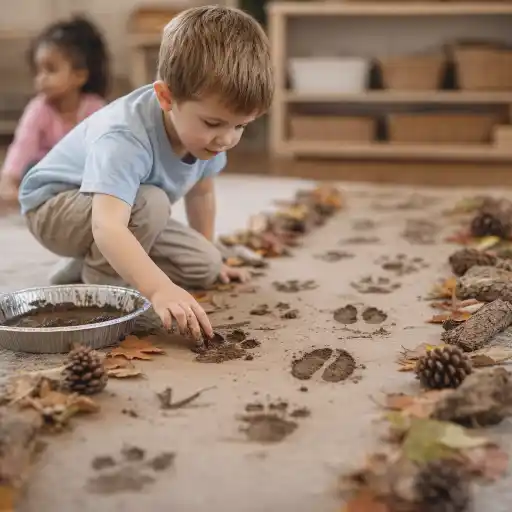
Comparison helps children move beyond a first impression. Place two prints side by side and invite the group to notice similarities and differences: size, outline, number of toe marks, spacing, and direction. Use familiar descriptive words and model new vocabulary naturally—such as paw, hoof, trail, pattern, shallow, or deep. Children may sort prints into broad groups, such as paw-like, hoof-like, or bird-like, without needing to identify a species.
Offer simple ways to represent what children see. They might sketch a print, count its marks, compare its length with blocks, or dictate a sentence for an educator to write. A small chart can connect each idea to the clue that prompted it: “We think it might be a bird because we see three narrow marks.” This encourages reasoning without requiring children to write independently.
Children can also create their own tracks with animal figures in play dough or a tray of sand, then compare how the prints change on a soft, firm, damp, or dry surface. Explain that these are classroom models and keep them separate from any actual outdoor evidence. Hands-on play supports inquiry when children can change one feature and notice what happens. The resource How Can Animal Footprints Turn Preschoolers Into Little Scientists? offers additional ideas for observing and comparing tracks.
- Take a brief photo or make a sketch of the clue, following program policies.
- Write one child’s exact observation or question alongside the image.
- Return to the chart later: “Did another clue change your thinking?”
These small records help educators plan the next invitation and show children that their ideas matter.
How can you make the investigation inclusive, playful, and safe?
Offer more than one way to participate. Some children may enjoy following the trail, while others prefer to study a print from a seated position, point to a feature, sketch it, or discuss it with a partner. Use large, high-contrast images, sturdy tools, picture cues, and a smaller number of choices where helpful. Children can communicate through speech, gestures, drawing, assistive communication, or a home language. The learning goal—sharing attention to clues and ideas—can remain consistent while the route into the activity varies.
Keep the pretend story enjoyable without pressuring children to guess correctly. An “animal detective” role, a simple badge, or a shared forest map can add imaginative energy. A child may decide the mystery-maker is a squirrel, while a peer suggests a bird; invite both to explain their thinking and look for another clue. If the evidence stays uncertain, that is a legitimate conclusion: “We have a few possibilities, and we need more information.”
Safety and supervision still matter, especially outdoors. Inspect the play area, use materials appropriate for the children’s ages and abilities, maintain active supervision, and keep children within approved boundaries. Avoid handling wildlife or unknown materials and do not follow real tracks into unsafe or restricted areas. State requirements vary - check your state licensing agency.
- 🕵️ Try a “detective pause”: everyone looks quietly for a few seconds before sharing ideas.
- Keep routes clear and prints placed where children can examine them safely.
- Use washable, nontoxic materials as appropriate and follow program policies.
- Label invented tracks as pretend or model prints so children can tell them apart from real clues.
These supports help children feel capable, welcome, and ready to contribute to the group’s investigation.
How can you extend the mystery and document learning?
Let children’s questions guide what happens next. If they wonder whether the mystery-maker hopped or walked, invite them to act out different movements and compare the patterns they create. If they are interested in animal homes, revisit a picture book, add a forest habitat to dramatic play, or look at animal photos together. Keep extensions connected to children’s original question rather than expanding the theme in every direction at once.
Documentation can be brief and useful. Save a child’s drawing, record a short quote, or take a photo of the group’s chart when permitted. Focus on the thinking process: “Amir counted four marks and predicted a small animal; after comparing the spacing, he wondered if it was hopping.” Avoid recording only the final guess. Later, invite children to revisit the evidence and explain whether they would keep or change their ideas.
For providers, these records can inform curriculum planning and conversations with colleagues or families. Notice who contributed verbally, through movement, drawing, or observation; consider what materials supported participation; and decide what small change could deepen the next investigation. To strengthen your broader approach to play-based inquiry, explore ChildCareEd’s Basic Science in Early Childhood Buy Now $25.00 course or the Creating the Natural Outdoor Classroom Buy Now $16.00 course. These are two additional professional learning options relevant to early science and outdoor exploration.
Conclusion: Who walked through the pretend forest?
The mystery’s strongest answer may be “We are not sure yet.” A fall footprint investigation gives children a playful reason to notice details, compare clues, make predictions, communicate ideas, and revise their thinking. Providers can support that learning by preparing a few clear clues, asking open questions, welcoming uncertainty, and documenting children’s reasoning rather than focusing only on a correct animal name.
Start small: set a trail, invite children to describe what they see, and return to their ideas as new evidence appears. Adapt the materials and participation options to your group, maintain safe supervision, and let children’s questions shape the next step. In a pretend forest, the footprints may be imaginary—but the habits of scientific inquiry are real.
- 45 Hour Child Growth and Development
- What Makes Me Special: An Overview of Autism and ADHD
- Teach with Respect!
- CDA Bridge Bundle: Preschool
- Pediatric RSV First Aid & CPR/AED
- CDA Bridge Bundle: Family Child Care without Portfolio Review
- CDA Bridge Bundle: Infant/Toddler without Portfolio Review
- CDA Bridge Bundle: Preschool without Portfolio Review
- CDA Certification en Español: Recursos y Consejos para Educadores Bilingües
- 💛🧩 ¿Cómo puedo hacer que mi enseñanza sea inclusiva para los niños con autismo?
- Cómo Abrir Una Quardería En Casa Sin Dinero?
- 10 Ejemplos de Cómo la Cultura Influye en el Desarrollo Infantil
- Capacitación en Salud y Seguridad Preventiva en Línea para Proveedores de Cuidado Infantil
- Proporciones de Cuidado Infantil y Tamaños de Grupo por Edad en Maryland (Guía Rápida para Centros y Hogares)
- Proporciones de Cuidado Infantil y Tamaños de Grupo por Edad en Nueva Jersey (Guía Rápida para Centros y Hogares)
- Proporciones de Cuidado Infantil y Tamaños de Grupo por Edad en Virginia (Guía Rápida para Centros y Hogares)
- Actividades de Otoño Fáciles para Preescolares esta Temporada
- Cómo Trabajar en el Cuidado Infantil en Carolina del Norte: Requisitos y Pasos
- Las Mejores Ideas de Excursiones para Guarderías en Texas
- Celebrando la amistad en el cuidado infantil durante el Día de los Mejores Amigos
- Canciones, juegos y preguntas de círculo para niños
- Cómo simplificar la capacitación para sus empleados de daycare
- How Can Simple Fall Activities Support Kindergarten Readiness Through Play?
- How Can Animal Footprints Turn Preschoolers Into Little Scientists?
- Clue or Guess? How Can You Teach School-Age Children to Use Evidence in a Fall Mystery?
- Who Walked Through Our Pretend Forest? How Can You Create a Fall Footprint Investigation?
- How Can Woodland Mail Make Fall Dramatic Play a Meaningful Writing Experience?
- Who Eats What in the Fall Forest? How Can After-School Programs Teach Food Chains?
