When a preschooler can point to “worried” but cannot yet explain why, a simple picture match can open the door to a meaningful conversation. Try the Brighter Futures: Social Emotional Development  Buy Now $16.00 course to deepen your understanding of emotional development and responsive interactions, and explore Opportunity for Growth: Emotional Development Buy Now $16.00 for additional professional learning about children’s emotional growth. Meanwhile, a monster sorting mat and situation cards can give children a playful, low-pressure way to connect feelings with everyday experiences.
Why does matching a feeling to a situation matter?
Preschoolers often experience an emotion before they have the language to explain it. A child may know that something feels “bad” after a friend takes a toy, yet be unsure whether the feeling is anger, disappointment, or worry. Matching a feeling image to a familiar situation gives the child a concrete starting point: “This happened; I might feel this.”
This process supports emotional literacy—the growing ability to recognize, name, and understand feelings in oneself and others. The CSEFEL guidance on enhancing emotional vocabulary describes how feeling words help children reflect on experiences and communicate with others. Similarly, practical guidance on helping children understand emotions emphasizes supportive relationships and intentional adult responses.
Sorting is not a test with one answer key. The same event can bring different feelings to different children, or even several feelings to one child. A child might feel excited and nervous on the first day of school. Treating the match as a chance to wonder—rather than to correct—helps children feel safe sharing their interpretations. This builds #empathy, communication, and the confidence to ask for support.
How can providers introduce a monster mat and situation cards?
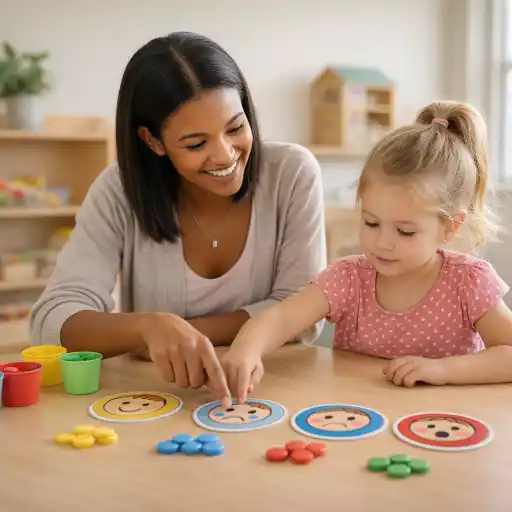
Set up a small space with the monster emotion sorting mat, a few illustrated situation cards, and a limited set of feeling choices. Start with three or four familiar emotions, such as happy, sad, mad, and scared; add words like frustrated, surprised, or worried as children become ready. Images can make the task accessible to children who are still building expressive language.
First, model one match aloud: “The monster’s tower fell down. It might feel frustrated. I notice its eyebrows are tight.” Then invite a child to choose a card and place it beside a possible feeling. A helpful sequence is:
- Look at the situation together and describe what happened without judgment.
- Offer a few feeling pictures and invite the child to point, name, gesture, or use a communication aid.
- Ask one gentle prompt: “What makes you think the monster feels that way?”
- Wonder about what might help next: “Could it ask for help or try again?”
Use short rounds of about three to seven minutes, and practice during calm moments as well as in follow-up conversations. An overview of emotion sorting activities for social-emotional learning offers additional ideas for simple, playful setups.
What questions help children connect feelings with events?
Questions work best when they are brief, open, and suited to the child’s current state. A child who is upset may need an adult’s calm presence before they can reflect. Once the child is settled, invite them to reconstruct the event in small steps: what happened, what they noticed in their body, what feeling might fit, and what they needed.
Try prompts such as:
- “What happened to the monster?”
- “What do you notice in its face or body?”
- “Which feeling could fit? Could more than one fit?”
- “Has something like that happened to you, or would you rather talk about the monster?”
- “What might help now?”
Give children time to answer. Accept a point, a gesture, a sound, a drawing, or a few words as meaningful participation. If a child’s choice differs from your guess, respond with curiosity: “Tell me about that choice.” The CECMHC ideas for teaching children about emotions include discussing story characters, acting out situations with puppets, and connecting feeling words to everyday experiences.
Children may also have mixed or uncertain feelings. You can say, “Maybe the monster feels sad because the game ended and excited to go outside.” This models flexible thinking without insisting that the child disclose a personal story. When a child does share, listen first and reflect the child’s words before offering solutions.
How can this activity build emotional vocabulary and problem-solving?
Matching a situation to an emotion gives children practice with more than a label: it links an event, a possible internal experience, and a next step. With repetition, children can begin to use simple sentence frames such as “I feel ___ when ___” or “I need help because ___.” These phrases offer alternatives when a child might otherwise communicate distress through grabbing, shouting, or withdrawing.
Keep the learning sequence concrete and supportive:
- Notice: Describe what happened: “The blocks toppled.”
- Name: Offer a possible feeling: “You might feel disappointed.”
- Connect: Invite the child to confirm, change, or add to the label.
- Choose: Identify one safe next step, such as asking for help, taking a breath, or trying again.
These steps align with guidance on talking with preschoolers about emotions, which recommends supporting children to label feelings, calm, communicate, and problem-solve. Remember, all feelings are acceptable; unsafe behavior still needs a clear, caring limit. “You can feel mad. I won’t let you hit. Let’s find a safe way to show me what happened.”
Notice small gains rather than expecting instant independence. A child pointing to “frustrated,” accepting your description, or asking for help is meaningful progress in #emotional understanding.
How can educators adapt the cards for different children?
Make the activity flexible enough for children with different language, sensory, cultural, and developmental needs. Some children may enjoy discussing a story card; others may prefer matching quietly, using a puppet, or watching before joining. Participation should never depend on speaking or sharing a personal experience.
- Offer two choices at first, then gradually introduce more feeling words.
- Pair pictures with spoken words, gestures, signs, home-language labels, or AAC supports.
- Use clear illustrations and varied images; avoid suggesting that one facial expression always proves a specific feeling.
- Let children sort cards by more than one possible emotion and explain different interpretations respectfully.
- Include familiar situations—waiting for a turn, losing a toy, joining play, or hearing a loud noise—without singling out a child’s private experience.
- Offer a quiet alternative for children who find group discussion or animated faces overwhelming.
Situation cards can also prompt a short puppet story or role-play. For example, a monster wants to join a game but feels shy. Children can choose a possible feeling card and rehearse asking, “Can I play?” Such practice makes the activity relevant to classroom relationships while protecting children from feeling put on the spot.
Keep the mat available as an invitation, not a behavior chart or a measure of a child’s emotional skill. For more classroom-ready ideas, see how emotion-sorting activities can support preschoolers. State requirements vary - check your state licensing agency.
How can staff avoid common pitfalls and keep practice supportive?
Emotion activities are most useful when they build connection instead of pressure. Avoid telling children that a feeling is wrong, insisting that each situation has only one correct answer, or asking for detailed explanations during peak distress. A monster card is a teaching tool, not a shortcut to diagnosing why a child behaved a certain way.
- Instead of correcting: “That’s not sad,” try “You chose sad. What did you notice?”
- Instead of demanding disclosure: “Tell us when this happened to you,” offer “You can talk about the monster, point, or pass.”
- Instead of overloading choices: Begin with a few emotions and add nuance gradually.
- Instead of teaching only after conflict: Practice during relaxed play, then gently revisit real events when the child is ready.
- Instead of rushing to fix: Acknowledge the feeling first, then offer one possible coping action.
Directors can help staff use consistent, respectful language by modeling a few shared prompts and discussing observations during team meetings. Record what the child did or communicated, what support was offered, and what seemed helpful—without labeling the child. If a child’s distress is persistent, intense, or affecting safety and participation, partner with the family and appropriate support professionals rather than relying on a sorting activity alone.
Small, repeated conversations matter. Every thoughtful match gives a child practice connecting experience with language, while a trusted adult communicates: “Your feelings make sense, and I’m here to help.”
Conclusion: How can emotion sorting help children explain what happened?
A monster mat and situation cards help preschoolers connect an everyday event with a possible feeling, giving them a practical first step toward explaining their experience. Begin with a few emotions, model the match, invite children to respond in the way that works for them, and stay curious when their interpretation differs from yours.
Most importantly, link recognition with relationship: listen, validate, and—when the child is ready—consider one helpful next step. Consistent, playful practice supports #feelings vocabulary, #communication, self-regulation, and empathy. The goal is not to make every child explain everything immediately; it is to help each child discover that feelings can be noticed, shared, and supported.
Additional ChildCareEd courses
- From Tantrums to Triumphs: Equipping Preschoolers with Self-Regulation Skills Buy Now $25.00 — explores engaging strategies for self-regulation in preschool.
- Self-Regulation & Change: Helping Children Cope Buy Now $16.00 — focuses on responsive care, routines, transitions, and coping support.
- CDA Subject Area 3 Buy Now $80.00 — offers 10 hours of learning on social-emotional development, self-regulation, and responsive practice.
- Lesson Planning for Preschoolers
- CDA Home Visitor Subject Area 3 Part 3 Birth to 5
- Open Heart, Open Art
- Birth to Five CDA Credential with Portfolio Review
- CDA Bridge Bundle: Family Child Care without Portfolio Review
- CDA Bridge Bundle: Infant/Toddler without Portfolio Review
- CDA Bridge Bundle: Preschool without Portfolio Review
- Brighter Futures: Social Emotional Development
- Staying Positive: Guidance for Preschoolers
- Every Moment Matters: Schedules and Transitions
- CDA Certification en Español: Recursos y Consejos para Educadores Bilingües
- Proporciones de Cuidado Infantil y Tamaños de Grupo por Edad en Maryland (Guía Rápida para Centros y Hogares)
- Cómo Celebrar el Día Nacional del Kindergarten
- Cómo Trabajar en el Cuidado Infantil en Carolina del Norte: Requisitos y Pasos
- How can we prepare preschoolers for kindergarten success?
- Celebrando la amistad en el cuidado infantil durante el Día de los Mejores Amigos
- Emotion Sorting Activities for Social-Emotional Learning
- How to Teach Feelings with an Emotion Sorting Activity
- Can we tame the ‘monsters’ of big emotions in young children?
- Can a Superhero Week Help Preschoolers Learn to Name and Manage Emotions?
- How can child care providers teach children to name and manage emotions?
- How can we build emotional vocabulary through books and play?
- Happy or Sad? Preschool Activities That Help Children Read Emotional Clues
- Can You Guess the Feeling? Emotion Games for Pre-K Kids
- What Are Simple Ways to Build Emotional Regulation in Preschoolers?
- How Can Child Care Providers Teach Feelings to Preschoolers Through Simple Activities?
- How Can Sorting Activities Strengthen Early Thinking Skills?
- How Can Child Care Providers Teach Emotional Regulation to Toddlers and Preschoolers?
- How Can Child Care Providers Help Children Repair a Conflict Beyond “Say Sorry”?
- How Can Emotion Sorting Help Preschoolers Explain What Happened?
