Big feelings are part of preschool—but children do not have to navigate them alone. By combining warm relationships, predictable routines, playful practice, and simple calming tools, providers can strengthen children’s emotional regulation while making the classroom safer and more connected; CDA Subject Area 3: Supporting Children’s Social and Emotional Development  Buy Now $80.00 offers 10 hours of focused professional learning to deepen these classroom practices. For an additional practical option, explore From Tantrums to Triumphs: Equipping Preschoolers with Self-Regulation Skills Buy Now $25.00, which addresses engaging activities, self-control, and challenging behavior.
Why does emotional regulation matter in preschool?
Emotional regulation is the developing ability to recognize feelings, manage physiological arousal, and choose actions that support safety and goals. Preschoolers may understand that they are angry or disappointed, yet still need substantial adult support to pause, communicate, and recover. The Administration for Children and Families describes co-regulation as the supportive process between caring adults and children that fosters self-regulation development.
This perspective changes how providers interpret behavior. A child who throws blocks may be communicating distress, fatigue, sensory overload, or a need for help—not demonstrating a fixed character flaw. Head Start emphasizes that relationships and caring environments provide the foundation for learning social-emotional skills, including regulating big emotions and solving problems.
Building regulation also supports participation. Children who can calm with assistance are more able to listen, persist, wait, repair peer interactions, and return to play. A systematic review of preschool interventions found particularly promising evidence for approaches involving mindfulness, mediated play, and physical activity, especially when implementation is consistent and includes meaningful cognitive or movement-based challenges.
How can warm relationships build a foundation for regulation?
Children borrow adult calm before they can reliably create it independently. Begin with responsive interactions: greet each child by name, notice interests, listen carefully, and respond without shame. A secure relationship does not eliminate limits; it makes limits easier for children to accept because the adult remains predictable and emotionally available.
Use a brief sequence such as Connect → Calm → Coach:
- Connect: move to the child’s level and say, "I’m here. You are safe."
- Calm: reduce language, soften your voice, and offer one familiar strategy.
- Coach: after the child is regulated, identify what happened and rehearse a next step.
Model your own regulation aloud: "The blocks fell. I feel frustrated, so I’m taking a slow breath and trying again." This demonstrates that #emotions are acceptable and that actions remain teachable. Validate the feeling while setting a clear boundary: "You are mad. I will not let you hit. You may stomp here or squeeze the ball."
Respect cultural and individual differences in emotional expression. Ask families which feeling words, comfort routines, and calming practices are familiar at home. Children may communicate through gestures, home-language words, pictures, or behavior; all are valuable information.
Which simple tools can children practice every day?
Choose two or three tools and practice them when children are calm. Repetition builds familiarity so the strategy is more available during stress. Keep instructions concrete and brief:
- 😮💨 Breathing: smell the flower and blow the candle, blow imaginary bubbles, or trace five fingers while breathing in and out.
- Movement: offer wall pushes, animal walks, stretching, carrying books, or pushing a light cart when appropriate and supervised.
- Hands-on calming: use Play-Doh, a soft squeeze item, fabric, or a sensory bottle selected for age and safety.
- Communication scripts: practice "Help, please," "My turn next," "Stop," and "I need space."
- Attention games: use Freeze Dance, Red Light/Green Light, and Simon Says to practice inhibition, waiting, and flexible attention.
Pair each tool with a visual cue. A child may point to a breathing card before they can explain what they need. CSEFEL provides emotion faces, feeling charts, scripted stories, the Turtle Technique, and problem-solving materials that can be adapted for classroom routines.
Offer choices rather than demanding immediate performance: "Do you want three breaths or the quiet chair?" Some children regulate through movement; others need reduced stimulation. Observe the child’s response and adjust rather than treating one strategy as universally effective.
How can routines and the environment prevent overwhelm?
Prevention is often more effective than correction. Consistent schedules, advance warnings, and visual reminders reduce the cognitive load associated with transitions. Head Start identifies predictable routines, clear expectations, and engaging environments as important supports for social-emotional development.
Consider these practical adjustments:
- Post a picture schedule at children’s eye level and refer to it before transitions.
- Use first–then language: "First cleanup, then outside."
- Give a two-minute warning and a final short countdown.
- Break multistep routines into pictures: coat, shoes, line, door.
- Provide a calm-down area with a small seat, feelings visuals, and two to four safe tools.
A calm-down area should be a supportive choice, never a punishment or isolation space. Teach its use during peaceful moments, model a brief visit, and keep an adult nearby. Limit materials to those that are developmentally appropriate, sanitary, and easy to supervise. State requirements vary - check your state licensing agency.
Directors can support consistency by including these routines in the program’s guidance plan. Staff should use shared language, agree on safety responses, and review whether the environment itself is contributing to repeated distress, particularly during noise, waiting, crowded areas, or unexpected changes.
How can play make regulation practice engaging?
Play gives children a safe rehearsal space for skills that are difficult in real conflicts. Make-believe play requires children to remember roles, follow shared rules, inhibit impulses, and adjust when peers introduce new ideas. NAEYC describes this agency-rich practice as an important bridge toward independent self-regulation.
Try short activities embedded across the day:
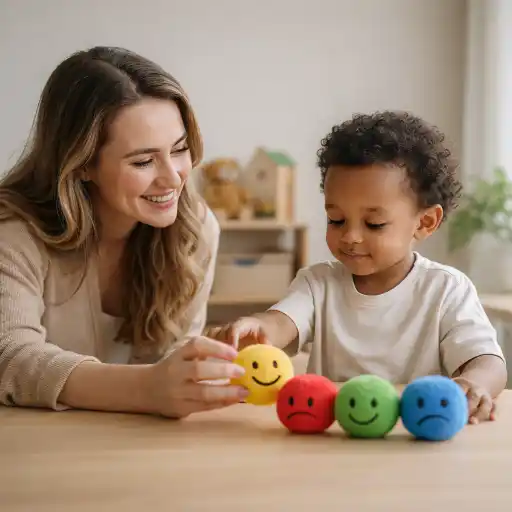
- Feelings check-in: invite children to point to a face, gesture, or color that represents their current state.
- Emotion charades: act out happy, worried, tired, frustrated, or calm and discuss observable clues without assuming one expression always has one meaning.
- Puppet problems: let a puppet lose a toy, wait for a turn, or make a mistake; ask children what the puppet might feel and what it could say.
- Story pauses: ask, "What happened? How might the character feel? What could help?"
- Emotion sorting: begin with two to four feeling cards and sort them into labeled baskets, then connect each feeling to a possible calming strategy.
Keep activities brief—often three to seven minutes—and praise attempts specifically: "You waited for the music to stop," or "You noticed your body was tense and chose a breath." Adapt participation for children who use augmentative communication, are learning English, have sensory differences, or prefer watching before joining. The goal is growing #selfregulation, not performing perfectly.
How should providers respond when a child is overwhelmed?
During a meltdown, the child’s capacity for reasoning and language is reduced. Prioritize safety and co-regulation over explanations. Move hazards, protect other children, and use a calm, low voice. Avoid lengthy questions, threats, public shaming, or demands for eye contact.
A practical response may look like this:
- Observe and identify the likely trigger without assuming intent.
- State the feeling and boundary: "You are frustrated. I won’t let you hit."
- Offer one safe alternative: "Stomp on the mat or squeeze the ball."
- Stay nearby and allow time; reduce unnecessary stimulation.
- After calm, briefly reflect: "The truck was unavailable. Next time, say, ‘Can I have a turn?’"
Document patterns rather than labels. Record the antecedent, observable behavior, duration, adult response, and what helped. The ABC framework—antecedent, behavior, consequence—can reveal whether a child is seeking communication, escape, sensory input, attention, or access to an activity. Use observations to redesign supports, not to blame the child.
Partner with families when behavior is frequent, intense, persistent, or unsafe. Seek guidance from your director, mental health consultant, early intervention provider, or other qualified specialists when consistent classroom supports do not produce improvement. Referral is an act of care, not failure.
Conclusion: What are the simplest next steps?
Simple ways to build emotional regulation in preschoolers include warm co-regulation, clear feeling language, predictable routines, playful practice, and a small menu of safe calming tools. The central goal is not to prevent children from feeling angry, sad, excited, or disappointed; it is to help them recognize those experiences, remain safe, communicate needs, and gradually choose effective responses.
- Teach two or three calming tools during calm moments.
- Use the same brief scripts across the teaching team.
- Offer visuals, choices, movement, and communication supports.
- Make the calm-down area voluntary, supervised, and nonpunitive.
- Track patterns and collaborate with families when concerns persist.
For continued professional learning, providers may also explore Brighter Futures: Social Emotional Development Buy Now $16.00, Social Foundations and Responsive Classrooms Buy Now $24.00, and Self-Regulation & Change: Helping Children Cope Buy Now $16.00. Small, steady practices help #preschoolers build confidence, connection, and lifelong coping skills.
- CDA Home Visitor Subject Area 3 Part 3 Birth to 5
- CDA Preschool Credential with Portfolio Review
- From Tantrums to Triumphs: Equipping Preschoolers with Self-Regulation Skills
- CDA Bridge Bundle: Preschool
- CDA Bridge Bundle: Family Child Care without Portfolio Review
- Art from the Heart for Preschoolers: Open Ended Art Projects that Build Self-Esteem
- CDA Bridge Bundle: Infant/Toddler without Portfolio Review
- CDA Bridge Bundle: Preschool without Portfolio Review
- Texas Director Credential
- ❄️ ¿Qué actividades al aire libre funcionan bien para los niños de Illinois en cada estación? 🌷🍂
- 👧 ¿Cómo iniciar y abrir una guardería en Texas? Lo que necesitas saber
- Apoyo en Español para Capacitaciones Grupales Presenciales y por Zoom en Cursos Selectos
- Regulaciones de Licenciamiento de Cuidado Infantil en California para Centros y Hogares de Cuidado Infantil Familiar
- Proporciones de Cuidado Infantil y Tamaños de Grupo por Edad en Maryland (Guía Rápida para Centros y Hogares)
- Ejemplos de Crianza Respetuosa vs. Crianza Permisiva
- Consejos de Supervisión Activa para Salones de Preescolar y el Juego al Aire Libre
- Celebrando la amistad en el cuidado infantil durante el Día de los Mejores Amigos
- How can child care providers teach children to name and manage emotions?
- Can Dance Support Young Children's Physical and Emotional Development?
- Why Are Coping Skills Important for Preschoolers?
- How Can Bingo Games Support Turn-Taking and Social Skills?
- What Are Simple Ways to Build Emotional Regulation in Preschoolers?
- How Can Child Care Providers Teach Feelings to Preschoolers Through Simple Activities?
- How Can Child Care Providers Teach Preschoolers to Manage Big Emotions?
- Why Do Preschoolers Fight Over Toys—and How Can Teachers Help?
- How Can Child Care Providers Help Children Develop Self-Control?
- What Should Be Included in a Preschool Calm-Down Area?
- How Can Child Care Providers Teach Emotional Regulation to Toddlers and Preschoolers?
- How Can a Feelings Chart Help Preschoolers Build Self-Regulation?
