Superhero themes give young children a playful and familiar way to practice bravery, kindness, problem-solving, and awareness of their inner feelings. When planned intentionally, a week of capes, helpers, and imaginative missions can become a meaningful tool for teaching emotional vocabulary, calming strategies, self-regulation, and skills for repairing peer relationships. This article offers child care providers and directors a practical, evidence-informed plan for creating a week-long social-emotional learning theme without sacrificing #play or established program #routines. Readers will find quick activity ideas, inclusive adaptations, safety checks, and family engagement strategies. Educators can strengthen this work through ChildCareEd’s self-paced online course Self-Regulation & Change: Helping Children Cope  Buy Now $16.00, which explores responsive care, predictable routines, prosocial behavior, and strategies that help children regulate emotions during challenging moments. For additional activity ideas, providers can use Superhero Activities for Preschoolers and the Emotions in Motion resource to connect imaginative play with emotional awareness, communication, and healthy coping skills.
Why does a theme about heroes teach real feelings and self-control?
Why it matters: children learn best when curriculum connects to their interests and bodies. A #superhero week scaffolds:
- Social-emotional vocabulary (name the feeling, identify bodily signs).
- Regulation practice (brief breathing, movement, and toolbox choices).
- Perspective-taking (rescuer/sidekick roles build empathy and turn-taking).
Research and field guides support these approaches: short, repeated practice builds emotional literacy (see Why Emotional Literacy Is the New Literacy) and dramatized roles strengthen social skills (see ChildCareEd dramatic play resources). Practical takeaways:
- 🦸♀️ Use characters to externalize feelings ("Hero Sam feels stormy inside—what helps?").
- 🛡️ Pair body-awareness prompts with movement so #preschoolers learn cues for calm—see Teaching Kids to Become Emotional Heroes through Body Awareness.
- 💬 Keep language specific: "I feel angry," not "bad." Naming narrows the problem and invites strategy. For a concise, research-informed explanation of why labeling emotions supports emotional literacy and resilience, see The Superpower of Emotions: Why Naming Feelings Matters in Child Care.
What classroom activities teach emotion recognition, labeling, and regulation?
Use small, repeatable centers, so children practice skills across contexts. Below are five focused station ideas, each tied to a learning target and quick setup notes. State requirements vary - check your state licensing agency.
For additional structured games, crafts, and scripts that explicitly scaffold preschoolers' recognition and expression of feelings, see Exploring Emotions: Fun and Educational Preschool Activities.
- 🎭 Dramatic Play Rescue Station — target: empathy & role language.
- Props: capes, clipboards, stuffed animals, mission board.
- Prompt: "How does the rescued friend feel? What could a helper say?"
- Link: see Superhero Examples for Kids.
- 🏃♂️ Hero Training Obstacle — target: body awareness & self-control.
- Stations: crawl tunnel, balance line, jump-to-target, calm landing.
- Coach a breathing cue at each station—"3 slow breaths before you jump."
- See gross-motor options at Superhero Activities for Preschoolers.
- 🎨 Mask-Making & Feelings Craft — target: emotion vocabulary & fine motor.
- Invite children to create masks for different feelings and role-play scenes.
- Use simple templates and give two craft levels for varying abilities.
- 🧠 Emotion Sorting Lab — target: labeling & problem-solving.
- Tools: face cards, bins labeled with feeling words, calm tools.
- Activity: draw a scenario card and sort which feeling the hero might have; then choose a calming tool—see Emotion Sorting for Kids.
- 📚 Story & Reflection Corner — target: perspective taking & language.
- Read a hero story; pause to ask, "How did the character feel? What helped?"
- Use real-photo emotion cards to expand recognition across faces (CSEFEL suggestions: CECMHC ideas).
Rotation timing: 12–20 minutes per station for preschoolers. Keep directions short, model once, and let choice drive engagement.
How do I adapt superhero SEL activities for different ages and needs?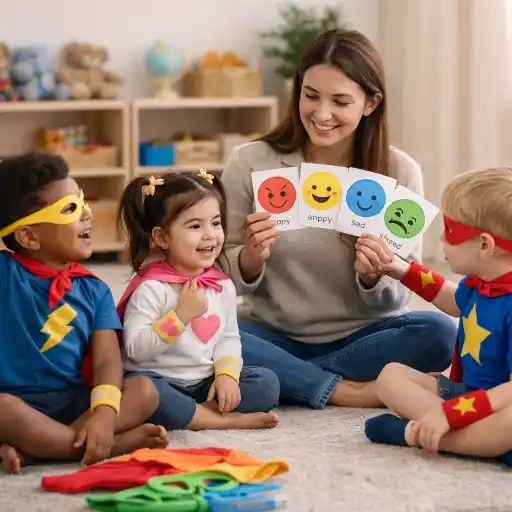
Adaptation is essential for inclusion. Use these 1–5 steps to scaffold across developmental and sensory needs:
For practical guidance on applying CDA-aligned strategies to plan and document differentiated instruction that meets each child's developmental level, see Using the CDA Credential to Provide Differentiated Instruction for All Levels of Development.
- 🧩 Selectable roles: planner, medic, cape-keeper, reporter—so children who prefer calmer roles still lead.
- 🔊 Visual supports: picture schedules, feeling charts, and social scripts (see CSEFEL scripted stories at CSEFEL).
- ♿ Sensory adaptations: soft masks, weighted lap blankets, quiet craft options, and a low-stimulation calm corner for breaks. Model and practice the calm space before use so it’s not punitive—see sensory and body-awareness strategies at Somatic Superpowers.
- 🧾 Differentiated tasks: offer two difficulty levels for each activity (e.g., toss at close vs. far target; trace vs. cut the mask).
- 🤝 Peer buddies & staff launch: a brief adult-led launch reduces conflict and models consent language ("May I help? May I touch your cape?").
For children with ongoing self-regulation needs, consider a curriculum like Zones of Regulation as a follow-up to the themed week.
How do I keep superhero play safe, licensing-friendly, and connected to families?
Safety, documentation, and family communication are critical. Follow these steps:
- 👀 Supervision & environment:
- Position staff so active areas are visible; clear landing zones and useone-stopp signal for movement games.
- Set clear physical rules (no jumping from furniture) and model safe alternatives (foam mats, soft landings).
- 🩺 Training & first aid:
- Ensure staff hold pediatric First Aid & CPR and that staff ratios meet licensing. requirements ChildCareEdd offers relevantraining foror many providers: see Superheroes & First Aid.
- 📋 Licensing and documentation:
- State requirements vary - check your state licensing agency.
- Keep incident logs, consent notes for photos, and notes about adaptations used.
- 📣 Family engagement:
- Share 1-page tip sheets: home breathing game, a short story prompt, and a photo of a child’s superhero mission report. Encourage families to practice simple acts of kindness and gratitude at home to extend empathy and emotional literacy; see Gift of Gratitude: Fostering Emotional Intelligence in Children through Acts of Kindness.
- Invite families to a Superhero Family Literacy Night to reinforce skills (see family literacy ideas at Superhero Examples for Kids).
Summary: How will I know this worked, nd what common pitfalls should I avoid?
Measure success through simple, routine checks and avoid these common mistakes.
- Signs of progress (collect weekly):
- ✅ Children label feelings more often during transitions.
- ✅ Increased use of calm tools (bottle, breathing, corner) instead of adult rescue.
- ✅ More peer-initiated repairs after conflicts ("Are you okay?").
- Common mistakes & fixes:
- 🚫 Mistake: Teaching skills only during meltdowns. ✅ Fix: Practice short tools daily while calm.
- 🚫 Mistake: Overcomplex crafts or crowded centers. ✅ Fix: Rotate props and keep one adult launch per station.
- 🚫 Mistake: Using calm corners as punishment. ✅ Fix: Model and normalize choice-making for breaks.
FAQ — quick answers for busy providers
- Q: How long should Superhero Week last? A: 3–5 days work well to repeat favorites across weeks.
- Q: Is dramatic "fighting" appropriate? A: Only under strict rules and adult coaching—use props and scripts; see play guidance at Superhero Activities for Preschoolers.
- Q: What if a child copies a risky stunt at home? A: Share safer alternatives with families and demonstrate alternative moves in class.
- Q: Where to go for more training? A: ChildCareEd courses on SEL and emotional development are practical next steps: Brighter Futures: Social Emotional Development Buy Now $16.00.
Running a #superhero theme with purpose turns make-believe into measurable SEL learning. Start small—pick one center, one calm tool, and one family handout—and watch how practice plus play builds emotional vocabulary and calm choices for your #preschoolers. To deepen practice, use printable emotion-sorting tools and scripted stories from CSEFEL and ChildCareEd resources like Emotion Sorting for Kids and CECMHC emotion ideas. You’re giving children lifelong #SEL strengths and safer play—hero work, indeed.
- CDA Home Visitor Subject Area 3 Part 3 Birth to 5
- 45 Hour Preschool Methods and Materials
- From Tantrums to Triumphs: Equipping Preschoolers with Self-Regulation Skills
- 45 Hour School Age Methods and Materials
- CDA Bridge Bundle: Family Child Care without Portfolio Review
- CDA Bridge Bundle: Infant/Toddler without Portfolio Review
- CDA Bridge Bundle: Preschool without Portfolio Review
- 45-Hour Preschool Curriculum
- Brighter Futures: Social Emotional Development
- Fun, superhero-themed lessons to teach kids about body awareness & safety
- Party Hats and Emotional Regulation: Helping Little Ones Navigate Big New Year Feelings
- CDA Certification en Español: Recursos y Consejos para Educadores Bilingües
- Proporciones de Cuidado Infantil y Tamaños de Grupo por Edad en Nueva Jersey (Guía Rápida para Centros y Hogares)
- How can positive guidance help manage big feelings during indoor play in Oklahoma classrooms?
- Celebrando la amistad en el cuidado infantil durante el Día de los Mejores Amigos
- Canciones, juegos y preguntas de círculo para niños
- Superhero Activities for Preschoolers: Play, Create, and Learn
- Superhero Examples for Kids: Learning About Helpers, Safety, and Kindness
- Cómo simplificar la capacitación para sus empleados de daycare
- How can superhero-themed play help build confidence in young children?
- What Do Superheroes Teach Kids About Kindness and Courage?
- Can we tame the ‘monsters’ of big emotions in young children?
- Can Superhero Day Capes and Pretend Play Teach Children to Help Others?
- Can a Superhero Week Help Preschoolers Learn to Name and Manage Emotions?
- How can child care providers teach children to name and manage emotions?
- How Can You Turn a Superhero Theme Into a Full Week of Preschool Learning Centers?
- Why Are Coping Skills Important for Preschoolers?
- How Can Child Care Providers Teach Preschoolers to Manage Big Emotions?
- How Can Child Care Providers Teach Emotional Regulation to Toddlers and Preschoolers?
