A child may know a feeling before having the words to explain it; a playful face-making activity can offer a welcoming place to begin. Explore ChildCareEd’s Open Heart, Open Art  Buy Now $16.00 for practical ideas about using open-ended art to support social-emotional development, and consider Brighter Futures: Social Emotional Development Buy Now $16.00 to deepen your understanding of children’s emotional growth and responsive interactions. These courses can help you turn a simple monster-face invitation into intentional classroom practice while you continue reading for steps you can try with children.
Why can playful art make feelings easier to discuss?
Talking directly about a child’s own feelings can feel demanding, especially when the child is upset, shy, or still building language. A made-up character creates gentle distance: instead of needing to say, “I feel worried,” a child can first say, “My monster looks worried.” That small shift can open a conversation without requiring personal disclosure.
Face-making also turns an abstract idea into something children can see, touch, change, and describe. When children choose eyes, eyebrows, and a mouth, they observe how features contribute to an expression. Educators can invite them to compare their choices and share what the character might be feeling. Emotional vocabulary develops through these repeated, warm exchanges—not through a single craft or a demand for a “correct” answer. Head Start’s guidance on fostering emotional literacy emphasizes that adults can build feeling words through pictures, games, stories, and everyday interaction.
The activity has value beyond naming faces. A child who begins to connect an expression with a feeling may also begin to explain what could have happened, ask for help, or imagine a kind response. Keep the goal supportive: art is a way to invite communication, not a test of how well a child can identify emotions.
How can teachers prepare a welcoming monster-face activity?
Keep the setup simple and flexible. The ChildCareEd Monster Faces and Feelings Guide Buy Now $1.50 offers a playful starting point for exploring facial features and simple emotions such as happy and surprised. Pair a resource like this with open-ended materials so children can make choices rather than copy a single adult-made example.
- Offer paper or pre-cut face shapes, crayons or washable markers, glue sticks, and reusable facial-feature pieces such as paper, felt, or foam shapes.
- Include child-safe mirrors and a few picture cards to support noticing and imitation.
- Start with two or three familiar feeling words—such as happy, sad, and surprised—then add others as children are ready.
- Provide visual choices, larger pieces, adaptive tools, or a quieter work spot when these make participation more accessible.
- Let children watch, point, gesture, use a home-language word, or make a face without explaining it aloud.
Introduce the activity with a brief invitation: “Our monsters can have all kinds of faces. What might this one be feeling?” Make clear that there is no one perfect monster and no requirement to share a personal story. Children may choose silly, mixed, or imaginative expressions. Respecting that freedom supports #creativity and helps the art space feel safe rather than evaluative.
How can the activity connect facial features with emotion words?
Begin by noticing before naming. Invite children to look closely at the monster’s eyes, eyebrows, and mouth: “What do you see?” or “What changed when you turned the mouth upside down?” Children can try expressions in a mirror, then select or draw features to show what their monster might be feeling. This observation-first approach helps children explain their thinking instead of guessing what the adult wants to hear.
Use open, nonjudgmental prompts and allow more than one interpretation. A wide-open mouth might suggest surprise, excitement, or something else to a child. A frown does not always prove that someone is sad. The ChildCareEd discussion of reading emotional clues encourages educators to consider multiple signals and context rather than treating facial expressions as fixed rules.
- “I notice the eyebrows are raised. What might that tell us?”
- “The mouth is turned down. What are some feelings this monster could have?”
- “What could help us understand the feeling—its face, body, voice, or what happened?”
- “Would you like to point to a feeling card, tell me, or show me another way?”
When a child offers a label, reflect it without overcorrecting: “You think your monster is surprised because its eyes are wide.” You can add a word naturally—“Some people might also call that amazed”—without replacing the child’s idea. The purpose is to build #vocabulary and curiosity, while recognizing that people express feelings differently.
How can teachers invite children to communicate through their artwork?
After children assemble a face, give them time to decide whether and how they want to talk. Some will narrate a detailed monster story; others may say one word, point, or simply continue creating. All of these can be meaningful forms of participation. Try asking about the artwork rather than pressing children to explain their private experiences: “What is your monster’s name?” “What might it need?” or “What could a friend do to help?”
Link the character’s feeling to a possible situation only as an invitation. For example, “Maybe the monster feels disappointed because its tower fell. What could it try next?” Children may invent their own story, choose a different feeling, or decline to answer. The activity can then extend into drawing a setting, adding a speech bubble, or dictating a short caption for the educator to write down.
To keep the conversation supportive:
- Accept a child’s interpretation and avoid telling them what their artwork “really means.”
- Validate feelings without approving unsafe actions: “It’s okay to feel mad; we keep hands safe.”
- Offer response options—speaking, pointing, drawing, acting, or using a communication support.
- Share children’s own words in captions or documentation, with appropriate privacy and family practices.
Art can provide an additional communication route, but it is not a diagnostic tool or a substitute for clinical art therapy. If you have ongoing concerns about a child’s distress or communication, follow your program’s procedures and collaborate with the family and appropriate professionals.
How can educators make the activity inclusive and developmentally appropriate?
Children differ in language, sensory preferences, motor skills, cultural experiences, and comfort with group participation. An inclusive face-making activity offers multiple ways to engage without treating one expression or response as universal. Use varied images and materials, and avoid suggesting that all people from a particular group show feelings in the same way. Facial expressions can provide clues, but context and individual communication styles matter too.
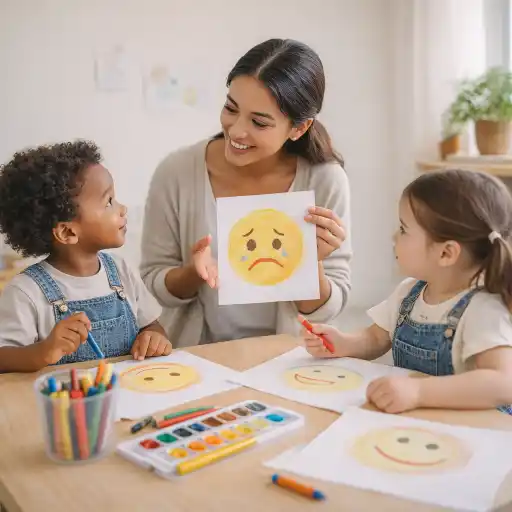
Adjust the materials and expectations to the children in your group. Some may benefit from large, pre-cut features and a small set of choices; others may enjoy designing a face from scratch or comparing two expressions. Children who use augmentative communication, signs, gestures, or a home language can participate through those modes. Offer a no-glue or low-texture option if certain materials feel uncomfortable.
- Model one face at a time, then let children choose whether to copy, change, or invent an expression.
- Use supportive language: “You can show me with a picture, a gesture, or words.”
- Include breaks and observation as valid ways to participate.
- Invite families to share familiar feeling words or communication strategies, without asking any child to represent a whole culture.
Remember that a group craft is not the right moment to require children to reveal personal feelings. A child can explore a fictional monster while keeping their own experience private. State requirements vary - check your state licensing agency when program policies or documentation practices are involved.
How can teachers build a repeatable routine and learn from it?
A short routine used more than once is often more useful than a long, one-time lesson. Try a simple sequence: notice an expression, create or change a monster face, name a possible feeling, and consider one supportive response. Keep the activity brief enough to fit your group’s attention and allow children to return to it during choice time.
For instance, during a small group, show a few eyes and mouths and ask children what they notice. Invite each child to build a monster, then offer a choice: “Would you like to tell us about it, point to a feeling card, or keep creating?” Close by naming a coping or connection idea if it fits the child’s story—taking a breath, asking a teacher for help, or inviting a friend to play. Practice these ideas during calm moments, not only when a child is distressed.
Observe learning without grading the artwork. Note whether a child notices a facial feature, uses or points to an emotion word, offers an interpretation, or communicates a preference. A short record might say, “Sam chose raised eyebrows and said the monster was surprised.” These observations can guide future materials and conversations, not label a child’s abilities from one activity.
As a common pitfall, avoid emphasizing the “right” face for each emotion, rushing children to explain, or turning a calming area into a consequence. Instead, stay curious, validate attempts, and keep the character’s feelings separate from judgments about a child.
Conclusion: How can art help preschoolers talk about feelings?
Playful monster-face art gives children a concrete, low-pressure way to notice facial features, try emotion words, and share ideas through speech, gesture, or creation. The central teaching move is to connect observation with respectful conversation: “What do you notice? What might the monster feel? What could help?” Then let children’s interpretations—and their choice to speak or not—guide the exchange.
Start with a few reusable features, mirrors, and familiar feeling words. Model curiosity rather than certainty, offer inclusive ways to participate, and revisit the activity in calm moments. With repeated, responsive practice, face-making can become one useful part of a classroom culture where children’s feelings are welcomed and communication is supported. For broader professional learning, explore ChildCareEd’s From Tantrums to Triumphs: Equipping Preschoolers with Self-Regulation Skills, which focuses on strategies for helping preschoolers manage emotions and navigate challenges.
- 45 Hour Child Growth and Development
- What Makes Me Special: An Overview of Autism and ADHD
- Birth to Five CDA Credential with Portfolio Review
- CDA Bridge Bundle: Family Child Care without Portfolio Review
- Art from the Heart for Preschoolers: Open Ended Art Projects that Build Self-Esteem
- CDA Bridge Bundle: Infant/Toddler without Portfolio Review
- CDA Bridge Bundle: Preschool without Portfolio Review
- Open Heart, Open Art
- Texas Director Credential
- Tiny Hands, Big Dreams: Fostering Creativity in Preschoolers
- National Grouch Day: Turning Grouches into Giggles, Teaching Kids about Handling Negative Emotions
- CDA Certification en Español: Recursos y Consejos para Educadores Bilingües
- Retraso del Habla en la Guardería: Cómo Pueden Ayudar los Proveedores
- Mother’s Day Classroom Ideas Families Will Love
- How Do Art Activities Support Cognitive Growth in North Dakota Preschoolers?
- Crayon Colors and What They Mean in Children’s Art
- Celebrando la amistad en el cuidado infantil durante el Día de los Mejores Amigos
- Why Do the Best Kids' Movies Work for Grown-Ups Too?
- What Are Age-Appropriate Ways to Teach Gratitude Before Thanksgiving?
- What Is Co-Regulation and How Can Child Care Teachers Use It?
- How Can Child Care Providers Teach Preschoolers to Manage Big Emotions?
- How Can Teachers Help Preschoolers Recognize When They Need a Break?
- How Can Teachers Support Children’s Emotional Development During Halloween?
- How Can Preschool Teachers Help Children Understand the Difference Between Wants and Needs?
- What Should Teachers Do When Children Constantly Compare Their Work to Others?
- How Can Teachers Help Preschoolers Talk About Their Feelings Through Art?
- How Can a November Letter H Invitation Help Preschoolers Learn, Create, and Help?
