A child’s story does not always arrive in words: a repeated hum, an offered object, or a whole-body dance may reveal curiosity, connection, and emerging ideas. The Observing & Assessing in Child Care  Buy Now $16.00 course helps providers strengthen observation and documentation skills so they can turn these moments into responsive planning and meaningful family conversations. Read on for practical ways to capture the story while honoring each child’s distinctive voice.
Why should educators document communication beyond spoken words?
Young children communicate through many channels. An infant’s repeated squeal, a toddler’s point toward a window, or a preschooler’s dramatic leap may carry meaning even when spoken language is still developing. Treating only spoken words as “voice” can leave important evidence of children’s thinking, interests, relationships, and agency unrecorded.
Multimodal documentation—notes that attend to sound, gesture, facial expression, posture, movement, and, when appropriate, images or audio—helps educators notice how children participate in real contexts. NAEYC’s guidance on observing, documenting, and assessing development emphasizes methods responsive to children’s developmental accomplishments, languages, and experiences. A child should have varied ways to demonstrate what they know.
This practice matters for families, too. A concrete account such as “Nia tapped the drum twice, paused, watched Leo, then repeated the pattern when he tapped back” offers a vivid, respectful starting point for conversation. It communicates that the educator is paying attention to the child’s strengths—not waiting for a polished sentence before recognizing learning.
- Notice a wider range of communication and learning evidence.
- Plan from children’s interests and strategies, rather than assumptions.
- Share specific, strengths-based moments with families and colleagues.
What should a multimodal story record?
A useful story preserves what happened and the context that helps someone else understand the moment. Start with a brief, factual sequence: where the child was, what materials or people were involved, what the child did or vocalized, and what happened next. Include exact words when available, but do not translate a sound or gesture into a definite intention unless the child or family has helped clarify its meaning.
For example, rather than writing “Milo wanted the song again,” record: “When the music stopped, Milo rocked side to side, vocalized ‘ah-ah,’ and raised both hands. The educator restarted the song; Milo smiled and swayed.” That account keeps observable details separate from interpretation. Head Start’s guidance on objective observation notes recommends recording what educators see and hear before drawing conclusions.
Use a simple template with fields such as:
- Context: date, time, setting, activity, materials, and participants.
- Child’s communication: sounds, gestures, gaze, facial expression, movement, words, or creations.
- Sequence: what came before, the child’s action, and what followed.
- Reflection: possible meanings or learning, clearly labeled as interpretation.
- Next step: an idea to revisit, extend, or explore with the family.
Keep the record concise enough to be practical, but detailed enough that another educator can picture the event.
How can providers capture sounds, gestures, and movement accurately?
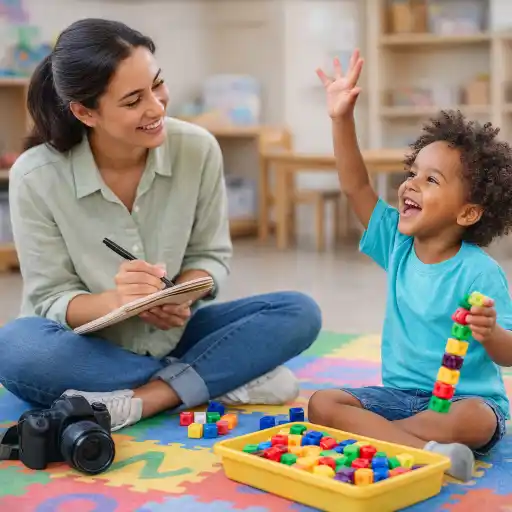
Choose a focus before observing: perhaps how a child initiates a turn, communicates during music, or uses movement in pretend play. Trying to document every signal at once can distract from children and make the notes hard to interpret. Write a short sequence using descriptive verbs—clapped, leaned, pointed, hummed, turned, paused—and quote vocalizations or spoken language as accurately as possible.
When feasible, jot keywords promptly and expand them later while details are fresh. Photos, audio, or brief video can help preserve subtle details, but use them only under program policy and with required permissions. Recording technology is optional; careful, contemporaneous notes are often sufficient. The aim is to stay present with children, not to collect footage.
- Describe visible or audible evidence: “raised one arm,” not “asked for help.”
- Note the sequence and response: what the child did and how peers or adults responded.
- Record the setting and materials, since context shapes how communication appears.
- When uncertain, preserve the signal without assigning a fixed meaning; observe again and ask the family.
🌟 Try a “sound-and-movement minute”: during a familiar play episode, note three audible or physical actions and what happened around each one. This focused exercise can help a team sharpen its descriptions without turning observation into a lengthy task.
How can educators interpret the story without imposing assumptions?
Documentation becomes useful when educators reflect on it, but interpretation should remain a thoughtful hypothesis rather than a verdict. Ask what the child may be exploring, what the sequence suggests, and what additional evidence would help. A repeated bounce might be rhythmic experimentation, sensory exploration, anticipation, or simply a movement the child enjoys. One observation cannot settle the question.
Consider the child’s context: familiar and unfamiliar adults, home languages, cultural communication practices, sensory preferences, mobility, and the activity itself. Children may show understanding by watching, moving, signing, pointing, vocalizing, or using assistive communication. NAEYC’s developmentally appropriate practice guidance calls for culturally and linguistically responsive assessment and attention to possible bias.
To strengthen interpretation, compare observations over time, invite a colleague’s perspective, and ask families what they recognize from home. A learning-story approach can connect observation, reflection, possible next steps, and family perspective; see NAEYC’s article on Learning Stories for a narrative example.
- Separate “what I observed” from “what I think it may mean.”
- Look for patterns across routines, people, and days before making a claim.
- Center the child’s strengths, initiative, and communication choices.
How can documentation support learning and family partnership?
Turn a documented moment into a small, responsive next step. If a child experiments with vocal rhythms, offer simple instruments or invite children to echo and vary a pattern. If gestures and movement carry a pretend story, provide props, pictures, or space to revisit it. Observe again to see whether the invitation deepens engagement or leads somewhere unexpected. Assessment is a cycle of noticing, reflecting, planning, and noticing again—not a conclusion drawn from one snapshot.
Share a short, specific story with the family and invite their knowledge: “During outdoor play, Ana crouched, made a soft ‘whoosh’ sound, and swept her hands across the leaves. What kinds of movement or sounds does she explore at home?” Family insight may reveal familiar songs, meaningful gestures, or home-language words that enrich the classroom’s understanding.
Programs may use Multimodal Story Documentation Sheets as a practical prompt for recording context, communication modes, reflection, and next steps. Adapt any sheet to your program’s procedures, protect children’s records, and follow consent requirements for photos or recordings. Documentation should support learning and relationships—not become a performance display or a substitute for direct interaction. State requirements vary - check your state licensing agency.
Conclusion: How can we honor a child’s story in every mode?
To document a child’s story through sounds, gestures, and movement, watch closely, describe what is observable, preserve the context, and keep interpretation open to revision. Include the child’s many forms of communication, reflect on strengths and possible learning, and invite families and colleagues to add perspective.
Small, accurate records can make quiet or nonverbal moments visible and help educators plan experiences that follow children’s interests. Most of all, remember that the purpose is not to capture every movement; it is to listen respectfully, respond thoughtfully, and ensure every child’s way of communicating has a place in the shared story.
Further professional learning
- CDA Certification en Español: Recursos y Consejos para Educadores Bilingües
- How Should Lesson Plans for Infants 0–12 Months Change by Age?
- National Massachusetts Day for Kids: Explore the Bay State Through Play
- Is This Development Typical? When Child Care Providers Should Watch, Document, or Refer
- How Can Child Care Providers Plan Infant Activities Around Developmental Milestones?
- Why Do Predictable Books Help Preschoolers Feel Like Readers?
- How Can Emergent Readers Make Story Time More Interactive?
- How Can Teachers Recognize Developmental Red Flags Early?
- How Can Puppets Support Communication and Literacy in Early Childhood?
- How Can You Manage Large-Group Time When Young Children Have Short Attention Spans?
- How Can Sensory Bin Ideas Promote Early Language Skills?
- How Can Simple Music and Movement Activities Build Early Literacy Skills?
- How Can Teachers Build Early Literacy Without Screens or Worksheets?
- How Can Child Care Providers Strengthen Young Children’s Listening Skills?
- When Should a Child Care Provider Be Concerned About Development?
- How Can a Five-Minute Classroom Reset Routine Create Safer, Calmer Transitions?
- How Can Writing and Art Activities Help Children Name What They Appreciate?
- How Can Predictable Ocean-Themed Text Build Reading Confidence?
- How Can Educators Document a Child’s Story Through Sounds, Gestures, and Movement?
