When children hesitate to speak, struggle to sustain attention, or need a playful way to organize ideas, a puppet can become a trusted communication partner. Explore practical ways to build language-rich experiences, and consider Reading Aloud and Storytelling  Buy Now $16.00 to strengthen interactive storytelling, vocabulary, and comprehension while earning relevant professional development hours. For a broader foundation, Language Development in Early Childhood Buy Now $16.00 offers strategies for supporting verbal and nonverbal communication throughout the day.
Why are puppets powerful tools for communication and literacy?
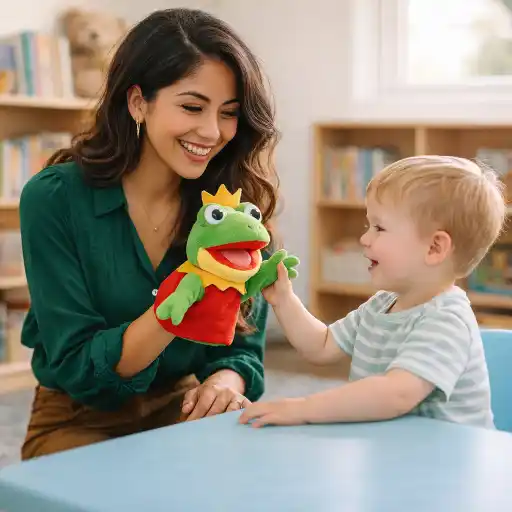
Puppets do more than attract attention. They create a relational space in which children can experiment with language, movement, emotion, and meaning without feeling that every response is being evaluated by an adult. Research on preschool puppetry describes a three-way relationship among educator, child, and puppet that can make interactions more playful and less threatening. Children may share interests, questions, and ideas through the puppet that they would not yet express directly.
This approach reflects an expansive understanding of literacy. Literacy includes listening, speaking, gesture, dramatic play, music, movement, drawing, storytelling, and print—not only reading books. Puppets help children move among these forms. A child may first communicate through a puppet’s movement, then add a sound, a word, a sentence, and eventually a complete story.
Intentional puppet use can support:
- Vocabulary, sentence structure, and conversational turn-taking.
- Active listening, prediction, recall, and comprehension.
- Narrative sequencing through beginning, problem, attempts, and resolution.
- Emotional vocabulary, perspective-taking, and conflict resolution.
- Participation by children who are shy, multilingual, disabled, or developing speech.
As emphasized in language and literacy development guidance, everyday conversations, songs, stories, and play are powerful contexts for learning. Puppets connect all of these experiences in one accessible medium.
How can educators introduce puppets without turning play into a performance?
Begin with relationship rather than a lesson objective. Introduce one puppet with a consistent name, voice, personality, and place in the classroom. Invite children to help choose its name, favorite activities, family connections, or cultural background. This shared authorship helps children experience the puppet as a group member rather than as a teacher-controlled prop.
At first, allow children to explore materials freely. Some children may examine the puppet silently; others may use it for physical or humorous play. These responses are meaningful observations, not failures. Educators can gradually model expanded possibilities by having the puppet greet children, ask a simple question, or need help solving a small problem.
Helpful introductory prompts include:
- “What do you notice about our new friend?”
- “What should we call the puppet?”
- “What might the puppet like to do?”
- “The puppet wants to join the play. How can we help?”
- “What could the puppet say next?”
Keep the educator’s role visible but secondary. The puppet should not dominate every interaction or become a reward for compliance. Instead, use it as a bridge that invites children into shared thinking. Short, repeated encounters are often more effective than elaborate shows because children need time to develop ownership, confidence, and a personal relationship with the character.
How do puppets strengthen listening, speaking, and vocabulary?
Puppets make listening purposeful. A puppet can whisper a message, misunderstand a direction, or ask children to remember details from a story. Because children often perceive the puppet as a social partner, they may attend closely to its voice, gestures, and facial orientation. Educators can build on this engagement with predictable routines.
During a puppet story, use three talk moments:
- Before: Show the puppet and an object related to the story. Invite predictions and introduce one or two important words.
- During: Pause for children to repeat a phrase, identify an emotion, answer a question, or imitate a sound.
- After: Ask children to retell events, sequence picture cards, act out a scene, or create a different ending.
Use the puppet to model conversational skills: greeting, waiting, responding, repairing a misunderstanding, and asking for clarification. A puppet can say, “I heard you say ‘truck.’ Did you mean the red truck or the blue truck?” This models expansion without correcting a child harshly.
For vocabulary, select words that children can see, feel, or act out. If the puppet is preparing a picnic, introduce words such as spread, container, carefully, share, and enormous. Repeat them across routines and play. The research summarized in Boosting Language Through Play supports using prompts that invite explanation, prediction, and sequencing. Puppets make those prompts feel like authentic conversation.
How can puppets make storytelling and emergent literacy more interactive?
Puppets help children enter stories physically and imaginatively. They can represent characters, narrate events, hold a book, or become listeners while children tell the story. This flexibility supports emergent literacy because children practice meaning-making before conventional reading and writing are mastered.
Try these classroom applications:
- 📚 Puppet read-aloud: Let the puppet “read” a familiar book while children help turn pages, notice pictures, and answer questions.
- Story retelling: Provide two or three puppets and ask children to reconstruct the main events.
- Story extension: Invite children to add a new setting, character, problem, or ending.
- Print connection: Create a sign, menu, letter, or simple message for the puppet’s story.
- Sound play: Use a puppet to explore rhyme, alliteration, syllables, or oral blending in playful contexts.
A puppet who makes a purposeful mistake can encourage children to become knowledgeable helpers. For example, the puppet may confuse two story events or misread a familiar word. The educator should use this strategy sparingly and respectfully; the goal is to invite reasoning, not to make children feel responsible for adult errors.
How can puppets support inclusion, multilingual learners, and children with communication differences?
Inclusive puppet practice begins with the assumption that every child is competent and communicates in multiple ways. A puppet should never be used to pressure a child to speak. Instead, it can offer additional entry points: pointing, eye gaze, gestures, signs, movement, sounds, home-language words, drawing, or selecting between choices.
Children learning English may first rehearse a phrase through a puppet before saying it independently. Educators can pair speech with gestures, objects, photographs, and repeated sentence frames such as “I see ___,” “The puppet feels ___,” or “We can ___.” Invite families to contribute words, songs, or stories in the child’s home language. A culturally responsive puppet experience treats multilingualism as an asset rather than a problem to overcome.
Children with disabilities may benefit from adapted puppets that are lightweight, tactile, visually clear, or easy to operate. Offer alternatives to a traditional stage, including table-top storytelling, partner puppets, felt characters, or digital photographs of puppet scenes.
Watch for barriers in the environment. Is participation dependent on spoken language? Is the stage too crowded? Are materials difficult to grasp? Can children observe from a comfortable distance? The social model of disability reminds educators to modify environments and expectations rather than locating the problem solely within the child.
How can directors and providers plan, observe, and improve puppet experiences?
Effective puppet work does not require professional theater skills. It requires intentional planning, responsive observation, and a willingness to play. Directors can support staff by providing a small collection of durable puppets, books, open-ended props, and simple documentation tools. Establish shared expectations for supervision, hygiene, turn-taking, and safe use of small parts.
Plan one communication or literacy goal at a time. For example:
- “Children will use at least two words to describe the puppet’s actions.”
- “Children will sequence three events from a familiar story.”
- “Children will practice taking two conversational turns.”
- “Children will identify and express one feeling through words, gesture, or movement.”
Document what children actually do, not only what adults intended. Note who initiates interaction, which communication modes are used, whether children sustain a storyline, and how peers respond. Use observations to adjust the experience: reduce group size, add visual choices, repeat a predictable phrase, or offer a quieter participation role.
Common pitfalls include using the puppet only for behavior control, talking for children too quickly, choosing characters that do not reflect the group, and expecting every child to perform publicly. Avoid these problems by protecting child agency, rotating leadership, offering opt-in roles, and connecting puppet play to children’s interests.
Professional learning can help teams move from occasional entertainment to purposeful pedagogy. Classroom Tools for Emergent Literacy Buy Now $25.00 focuses on practical materials and interactive strategies, while Language and Literacy Foundations in Pre-K Buy Now $16.00 supports more intentional planning for listening, speaking, vocabulary, and communication.
Conclusion: What is the central role of puppets in early literacy?
Puppets support communication and literacy by creating a safe, imaginative, and relational space for children to listen, speak, gesture, retell, negotiate, and make meaning. They can draw children into books, strengthen vocabulary, invite narrative thinking, and provide alternative ways to participate. Their greatest value is not the puppet itself but the responsive relationship educators build around it.
To begin this week, choose one puppet, one short story, and one observable goal. Introduce the character gradually, invite children’s ideas, use before-during-after conversation, and document multiple forms of communication. When puppet play is inclusive, repeated, and connected to children’s interests, it becomes a joyful pathway into #communication, #literacy, #language, #storytelling, and #inclusion. State requirements vary - check your state licensing agency.
- CDA Home Visitor Subject Area 3 Part 3 Birth to 5
- Language and Literacy Foundations in Pre-K
- Birth to Five CDA Credential with Portfolio Review
- Positive Attention: Interactions & Supervision for Infants & Toddlers
- Language Development in Early Childhood
- Wellness in Action: Teaching Healthy Habits to Children
- Equity-Centered Communication in ECE
- Bridging Cultures: Family Communication & Collaboration
- Supporting Families and Caregivers in Language and Literacy
- Language Development in School Age
- CDA Certification en Español: Recursos y Consejos para Educadores Bilingües
- Boosting Language Through Play
- How can we teach letters, numbers, and early literacy to young children?
- Is the Lost Art of Storytelling the Key to Building Language in Young Children?
- Can we build early literacy skills through play in high-quality child care?
- Social-Emotional Activities for 2-Year-Olds: Big Feelings, Little Words, Big Growth
- How Can Child Care Providers Support Language Development in Young Children?
- How Can Child Care Providers Strengthen Language and Literacy Development?
- How Can We Help Children Understand Mixed Emotions Beyond the Feelings Chart?
- How Can You Build a Preschool Literacy Center Without Spending Hours Planning?
- What Are the Best Ways to Support a Child’s Speech Development?
- How Can Puppets Support Communication and Literacy in Early Childhood?
- How Can Child Care Providers Understand and Support Speech and Language Development?
- How Can Families and Educators Connect Early Literacy With STEM, Art, Music, and Creativity at Home?
- How Can Teachers Build Early Literacy Without Screens or Worksheets?
- How Can Print-and-Play Resources Support Any Learning Center?
- What Should a 5-Year-Old Know Before Kindergarten?
- What Speech and Language Milestones Should Child Care Providers Know?
- How Can Educators Invite Children to Revise a Story They Told Earlier?
