When a child cannot yet explain what they need, the message may still be there—in a gesture, glance, sound, movement, sign, or picture. Learn how to notice these signals and build daily opportunities for infants, toddlers, and preschoolers to express themselves; Language Development in Early Childhood  Buy Now $16.00 offers practical strategies for strengthening verbal and nonverbal communication in your classroom. For a broader look at individualized support and responsive observation, explore Recognize, Respond, Respect: Supporting Diverse Learners Buy Now
$55.00$45.00 as a next step in your professional learning.
Why does every form of communication matter?
Communication is more than spoken language. A baby turning toward a familiar voice, a toddler pushing away a cup, and a preschooler drawing a picture can each be sharing information, preferences, feelings, or ideas. When adults attend only to clear spoken words, they can miss children’s efforts to connect and may unintentionally limit opportunities to participate.
Responsive back-and-forth exchanges help children develop language, thinking, relationships, and emotional expression. Head Start describes conversations as exchanges in which adults actively listen and respond to children’s verbal and nonverbal communication. These exchanges can happen during play, meals, caregiving routines, and transitions—not only during planned lessons.
Recognizing a child’s message also supports belonging. A child is more likely to feel understood when adults treat an attempt to communicate as meaningful, even when its meaning is not immediately certain. This strengths-based stance shifts the question from “Why isn’t this child talking?” to “How is this child communicating, and how can I respond?” It helps educators build a #classroom where participation is not reserved for the most verbally confident children.
Every child’s communication profile is shaped by development, temperament, language, culture, sensory experience, and relationships. Understanding these factors requires patient observation and partnership with families—not quick assumptions or comparisons.
How can educators recognize children’s different communication signals?
Begin by watching and listening across familiar routines. Notice what happens before a child communicates, the signal the child uses, who is present, and what happens after the signal. A reach toward a shelf, a shift in gaze, a repeated sound, a pause in play, or a movement toward the door may carry useful information. Record what you observe before deciding what it means.
Communication may include:
- Sounds, babbling, vocalizations, crying, or spoken words.
- Facial expressions, eye gaze, body posture, gestures, and movement.
- Signs, home-language words, drawings, objects, photographs, or picture boards.
- Augmentative and alternative communication (AAC), including communication books, devices, and speech-generating tools.
Children may understand more than they can express in speech, and their communication can change depending on the people and setting. The Virtual Lab School emphasizes that infants and toddlers communicate through gestures, sounds, facial expressions, movement, and language, while development varies from child to child. Milestones can inform observation, but they are not a substitute for understanding an individual child’s context.
Keep notes specific and objective. Instead of writing “wanted help,” record, “looked toward the closed container, reached toward the educator, and vocalized.” Ask the family what the child’s signals mean at home and whether familiar words, signs, or routines may help you interpret them. This careful attention builds a clearer picture of each child’s #communication.
What opportunities help infants, toddlers, and preschoolers express themselves?
Communication grows through everyday interaction. With infants, notice a gaze, gesture, sound, or change in expression, then respond warmly and leave a pause for another turn. During diapering, feeding, and floor play, describe what you are doing, imitate a sound, and connect words to the infant’s focus. Consistency teaches infants that their signals matter.
For toddlers, offer simple choices and respond to words, approximations, signs, and gestures. If a toddler points to a book, say, “You’re choosing the truck book,” then wait. Use songs, repeated stories, pretend play, and predictable routines to invite participation without requiring children to copy a word.
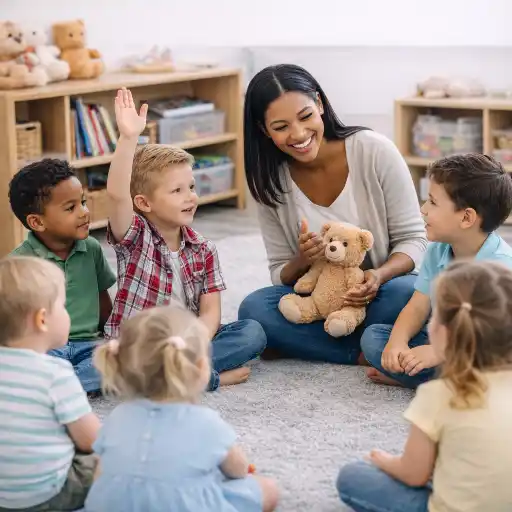
Preschoolers benefit from conversations that follow their interests and allow different ways to contribute. Try small-group discussions, dramatic play, collaborative building, drawing, and story dictation. Ask open prompts such as “What are you noticing?” or “What should happen next?”—then give children time to respond verbally or in another mode.
Plan communication openings throughout the day:
- Offer choices at meals, during play, and when selecting books or materials.
- Pause expectantly after a comment, question, or shared activity.
- Use visual choices, objects, gestures, and simple signs alongside spoken words.
- Build in peer interaction through turn-taking games and shared projects.
- Notice and respond to children’s refusals, requests, comments, and emotional expressions.
Head Start’s guidance on engaging children in conversations highlights responsive adult attention and opportunities for children to share interests, feelings, and observations. The aim is meaningful exchange—not a test of how many words a child can produce.
How can the classroom environment make communication accessible?
A supportive environment makes ways to communicate easy to find, reach, and use. Place picture choices and visual schedules where children can see them; keep communication boards and devices available during routines, play, and outdoor time. When a child uses AAC, adults can model it naturally while speaking, rather than treating it as a special activity or asking the child to prove a need before responding.
Keep spoken language clear and relevant. Use short phrases, emphasize key words, and allow enough processing time. Pair words with objects, photographs, gestures, or demonstrations. A visual sequence for handwashing or a “first/then” cue can help a child understand what is coming and offer a way to respond.
Consider how group size, noise, pace, lighting, and transitions affect a child’s ability to communicate. A quieter spot or smaller group may make it easier for some children to participate. Ensure materials and communication tools are accessible to children with varied mobility, vision, hearing, and sensory needs. The Virtual Lab School recommends adapting routines and environments, including visual supports and communication aids, to support children’s individual needs.
Home languages belong in the communication-rich classroom. Invite families to share meaningful words, songs, stories, and gestures, and welcome children to use the languages they know. Mixing languages can be a natural way for children to express an idea. When the environment honors multiple modes and languages, it affirms that every child’s voice has value.
🌱 Make one routine more accessible this week: add picture choices at snack, keep a child’s communication board within reach, or build in a quiet pause after asking a question.
How can educators partner with families and respond to concerns?
Families know the child across relationships and routines that educators may not see. Ask how the child communicates requests, refusals, feelings, pain, and interest at home. Learn which words, signs, gestures, images, or devices are familiar, and ask what helps the child feel understood. Share specific observations and invite the family’s perspective instead of leading with labels or conclusions.
When a child uses an IFSP, IEP, AAC system, or other individualized supports, coordinate classroom strategies with the family and relevant professionals, with appropriate consent. Keep tools accessible and ensure staff—including substitutes—know how to use the agreed supports. Consistency across adults and routines can make communication more dependable for the child.
If concerns persist, skills appear to be lost, or communication is limiting participation, document observations and follow your program’s referral procedures in collaboration with the family. Educators can share what they observe and connect families to appropriate resources, but should not diagnose. Developmental differences, multilingual learning, and disability require thoughtful, individualized consideration. State requirements vary - check your state licensing agency.
Avoid common pitfalls that can close down communication:
- Do not wait for spoken words before responding to a clear gesture, sign, picture, or device message.
- Do not rush to interpret an ambiguous signal; observe, respond gently, and check your understanding.
- Do not overload children with repeated questions; pause and follow their lead.
- Do not remove communication supports when a child is upset or moving between activities.
Partnership makes careful observation more meaningful and helps the team identify practical supports that honor the child’s strengths.
How can programs make “every voice counts” a shared practice?
A communication-inclusive classroom depends on more than one educator’s good intentions. Directors can support staff by scheduling time to discuss observations, documenting useful strategies in concise communication plans, and ensuring visual supports and communication tools are maintained and accessible. Training and coaching can help all adults recognize signals and respond consistently.
Teams can review routines with questions such as: Who gets chances to initiate? Are children offered choices in ways they can access? Do adults allow enough time for a response? Are home languages and communication tools included in play and group activities? The goal is not to make every child communicate in the same way; it is to remove barriers so children can participate, connect, and influence what happens around them.
Small adjustments can have a meaningful effect. A teacher who notices an infant’s gaze, gives a toddler time to point, or includes a preschooler’s picture in a group conversation is communicating respect. Over time, these responses help create a culture in which communication is a shared responsibility and children’s ideas shape learning.
For further professional learning, consider Effective Approaches for Autism and Inclusion Buy Now $55.00$45.00, Assessment of Language and Literacy Skills Buy Now $24.00, and Building Bridges for Dual Language Learners Buy Now $25.00. These courses address inclusive classroom strategies, observation of language growth, and support for children learning more than one language.
Conclusion: What does it mean to make every voice count?
Building a classroom where every voice counts begins with recognizing that communication can be spoken, signed, pictured, drawn, sounded, or expressed through movement and behavior. Educators can observe carefully, respond with warmth, provide accessible choices and tools, allow wait time, and weave conversation into daily routines. Just as importantly, they can learn from families and collaborate with specialists when individualized support is needed.
The central question is not whether every child communicates in the same way, but whether each child has a dependable opportunity to express needs, feelings, interests, and ideas—and to be heard. Consistent, thoughtful responses help create that opportunity for infants, toddlers, and preschoolers alike.
- Engaging Families During a Pandemic
- Roots & Resilience: Understanding What Shapes a Child
- Pediatric RSV First Aid & CPR/AED
- Baby Steps to Milestones
- CDA Bridge Bundle: Infant/Toddler without Portfolio Review
- Building Equity: Inclusionary Practices in Preschool
- CDA Bridge Bundle: Infant/Toddler
- Texas Director Credential
- CDA Infants/Toddlers: Abuse and Neglect Reporting Requisites
- The Power of International Sign Language in Early Childhood Education
- CDA Certification en Español: Recursos y Consejos para Educadores Bilingües
- Why Every Parent and Educator Should Learn Adult, Child, and Infant CPR
- 😫🧸 ¿Qué hacer cuando un bebé no quiere dormir la siesta en el aula?
- 👶 ¿Cuáles son las proporciones y grupos requeridos en Dakota del Norte? 🏫
- Curso de Comunicación de 9 Horas de Maryland
- 10 Ejemplos de Cómo la Cultura Influye en el Desarrollo Infantil
- Proporciones de Cuidado Infantil y Tamaños de Grupo por Edad en Virginia (Guía Rápida para Centros y Hogares)
- Cómo Trabajar en el Cuidado Infantil en Carolina del Norte: Requisitos y Pasos
- Celebrando la amistad en el cuidado infantil durante el Día de los Mejores Amigos
- What can the National Mall teach us about building a classroom where every child has a voice?
- How can family feedback improve program quality?
- How Can We Celebrate Every Family and Create a Classroom Where Everyone Is Represented?
- What Do Children Learn When Educators Change Their Minds?
- How Can Micro-Moments of Connection Strengthen Relationships During Busy Child Care Days?
- How Can Child Care Leaders Help Staff Feel Heard Beyond the Suggestion Box?
- What Does Your Classroom Tone Sound Like to a Child?
- How Can Family Knowledge Enrich a Montessori Toddler Classroom?
- How Can Child Care Educators Rehearse Classroom Voice and Pacing Before Children Arrive?
- How Can Educators Build a Classroom Where Every Child’s Voice Counts?
