When a child’s development seems different from expected patterns, your careful observations can become the bridge to timely support rather than a source of alarm. The Developmental Screening in Early Childhood  Buy Now $16.00 course can strengthen your ability to distinguish monitoring from screening, document concerns, and collaborate with specialists while earning focused professional learning. For a broader foundation in typical and atypical development, explore The Science of Growing Up: Typical and Atypical Development Buy Now $55.00.
Why does early recognition matter?
Child care providers see children across play, meals, transitions, relationships, and routines. That sustained perspective may reveal patterns that are not visible during a brief appointment. Concern does not mean certainty, and noticing a difference does not mean diagnosing a disability. It means pausing thoughtfully, gathering information, and considering whether additional support may benefit the child.
The CDC explains that developmental monitoring complements formal screening. Monitoring involves observing how children play, learn, speak, act, and move over time; screening uses a validated tool to determine whether further evaluation may be appropriate. Both processes can help families and professionals respond earlier and more effectively.
- Early recognition can support timely conversations with families.
- Objective observations can inform health care or early intervention referrals.
- Responsive classroom adaptations can begin before an evaluation is complete.
- Strengths-based support protects the child’s dignity and participation.
IDEA requires state systems to maintain referral procedures so families, health care providers, social service agencies, and early childhood educators can refer children when developmental concerns arise. Your role is therefore meaningful—but appropriately bounded: observe, document, communicate, support, and connect.
What developmental patterns should providers observe?
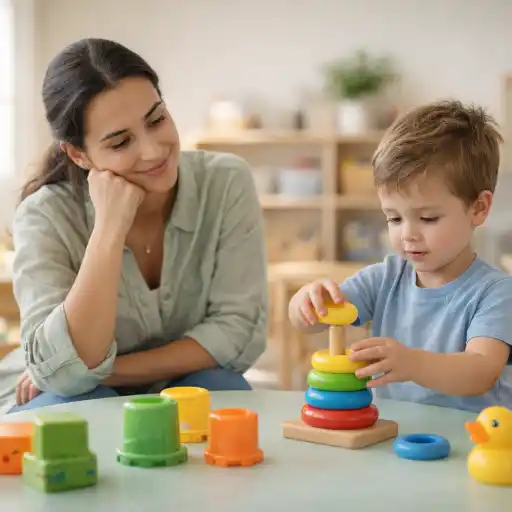
Development unfolds across interconnected domains, and children do not acquire skills in a perfectly linear sequence. A child may demonstrate strong problem-solving while needing support with expressive language, or show social interest while experiencing motor challenges. Observe the whole child rather than focusing on one isolated skill.
- Communication: gestures, sounds, understanding, expressive language, and attempts to connect.
- Physical development: balance, movement, coordination, hand use, and participation in active play.
- Cognitive development: attention, exploration, memory, imitation, and problem-solving.
- Social-emotional development: relationships, shared enjoyment, emotional expression, and regulation.
- Adaptive development: feeding, dressing, toileting, routines, and other self-help skills.
Milestones are guides, not rigid deadlines. Consider home language, culture, temperament, opportunity, health, hearing, vision, disability, and prior experiences. For dual language learners, observe communication in every available language; limited English expression alone does not establish a delay.
Pay particular attention to patterns such as consistently limited response to communication, difficulty participating across several routines, substantial challenges in more than one domain, or skills that appear to be declining. A single quiet day, missed task, or challenging transition is rarely enough to justify concern.
Which signs require prompt follow-up?
Some observations deserve timely consultation with a director, family, and qualified professional. Regression—the loss of a skill previously demonstrated—is especially important. Examples may include losing words or gestures, reduced social engagement, loss of movement skills, or decreased ability to participate in familiar routines.
Other concerns that warrant prompt follow-up may include persistent feeding or swallowing difficulties, significant asymmetry in movement, very limited response to sounds or voices, or multiple missed milestones that affect daily participation. These signs are not diagnoses. They indicate that additional information may be useful.
The American Academy of Pediatrics recommends developmental surveillance and standardized screening in health care settings, including general developmental screening at 9, 18, and 30 months and autism-specific screening at 18 and 24 months. Child care providers do not replace medical screening, but they can share observations and encourage families to consult the child’s health care provider.
Use this response sequence:
- Confirm the pattern across multiple days, settings, and routines.
- Record specific behavior, context, frequency, and supports offered.
- Consult your program’s director or inclusion professional.
- Share observations privately and respectfully with the family.
- Encourage discussion with a pediatrician or local early intervention program.
- Continue individualized classroom support while next steps are considered.
When safety, serious feeding concerns, or sudden skill loss is involved, do not wait for a routine conference.
How can providers document concerns without labeling children?
Useful documentation describes what happened rather than declaring why it happened. Include the date, setting, activity, people present, observable behavior, frequency or duration, the child’s strengths, and the response to adult support.
For example, write: “During three small-group book activities, Maya looked toward the book when peers pointed but did not point or vocalize when offered two choices. After the teacher modeled pointing, Maya selected the red block.” Avoid writing, “Maya has poor communication.” The first description can be discussed, revisited, and shared with professionals; the second is an unsupported conclusion.
- Observe indoors and outdoors, during structured and unstructured activities.
- Use multiple observers when possible.
- Document communication across home languages and communication methods.
- Record which adaptations, prompts, or environmental changes helped.
- Include successful conditions and emerging skills, not only difficulties.
- Store records securely and share them according to consent and policy.
Screening tools should be used only by trained or authorized personnel and should never be treated as proof of a diagnosis. Directors can support consistency by providing observation forms, confidentiality procedures, referral directories, and scheduled team review. The Privacy Matters: Documentation and Observation in Early Learning Buy Now $55.00 course offers additional guidance on objective observation, screening tools, family context, and confidentiality.
How should providers talk with families about developmental concerns?
Families may feel worried, surprised, defensive, relieved, or overwhelmed. These reactions are understandable, particularly when families have encountered stigma or conflicting professional opinions. Choose a private, unhurried time and approach the conversation as shared problem-solving.
- Begin with an authentic strength: “Jordan is persistent with puzzles and enjoys helping classmates.”
- Describe a pattern neutrally: “During several group routines, Jordan uses gestures to request materials but has not yet used words.”
- Explain why you are sharing: “I want us to consider ways to support communication.”
- Invite the family’s knowledge: “What do you notice at home or in your family’s language?”
- Listen without interrupting and acknowledge emotions.
- Discuss options such as monitoring, classroom adaptations, screening, or referral.
- Agree on who will do what and when you will follow up.
Avoid “something is wrong,” “he is behind,” or “I think she has autism.” Instead say, “We are noticing a pattern and would like to understand what support may help.” Use qualified interpreters when needed, provide resources in the preferred language, and never use a child as an interpreter.
The Engaging Families for Child Success Buy Now $55.00 course can deepen skills in family conferences, culturally responsive communication, and collaborative planning. State requirements vary - check your state licensing agency.
What should providers do while families pursue next steps?
Children should not have to wait for a diagnosis before receiving responsive teaching. Adapt access without lowering expectations, and embed support in ordinary play and routines.
- 🔎 Use visual schedules, gestures, objects, photographs, and demonstrations.
- Break complex tasks into smaller, visible steps.
- Offer additional processing time and meaningful choices.
- Model language during play rather than demanding repetition.
- Provide quieter spaces, flexible seating, movement options, and predictable transitions.
- Adapt materials, group size, pacing, and sensory demands.
- Teach peers how to invite, wait, share, and include.
For children younger than three, families may contact the state’s Part C early intervention system. For children age three or older, families commonly contact the local school system regarding preschool special education evaluation. Pathways, eligibility rules, timelines, and consent requirements vary by state. A referral is a request for information and support—not a diagnosis, rejection, or guarantee of eligibility.
Follow up with families even when they are not ready to pursue evaluation. Share progress, document agreed strategies, protect confidentiality, and coordinate with specialists when families provide consent. Directors can strengthen systems through written referral procedures, staff training, interpreter access, community partnerships, and regular case consultation.
Conclusion: When should a provider be concerned about development?
A provider should become concerned when observations reveal a persistent pattern, significant difficulty across routines or domains, regression, or a barrier to meaningful participation—not simply because a child develops differently from peers on one occasion. The appropriate response is careful monitoring, objective documentation, respectful family partnership, individualized support, and timely connection to qualified professionals.
Remember these practical actions:
- Observe across settings, routines, languages, and relationships.
- Document facts, strengths, context, and response to support.
- Consult program leadership and follow referral procedures.
- Discuss concerns privately with empathy and cultural humility.
- Encourage screening or evaluation when appropriate, without diagnosing.
- Continue inclusive classroom support and schedule follow-up.
Your role is not to predict a child’s future. It is to notice carefully, respond compassionately, and help families access the information and support they may need.
- 45 Hour Child Growth and Development
- CDA Home Visitor Subject Area 3 Part 3 Birth to 5
- 45 Hour Infant and Toddler Methods and Materials
- Recognize, Respond, Respect: Supporting Diverse Learners
- 45 Hour School Age Methods and Materials
- CDA Bridge Bundle: Family Child Care
- CDA Bridge Bundle: Preschool without Portfolio Review
- Creating Environments that Nurture Growth and Community
- Texas Director Credential
- CDA Certification en Español: Recursos y Consejos para Educadores Bilingües
- Lista para Guardería en Casa en California: Cómo Iniciar una Guardería en el Hogar
- Retraso del Habla en la Guardería: Cómo Pueden Ayudar los Proveedores
- Cómo Trabajar en el Cuidado Infantil en California: Requisitos y Pasos
- Baby Milestones and Red Flags: A Month-by-Month Guide
- What to Expect During Your Baby’s First Months
- Baby Development by Week: Signs, Growth, and Red Flags
- What are developmental milestones and how can child care providers use them?
- What Is the Difference Between Early Childhood Education and Child Development?
- How Can Child Care Providers Share Developmental Concerns with Sensitivity?
- How Can Child Care Providers Handle Difficult Conversations with Families Professionally?
- When “I Don’t Know” Means Something More: How Can Child Care Providers Understand Children’s Communication?
- How Can Child Care Leaders Help Staff Use What They Learn on Monday?
- When Should Providers Be Concerned About Language Delays?
- When Should a Child Care Provider Be Concerned About Development?
- When Should a Child Care Provider Be Concerned About Speech Development?
- How Can Child Care Providers Prepare for a Family Meeting When a Child May Need Additional Support?
- When Is a Child’s Behavior a Developmental Concern?
- Who Should Parents Contact About Their Child’s Care?
