Children often feel appreciation before they have the words to explain it. Thoughtful writing and art experiences give them a concrete, joyful way to notice caring people, meaningful moments, and personal strengths; Community and Family Engagement in Childcare  Buy Now $24.00 can help providers extend that work through stronger family partnerships and practical professional learning. For additional support with children’s emotional expression, explore Brighter Futures: Social Emotional Development Buy Now $16.00, which focuses on developmentally responsive interactions and can contribute to relevant training hours.
Appreciation is more than asking children to say “thank you.” It involves noticing who helps, identifying what feels meaningful, connecting actions to emotions, and communicating those observations in a personally comfortable way. In early childhood settings, art and emergent writing are especially powerful because they allow children to express complex ideas through marks, pictures, dictated words, symbols, movement, and conversation.
Why do appreciation activities matter in early childhood?
Appreciation supports social-emotional learning because it helps children recognize relationships, effort, kindness, and belonging. A child who draws the teacher who reads a favorite story, dictates “Grandpa helps me ride my bike,” or paints a picture of friends building together is practicing perspective-taking and emotional vocabulary. These experiences also communicate that children’s observations matter.
Writing and art are particularly inclusive forms of expression. Some children speak readily; others communicate through gestures, home languages, drawing, sensory exploration, or short phrases. When educators accept multiple forms of participation, they avoid turning gratitude into a performance and create space for authentic #expression.
These activities also build several developmental domains at once:
- Oral language grows as children describe people, actions, and feelings.
- Emergent writing develops through drawing, dictation, labeling, and purposeful mark-making.
- Fine-motor skills are strengthened through painting, cutting, gluing, and manipulating tools.
- Social competence develops as children listen to peers and consider another person’s contribution.
- Family relationships deepen when children create meaningful work to share at home.
Research-informed family engagement practice emphasizes reciprocal relationships rather than one-way communication. A child’s appreciation project can become a bridge: educators learn what children value, families see classroom learning, and children experience their home and care communities as connected.
How can educators prepare children to name what they appreciate?
Begin with concrete experiences instead of abstract definitions. Young children may not understand a broad question such as “What are you grateful for?” but they can respond to “Who helped you zip your coat?” or “What made play feel fun today?” Specific prompts connect appreciation to observable events.
Model the thinking process aloud: “I appreciate how you brought me the book when I was helping Maya. That helped me finish our story.” This language identifies the action, the effect, and the feeling without requiring children to imitate a scripted response.
Before an activity, build a small vocabulary bank with words such as help, care, share, listen, safe, joyful, proud, favorite, and appreciate. Add pictures or translations when appropriate. Invite children to contribute words from their homes, recognizing that families may express appreciation differently.
Offer children several ways to participate:
- Draw a person, place, object, or experience.
- Dictate a sentence for an adult to write.
- Copy a meaningful word or write initial sounds.
- Use stickers, photographs, symbols, or collage materials.
- Tell a partner, use a home-language phrase, sign, or gesture.
Do not confuse reluctance with a lack of appreciation. A child may need privacy, more processing time, or an alternative audience. Choice protects autonomy and makes the activity more emotionally safe.
Which writing activities help children communicate appreciation?
Writing activities should be purposeful, brief, and developmentally flexible. The goal is not polished handwriting; it is helping children communicate an idea. For preschoolers, dictation is legitimate composition. Educators can write the child’s exact words, read them back, and invite the child to add a drawing or signature.
Appreciation postcards: Provide a simple card with the prompts “I appreciate you because…” and “You helped me…” Children may draw while teachers record their words. The card can be sent to a family member, classroom helper, friend, or community member.
Class appreciation book: Each child creates one page about a person or experience they value. Combine pages into a book for the reading area. Revisit it during group time and invite children to explain their illustrations.
Kindness captions: Display photographs or drawings of classroom cooperation. Ask children to dictate captions such as “Lena shared the blocks” or “We cleaned together.” This connects appreciation with real actions rather than possessions alone.
Appreciation lists: Older preschoolers can make a list of people, places, sounds, foods, activities, or qualities they enjoy. Teachers can support spelling without taking ownership of the child’s message.
Father’s Day Trophy Award: The Father’s Day Trophy Award Buy Now $0.00 offers a simple, sellable resource children can color, decorate, and personalize with why someone special deserves recognition. Although the title references Father’s Day, educators can adapt the language for a father, grandfather, uncle, caregiver, mentor, or another important person, depending on each child’s family structure.
Keep the audience flexible. A child may want to take the writing home, place it in a portfolio, or share it privately with an educator. Meaningful writing is communication—not a public test.
How can art make appreciation visible and accessible?
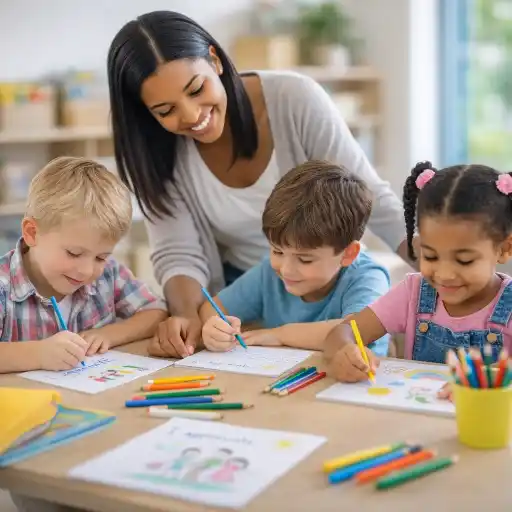
Open-ended art gives children a nonverbal route into emotional expression. Rather than requiring identical products, offer materials that support personal meaning: tempera paint, crayons, collage pieces, clay, fabric, natural materials, photographs, and washable markers. The educator’s role is to invite reflection while preserving the child’s artistic decisions.
Try a “people who help me” collage. Children can draw or select images of family members, educators, friends, pets, neighbors, or community helpers. Ask, “What does this person do?” and “How do you feel when you are together?” Record the child’s response beside the image.
A collaborative appreciation mural can show that a classroom community is built from many contributions. Each child adds a picture, color, texture, or dictated phrase. Children who do not wish to name a person can represent a place, activity, object, sound, or personal strength instead.
For a respectful seasonal extension, educators can explore Memorial Day activities for young children that introduce remembrance, kindness, and community in developmentally appropriate ways.
Other effective possibilities include:
- 🎨 A gratitude flower with one appreciation on each petal.
- A handprint banner in which each finger represents something meaningful.
- An appreciation garden made from painted paper leaves.
- Clay sculptures of a favorite person, animal, activity, or memory.
- A family-photo collage created from drawings when photographs are unavailable.
Good2Know’s gratitude-themed art activities illustrate how handprints, collages, and classroom displays can combine sensory exploration with conversation. Always supervise materials appropriately and adapt tools for children with differing motor, sensory, or communication needs.
How can educators include families and honor every child’s relationships?
Family engagement makes appreciation activities more authentic, but inclusion requires careful planning. Not every child lives with a father, celebrates Father’s Day, or identifies one adult as a “dad.” Use expansive language such as “someone special,” “a caring adult,” or “a person who helps you.” Invite children to choose the recipient rather than assigning one.
Before sending a project home, ask families about names, pronouns, languages, traditions, and preferred forms of participation. A short translated note might explain: “We are exploring how children notice care and express appreciation. Your child may create something for any person, place, or experience that matters to them.”
Family participation should not depend on attendance, income, technology, or comfort speaking publicly. Offer options such as:
- Sending a drawing or message from home.
- Sharing a family word for appreciation.
- Recording a short voice message, when permitted.
- Contributing a photo or helping a child create a collage.
- Completing the activity privately with the child.
Children’s family realities may include separation, foster care, bereavement, deployment, incarceration, or complex caregiving arrangements. Avoid pressuring children to produce a cheerful message about a difficult relationship. A child can appreciate a teacher, pet, sibling, place, or routine instead. State requirements vary - check your state licensing agency, especially when collecting photographs, recording children, or sharing work digitally.
For deeper preparation, Family Voices Matter: Tools for Meaningful Collaboration Buy Now $55.00 offers strategies for culturally and linguistically responsive communication and meaningful family partnership.
What common mistakes should providers avoid?
Appreciation activities can lose their value when adult expectations overshadow children’s meaning. A reflective approach helps programs avoid common pitfalls.
- Forcing a specific recipient: Let children choose someone special or appreciate an experience.
- Requiring verbal thanks: Accept drawing, dictation, gestures, home-language expression, or private sharing.
- Using identical crafts: Focus on process and personal meaning instead of matching products.
- Correcting the message: Preserve children’s words, even when grammar or spelling is emerging.
- Equating appreciation with obedience: Children can value someone and still set boundaries, disagree, or say no.
- Centering expensive gifts: Emphasize care, effort, relationships, nature, creativity, and shared experiences.
- Making children disclose personal information: Provide neutral alternatives and protect privacy.
Directors can support quality by giving staff shared guidance: use open-ended prompts, document children’s exact words, obtain consent before displaying work, and review materials for family inclusivity. Educators can reflect on whether every child had a meaningful way to participate and whether the activity expanded children’s language rather than narrowed it.
Observation notes may include statements such as “named a peer’s helpful action,” “used drawing to represent a caring adult,” or “dictated a two-part appreciation message.” These notes support planning; they should not rank children’s emotional lives.
Summary: How do writing and art help children name appreciation?
Writing and art help children transform an internal feeling into a communicable idea. Through drawing, dictation, mark-making, collage, painting, and personalized keepsakes such as the Father’s Day Trophy Award, children can identify people, actions, places, and experiences that matter to them. The strongest activities are concrete, open-ended, inclusive, and connected to genuine relationships.
Providers can begin with one simple prompt: “Who or what helped make today meaningful?” Then offer multiple ways to respond, honor family diversity, and share children’s work only with appropriate permission. When appreciation is woven into everyday classroom life rather than limited to a holiday, children build language, empathy, confidence, and belonging. Professional learning in community and family engagement can help directors and educators strengthen these practices across the entire program.
Frequently Asked Questions
What if a child says they appreciate nothing?
Accept the response without pressure. Offer concrete choices, revisit the activity later, or invite the child to draw a favorite color, place, activity, or object.
Can toddlers participate?
Yes. Toddlers can choose photographs, make marks, point, gesture, or dictate a short phrase while an adult narrates their meaning.
Should every child make a Father’s Day gift?
No. Offer the Father’s Day Trophy Award as an optional, adaptable resource and let children select a meaningful recipient or alternative project.
How can art support children who are learning English?
Use visuals, gestures, home-language words, peer modeling, and dictation. Art allows children to communicate meaning even when English vocabulary is still developing.
How can directors connect this work to professional development?
Teams can study family engagement, social-emotional development, inclusive communication, and emergent literacy. Review state requirements before counting any course toward required training hours.
- CDA Home Visitor Subject Area 3 Part 3 Birth to 5
- CDA Home Visitor Subject Area 2 Part 3 Birth to 5
- Power of Art: Bldg Self-Esteem & Positive Behavior for ALL Abilities
- Children at the Wheel: Emergent Curriculum
- CDA Bridge Bundle: Family Child Care without Portfolio Review
- Art from the Heart for Preschoolers: Open Ended Art Projects that Build Self-Esteem
- CDA Bridge Bundle: Infant/Toddler without Portfolio Review
- CDA Bridge Bundle: Preschool without Portfolio Review
- Montessori Cultural Activities: Exploring the World Through Play and Learning
- Professional Integrity in Child Care
- Nature’s Classroom: Why Fall Is the Best Season for Sensory Learning Outdoors
- CDA Certification en Español: Recursos y Consejos para Educadores Bilingües
- 🚨 Reporte Obligatorio en Nevada
- Recursos en Español sobre el Sueño Seguro del Bebé
- Regulaciones de Licenciamiento de Cuidado Infantil en California para Centros y Hogares de Cuidado Infantil Familiar
- Proporciones de Cuidado Infantil y Tamaños de Grupo por Edad en Maryland (Guía Rápida para Centros y Hogares)
- Proporciones de Cuidado Infantil y Tamaños de Grupo por Edad en Nueva Jersey (Guía Rápida para Centros y Hogares)
- Proporciones de Cuidado Infantil y Tamaños de Grupo por Edad en Virginia (Guía Rápida para Centros y Hogares)
- Cómo Celebrar el Día Nacional del Kindergarten
- Lista para Guardería en Casa en Illinois: Cómo Iniciar una Guardería en el Hogar
- Consejos de Supervisión Activa para Salones de Preescolar y el Juego al Aire Libre
- Cómo Trabajar en el Cuidado Infantil en Carolina del Norte: Requisitos y Pasos
- Celebrando la amistad en el cuidado infantil durante el Día de los Mejores Amigos
- Canciones, juegos y preguntas de círculo para niños
- Cómo simplificar la capacitación para sus empleados de daycare
- Easy Glitter Crafts for Toddlers and Preschoolers
- Labor Day Makers: Creative Projects That Get Pre-K Kids Thinking and Building
- Labor Day Crafts for School-Age Kids That Go Beyond Coloring Pages
- How Can “All About Me” Activities Build a Stronger Classroom Community?
- How Can Writing and Art Activities Help Children Name What They Appreciate?
