When a child anticipates the next sea creature and joins a familiar sentence, story time becomes a chance to say, “I can read!” Use a simple ocean reader to invite participation, build vocabulary, and create joyful routines; the Classroom Tools for Emergent Literacy  Buy Now $16.00 course offers practical strategies for interactive read-alouds, reading buddies, and other classroom literacy experiences. Keep reading to see how predictable ocean text can become a meaningful part of your daily practice.
Why does predictable ocean text help children feel capable?
Predictable text uses recurring words, sentence structures, rhythms, or sequences to help children anticipate what comes next. In an ocean-themed reader, a sentence frame might remain steady while the animal changes from page to page. That balance of familiar structure and new content gives children a secure way to join in while staying curious.
For young children, this is more than a pleasant reading routine. Familiar language reduces the demand of figuring out every sentence from scratch, leaving more attention available for pictures, meaning, and participation. A child may say a repeated word, point to the pictured creature, make a gesture, or simply listen closely before joining later. Each is a meaningful entry point into the experience.
The ChildCareEd resource Emergent Readers - Sea Animals Buy Now $1.75 introduces five friendly sea creatures through simple repeating sentences and includes a coral-reef coloring page. The predictable pattern can help children anticipate language and experience themselves as contributors to the story. Repetition is not the same as decoding unfamiliar words, but it can strengthen a young child’s identity as someone who belongs in a community of #readers.
Predictable books also give educators a practical way to observe children’s interests and emerging skills. Notice who anticipates an animal’s name, turns pages, connects a picture to a real-world experience, or returns to the book independently. These small moments offer useful clues for planning the next reading or play invitation.
What makes an ocean-themed emergent reader engaging and useful?
An effective emergent reader pairs accessible language with meaningful content. Sea animals naturally spark questions: Where does an octopus live? How does a turtle move? What might a crab do? A simple sentence pattern provides a stable frame for those conversations, while the changing creatures introduce new details and vocabulary.
Choose a time when children are interested and comfortable, and preview the book so you can identify a few words to emphasize. The resource’s five sea creatures can anchor a short exploration rather than an overloaded lesson. Invite children to name what they notice in the illustrations, connect an animal to prior experiences, and wonder aloud about its movement or habitat. Follow children’s curiosity instead of expecting them to memorize facts.
- Introduce a few words such as coral, fin, or tentacle with pictures, gestures, or toy animals.
- Use the repeated sentence as an invitation, not a demand; children may speak, point, sign, or watch.
- Pause briefly before the animal name to give children time to predict or respond.
- Ask open questions such as, “What do you notice?” or “How might this animal move?”
Ocean themes can also bridge literacy and science without blurring their purposes. The shared book supports language and story participation; follow-up activities can invite observation, sorting, drawing, or imaginative play. Select images and materials that are clear, age-appropriate, and respectful of children’s varied experiences with the ocean. Some children may have visited a beach; others may know sea life through books, family stories, or media. Each connection can enrich the conversation.
How can providers make each rereading purposeful?
Children often ask for a favorite book again, and that repetition is valuable. Rather than turning every rereading into the same performance, keep the text familiar while shifting the focus gently. A first reading can prioritize enjoyment; another can invite children to join the repeated sentence; a later reading can connect a word or animal to play, drawing, or a new question.
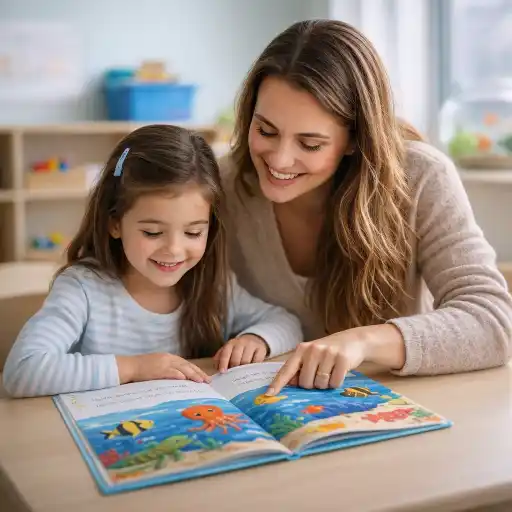
Try a simple three-reading sequence:
- First reading—enjoy and notice: Read at a natural pace, show the illustrations, and observe which creatures draw children’s attention.
- Second reading—participate: Pause before a familiar word or phrase. Accept a spoken response, point, sign, gesture, or sound.
- Third reading—extend: Invite children to describe an animal, compare pages, act out a movement, or create a new sentence together.
Use print awareness naturally. Show the cover and title, turn pages in order, and occasionally point to the words as you read. A light touch is enough: the goal is to connect the story with how books and print work without interrupting the pleasure of reading. A book’s repetitive sentence structure may also support prediction and memory as children notice what stays the same and what changes.
After the read-aloud, keep the idea alive in the room. Set out sea-animal figures, blue fabric, blocks, or drawing materials for a reef scene. Invite children to dictate a new page using the shared sentence frame. For example, children might choose an animal and tell you what it is doing. You can write their words down and reread the class-created text together. This approach makes children’s ideas visible and connects oral language, writing, and #play.
For more structured professional learning, Reading Aloud and Storytelling Buy Now $16.00 explores interactive reading and storytelling practices that support vocabulary, comprehension, and engagement.
How can ocean-themed reading include every child?
Meaningful participation does not require every child to answer aloud. One child may name the animal; another may point, use a communication device, make a movement, select a matching figure, or attend closely. Watch for each child’s way of engaging, and respond as though that contribution matters—because it does.
For children learning English alongside another language, repetition can offer a low-pressure opportunity to hear and explore new words. Pair animal names with photographs, gestures, objects, and, when possible, words in children’s home languages. Families may know songs, stories, or experiences related to water and sea life; inviting those connections can affirm children’s identities and enrich classroom understanding.
- Offer sturdy, easy-to-handle copies or enlarge illustrations when helpful.
- Use tactile figures, textured materials, or clear picture choices to support access.
- Pair spoken words with gestures, signs, or a child’s augmentative and alternative communication system.
- Allow children to participate by moving, pointing, drawing, watching, or speaking.
- Keep the reading brief or focus on selected pages when that better suits children’s attention and processing needs.
Representation and access go together. Choose additional books that portray diverse children, families, and communities, and include a range of ocean settings and perspectives. Avoid assuming that every child has had the same experiences or that one response style signals understanding. An inclusive read-aloud makes room for different ways to communicate, different background knowledge, and different levels of familiarity with the topic.
Directors can support staff by making adaptable books and props available and by discussing participation broadly during coaching. Ask: What did the child notice? How did they communicate? What made access easier? These questions keep attention on strengths and help educators plan responsive next steps.
What common pitfalls should educators avoid?
One pitfall is moving too quickly through every page. When adults rush to finish, children have fewer chances to look, anticipate, and contribute. Another is asking a question after every sentence until the story feels like a quiz. Use pauses and questions selectively, preserving the rhythm and warmth that make shared reading enjoyable.
It is also easy to confuse reciting a familiar pattern with reading new words independently. A child’s remembered sentence is a real accomplishment in oral language, memory, and participation, but it does not establish that the child can decode unfamiliar text. Honor the achievement while continuing to offer varied books and developmentally appropriate experiences with sounds, letters, print, and language.
Finally, avoid treating a theme as a requirement that every child must enjoy or know. Some children may be more interested in another topic, and that interest is useful information. Follow their questions, provide a range of books, and adapt rather than insisting on one activity or response.
- Don’t require every child to speak; offer multiple ways to join.
- Don’t correct approximations sharply; model the word naturally and keep the exchange positive.
- Don’t introduce too many target words or skills in one short reading.
- Don’t rely only on predictable books; include stories, informational texts, poetry, and wordless books.
Brief, practical observations can guide instruction: Does a child anticipate a phrase, point to an animal, use a new word in play, or revisit the book with a friend? Record a few examples and use them to choose a next step. State requirements vary - check your state licensing agency when planning curriculum or documenting instruction.
Conclusion: How can predictable ocean text build reading confidence?
Predictable ocean-themed text builds reading confidence by giving children a familiar structure in which to participate, while changing sea creatures and details sustain curiosity. A book such as Emergent Readers - Sea Animals Buy Now $1.75 can support shared enjoyment, vocabulary, prediction, and early awareness of how books work. Children may join through words, gestures, pictures, movement, or careful listening—and each route deserves recognition.
Keep readings warm and flexible: enjoy the first encounter, invite participation on a rereading, and extend the story through conversation or play. Notice children’s responses, make access individual, and balance patterned readers with a rich variety of texts. To strengthen your broader classroom practice, explore Classroom Tools for Emergent Literacy Buy Now $16.00, Reading Aloud and Storytelling Buy Now $16.00, Science of Reading Foundations in the Pre-K Classroom Buy Now $16.00, Understanding Print Knowledge in Preschool Buy Now $16.00, and Assessment of Language and Literacy Skills Buy Now $24.00. Most of all, celebrate the moment a child anticipates a phrase and recognizes that their voice belongs in the story.
- Science of Reading Foundations in the Pre-K Classroom
- CDA Home Visitor Subject Area 3 Part 3 Birth to 5
- Reading Aloud and Storytelling
- Language and Literacy Foundations in Pre-K
- Birth to Five CDA Credential with Portfolio Review
- Setting the Stage: Story Time
- Positive Attention: Interactions & Supervision for Infants & Toddlers
- Texas Director Credential
- Classroom Tools for Emergent Literacy
- Classroom Tools for Emergent Literacy
- 📖 ¿Cómo puedo hacer que la hora del cuento sea la parte más poderosa de mi día?
- 👶 ¿Cuáles son las proporciones y grupos requeridos en Dakota del Norte? 🏫
- Celebra El Cumpleaños de Dr. Seuss En Tu Guardería Con Actividades Fáciles y Divertidas!
- Recursos en Español sobre el Sueño Seguro del Bebé
- Curso de Comunicación de 9 Horas de Maryland
- 10 Ejemplos de Cómo la Cultura Influye en el Desarrollo Infantil
- Cómo Crear Tu Portafolio CDA Paso a Paso
- Reglas de Cuidado Infantil en Illinois
- Proporciones de Cuidado Infantil y Tamaños de Grupo por Edad en Nueva Jersey (Guía Rápida para Centros y Hogares)
- Proporciones de Cuidado Infantil y Tamaños de Grupo por Edad en Virginia (Guía Rápida para Centros y Hogares)
- Cómo Trabajar en el Cuidado Infantil en Carolina del Norte: Requisitos y Pasos
- Celebrando la amistad en el cuidado infantil durante el Día de los Mejores Amigos
- Canciones, juegos y preguntas de círculo para niños
- Easy Pool Noodle Sea Creatures for Ocean Theme Activities
- Cómo simplificar la capacitación para sus empleados de daycare
- Summer Crafts and Activities for Preschool Classrooms
- Why Do Simple Books Build Early Reading Confidence?
- How Do Repetitive Sentence Patterns Build Early Reading Confidence?
- How Can Predictable Ocean-Themed Text Build Reading Confidence?
- A Child Has Memorized the Book: What Can You Teach Next?
