Number activities can build early math understanding without requiring every child to use materials in the same way. With thoughtful changes to tools, positioning, pacing, and response options, providers can support meaningful participation for children with cerebral palsy; ChildCareEd’s Intro to Cerebral Palsy  Buy Now $16.00 course offers practical inclusion strategies and foundational knowledge to strengthen that work. Read on for ways to adapt a simple Do-A-Dot Numbers worksheet while keeping the child’s choices and learning at the center.
Why adapt number activities rather than lower the learning goal?
Number activities bring together several skills: recognizing symbols, counting objects, comparing quantities, and communicating what a child knows. A worksheet may ask a child to mark dots with a tool, but difficulty holding or directing that tool does not necessarily indicate difficulty understanding the number. The barrier may lie in the activity’s format—not in the child’s interest or capacity.
Cerebral palsy affects movement and posture differently from one child to another. Some children may experience differences in coordination, grasp, range of motion, or fatigue; others may use mobility equipment or communicate through gestures, pictures, or assistive technology. Avoid treating a diagnosis as a prediction of what a child can learn. Observe the child, ask about their preferences, and work with the family and relevant specialists where appropriate.
Research on early numeracy in children with cerebral palsy has found relationships between early number performance, working memory, and fine motor skills. This supports a practical teaching point: make sure the motor demands do not obscure the math concept you intend to teach. Adapt the pathway to the learning goal, and offer the child a real role in the activity.
How can you prepare the worksheet, space, and materials?
Start by identifying the intended learning objective. Is the child matching a numeral to a quantity, counting a set of dots, or exploring number recognition? Then check which parts of the activity create access barriers. A standard worksheet can be one option, not the only route to the same math idea.
- Use a stable work surface and place the page where the child can comfortably see and reach it. Secure the paper with tape or a non-slip mat if that helps.
- Try larger print, bold outlines, high contrast, and uncluttered page layouts. Present one number or a small set of choices at a time.
- Offer suitable tools such as broad dot markers, stampers, easy-grip crayons, or large stickers. Check that materials are age-appropriate and safe for the individual child.
- Provide counters, tactile number cards, or objects that can be counted by looking, pointing, touching, or directing a partner.
- 🌟 Invite the child to choose the tool, color, or number they want to explore, using their preferred communication method.
Some children may benefit from a slanted surface, adapted handle, or assistive technology; others may prefer no additional equipment. Follow the child’s plan and family or specialist guidance for positioning and equipment, and do not improvise supports that may be uncomfortable or unsafe. The aim is access to the task—not a particular grip or posture.
What are practical ways to adapt a Do-A-Dot Numbers worksheet?
A Do-A-Dot Numbers worksheet can help children notice numerals and connect them to quantities. Keep that central purpose, but vary how children complete the page. If the child is matching a number to a quantity, for example, they might place a large sticker for each counted item, direct an adult to stamp the dots, point to the matching number, or select a corresponding group of counters.
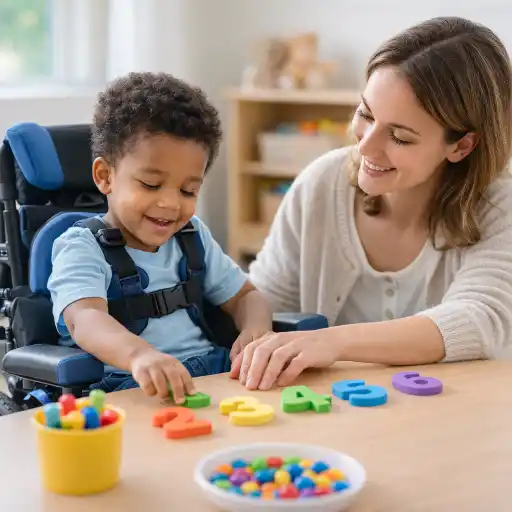
- Reduce the motor demand: Offer a larger stamp or marker, stabilize the worksheet, or place dot stickers within easy reach. Let the child take breaks as needed.
- Make the concept hands-on: Pair the numeral with large counters, blocks, or other safe manipulatives. Count aloud together, or invite the child to indicate each count in their own way.
- Offer alternate responses: Accept pointing, eye gaze, a communication device, a gesture, a switch, or verbal responses when these match the child’s communication and support needs.
- Adjust the sequence: Show one number at a time, model the first step, and give unhurried wait time before offering a prompt.
Choices should preserve meaningful authorship. Rather than completing the page for the child, ask where the next dot belongs or which number comes next. If adult assistance is needed, follow the child’s directions and provide only the support required to enable participation. Hands-on math and tactile number activities can offer useful alternatives to pencil-based responses, as illustrated by accessible math activity ideas from WonderBaby.org.
How can communication, pacing, and peer participation support learning?
Participation does not have to look identical for everyone. A child may show number knowledge by pointing, selecting an image, using a communication device, moving a switch, looking toward a choice, or directing someone else to place a counter. Allow enough time for the child to respond; slower movement or speech is not evidence of uncertainty or disengagement.
Use concise directions and make the sequence visible. For example: “Choose a number,” “count the objects,” and “show how many.” Demonstrate the action, then pause. If a child tires or becomes frustrated, consider a shorter set, a brief break, or a different response method. The goal is sustained access and meaningful math thinking, not finishing a page quickly.
Peers can make the activity more social without taking over. One child might choose a numeral while a partner places counters where directed. Rotate roles so each child contributes to the shared work. Keep language respectful and strengths-based: “You chose five and showed us how many,” rather than focusing on neatness or speed. These choices foster #belonging, collaboration, and confidence as part of everyday #inclusion.
What common pitfalls should educators avoid?
Well-intentioned support can accidentally shift attention away from the child’s learning. If the worksheet is hard to use, first adjust the activity rather than deciding the child is not ready for numbers. Also be cautious about making assumptions based on diagnosis: cerebral palsy is diverse, and one adaptation will not suit every child or every day.
- Do not equate motor difficulty with limited understanding. Check learning through varied response methods.
- Avoid insisting on one “correct” tool. Offer options and observe what improves comfortable access.
- Do not overprompt or rush. Give processing and movement time, and offer assistance only when needed.
- Avoid doing the task for the child. Preserve choice and let the child direct assistance.
- Do not treat a worksheet as the only evidence of learning. Use play, objects, conversation, and observation to notice number understanding.
Afterward, make a brief note of the objective, adaptation, response method, and what seemed to support engagement. Share observations respectfully with the family and team, and use them to refine the next activity. State requirements vary - check your state licensing agency. For more structured professional learning, providers may also explore Inclusive Lessons for Preschoolers Buy Now $16.00, Supporting Skill Development: Children with Special Needs Buy Now $24.00, Tailoring Instruction to Children’s Needs Buy Now $24.00, and Letter & Number Planning in Child Care Buy Now $24.00.
How can providers tell whether an adaptation is working?
Evaluate access and learning separately. Ask whether the child could participate comfortably, make choices, and show their thinking—and whether the activity gave you useful information about the intended number concept. A completed worksheet is not the sole measure of success. A child who selects the correct numeral or directs a peer to place the right number of counters may demonstrate the same understanding through a different route.
Notice practical details: Was the page easy to see and reach? Did the child have enough time? Which tool or communication option did they choose? When did they need help or a pause? These observations can guide small, purposeful adjustments next time. When positioning, adaptive equipment, or motor demands are unclear, consult the family and appropriate specialists rather than guessing.
Build on the child’s interests: count toy cars, snack pieces, blocks, or favorite pictures. Keep the number idea consistent while varying materials and participation methods. This helps educators create a flexible routine for #math learning that respects individual access needs and keeps children engaged with peers.
Conclusion: How can number activities become accessible?
To adapt number activities for a child with cerebral palsy, preserve the math goal while changing tools, page design, positioning, pacing, or response options as needed. Begin with observation and the child’s preferences; offer meaningful choices, accessible materials, and enough time to respond. A Do-A-Dot Numbers worksheet can be a useful starting point when children can stamp, place, point, count, or direct the action in ways that work for them.
Above all, treat access as part of thoughtful lesson design rather than an exception. Collaborate with families and specialists, reflect on what supports participation, and build from each child’s strengths. In an inclusive number activity, the child is not simply present—they are an active math learner.
- 45 Hour Child Growth and Development
- CDA Home Visitor Subject Area 3 Part 3 Birth to 5
- 45 Hour Preschool Methods and Materials
- Birth to Five CDA Credential with Portfolio Review
- 45 Hour Infant and Toddler Methods and Materials
- CDA Bridge Bundle: Family Child Care without Portfolio Review
- Intro to Cerebral Palsy
- CDA Bridge Bundle: Infant/Toddler without Portfolio Review
- CDA Bridge Bundle: Preschool without Portfolio Review
- Texas Director Credential
- CDA Certification en Español: Recursos y Consejos para Educadores Bilingües
- 💛🧩 ¿Cómo puedo hacer que mi enseñanza sea inclusiva para los niños con autismo?
- ⏰ Cómo puedo facilitar las transiciones y las rutinas diarias en mi aula?
- 🤯 ¿Por qué este niño está teniendo un comportamiento difícil de repente?
- Proceso CDA: Entrenamiento, Portafolio, Examen y Visita de Verificació
- ¿Cuáles son las mejores actividades del Día de la Tierra para niños en casa o en el aula?
- ¿Cómo afecta la dopamina a los niños: señales, efectos e influencias diarias?
- Actividades de Motricidad Gruesa que Desarrollan el Equilibrio, la Coordinación y la Fuerza
- Actividades de Fiesta para Niños de Preescolar y Primaria
- Cómo Empezar una Guardería en Casa: Requisitos y Pasos
- Proporciones de Cuidado Infantil y Tamaños de Grupo por Edad en Maryland (Guía Rápida para Centros y Hogares)
- Proporciones de Cuidado Infantil y Tamaños de Grupo por Edad en Nueva Jersey (Guía Rápida para Centros y Hogares)
- Proporciones de Cuidado Infantil y Tamaños de Grupo por Edad en Virginia (Guía Rápida para Centros y Hogares)
- Cómo Celebrar el Día Nacional del Kindergarten
- Lista para Guardería en Casa en Illinois: Cómo Iniciar una Guardería en el Hogar
- Apoyo en Preescolar para Retrasos del Habla: Estrategias Simples que Ayudan
- Celebrando la amistad en el cuidado infantil durante el Día de los Mejores Amigos
- Canciones, juegos y preguntas de círculo para niños
- How Can You Make a Design Activity Accessible to a Child with Cerebral Palsy?
- How Can You Adapt Number Activities for Children with Cerebral Palsy?
