When school-age children learn to notice one another’s contributions, gratitude becomes more than a polite phrase—it can strengthen relationships and make cooperation feel meaningful. Explore practical activities you can use in your program, and deepen your planning skills with ChildCareEd’s Lesson Planning to Meet School Age Needs  Buy Now $16.00, which offers strategies for engaging, developmentally appropriate experiences and supports your professional learning.
For additional background on how children’s emotions and relationships develop, consider ChildCareEd’s Opportunity for Growth: Emotional Development Buy Now $16.00. Together, these courses can help you connect meaningful activities to children’s needs while building a stronger social-emotional learning environment.
Why do gratitude activities matter in a school-age program?
School-age children are developing a deeper understanding of fairness, perspective, and the effects of their actions. Gratitude activities give them structured ways to recognize help, effort, and shared contributions—not only gifts or special events. When a child thanks a peer for including them in a game or recognizes a group member’s careful work, appreciation is linked to real relationships and everyday behavior.
Gratitude can also provide a natural entry point to conversation about kindness and cooperation. Research on children’s understanding of gratitude and reciprocity suggests children use expressions of thanks as social cues, while their understanding continues to develop. The practical implication for providers is to model appreciation and invite reflection rather than assume a child already knows how to express it.
In a school-age setting, the aim is not to require cheerfulness or compel children to disclose personal feelings. Instead, create low-pressure opportunities to notice what supports belonging and how individual contributions help a group. This aligns with program approaches that balance creativity, choice, and collaboration, as described in ChildCareEd’s school-age program activity ideas.
How can educators introduce gratitude without making it feel forced?
Begin with concrete examples. “What are you grateful for?” may feel too broad, especially after a long school day. Instead, ask, “Who helped our group finish the puzzle?” or “What made today’s game more fun?” Specific prompts help children connect appreciation to an action, a person, or a moment.
Adult modeling makes the skill visible. Use sincere, specific language: “I appreciated how you waited while your teammate explained the rules. That helped everyone join in.” This identifies the behavior and its effect without turning gratitude into a performance or using praise as a reward system.
Offer several ways to participate. Children might speak, write, draw, use a home language, or pass. They may prefer to share privately or focus on a place, activity, or personal strength rather than a person. Invite children to help choose prompts and set group agreements for listening respectfully. A short, predictable reflection at snack, circle, or closing time can make the practice sustainable.
Which gratitude activities encourage kindness and teamwork?
Choose activities that let children practice appreciation and cooperation in the same experience. Keep materials simple, vary the format, and make participation flexible for different ages and communication styles.
- Team gratitude chain: Give each child a paper strip to write or draw one helpful action they noticed. Connect the strips into a shared chain and read selected examples aloud, emphasizing the many ways children contribute.
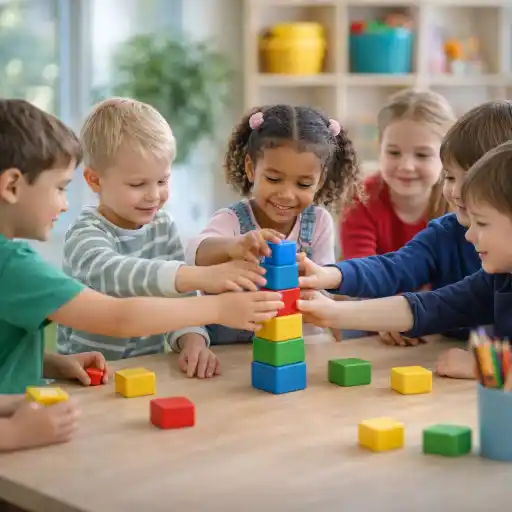
- Appreciation relay: In small groups, children take turns naming one contribution that helped the team complete a challenge, such as building a tower or solving a scavenger-hunt clue. Invite them to describe the action, not rank teammates.
- Gratitude detective: Children write or draw a specific appreciation for a peer. An educator reads the notes and the group guesses the action being described; sharing the recipient’s name can be optional.
- Collaborative gratitude mural: Each child adds a picture, word, or symbol representing something that helps the group feel welcome. Discuss how the different parts work together.
- 🎨 Kindness-and-thanks challenge: Invite children to notice a need, offer a kind action, and later reflect on how the action affected the group.
These approaches echo classroom ideas such as gratitude chains, collaborative art, and kindness challenges. For broader choices that include movement, creative work, and group projects, see the practical activity mix in ChildCareEd’s school-age guide linked above.
How can providers adapt activities for different ages and needs?
School-age groups often include children with varied reading, writing, social, and motor skills. Design activities with more than one route to success. A child who finds writing difficult can dictate a message, draw a picture, select a symbol, or partner with an adult. Older children may add a reflection about how a contribution affected the team or propose a new group goal.
Offer meaningful choice in subject and audience. Some children may prefer to appreciate a classroom routine, a shared game, or their own persistence rather than discuss family relationships. Avoid assumptions about children’s home lives, culture, or comfort with public sharing. Invite children to contribute words and examples that reflect their languages and experiences.
- Use short, clear prompts and show an example before beginning.
- Provide partner, small-group, and independent options.
- Let children choose whether to read their contribution aloud.
- Use mixed-age peer partnerships only when roles are respectful and voluntary.
- Plan accessible materials, adequate space, and active supervision.
For activity planning, consider children’s interests, abilities, available space, and supervision needs. ChildCareEd’s guide to engaging school-age activities also recommends layered challenges and visual steps that help children join in at different levels.
How can programs keep gratitude practices meaningful over time?
Consistency matters more than elaborate materials. Repeat a brief routine weekly or a few times each week, and rotate between discussion, movement, art, and cooperative challenges. Connect the activity to real moments children experienced: a helpful cleanup, a welcoming invitation to play, or a teammate who listened carefully.
Focus recognition on actions and their impact rather than popularity, prizes, or “best” kindness. Instead of singling out a fixed group of children, notice a range of contributions: asking for help, including someone, sharing ideas, and repairing a disagreement. This helps gratitude strengthen a shared sense of belonging rather than become a competition.
Common pitfalls are easy to avoid with a little planning:
- Forcing participation: Offer a pass, private response, or alternative prompt.
- Making appreciation generic: Ask children to name the specific action and how it helped.
- Rewarding only visible gestures: Recognize quiet, practical contributions as well as public acts.
- Using the activity only for a holiday: Build short, inclusive practices into ordinary program routines.
Track participation informally through brief observations: Are children noticing peers’ efforts, offering help, or using appreciative language? Use what you observe to adjust prompts and supports—not to grade children’s feelings. State requirements vary - check your state licensing agency when program policies or activity procedures raise compliance questions.
Conclusion: What should providers remember about gratitude activities?
Gratitude activities are most useful when they help children notice real people, actions, and shared experiences. Specific adult modeling, inviting rather than forced reflection, and inclusive choices make participation more authentic. Activities such as a team gratitude chain, appreciation relay, peer notes, and collaborative mural offer children practical ways to connect thankfulness with kindness and cooperation.
Start small: choose one activity, explain the purpose in child-friendly language, and make speaking optional. Notice whether children begin to recognize helpful actions and include one another more often, then adapt the routine to their interests and needs. With steady practice, appreciation can become part of the everyday teamwork that makes a school-age program feel welcoming.
Additional ChildCareEd courses for providers:
- 45 Hour Child Growth and Development
- 45 Hour Preschool Methods and Materials
- What Makes Me Special: An Overview of Autism and ADHD
- 45-Hour School Age Curriculum
- 45 Hour Infant and Toddler Methods and Materials
- 45 Hour School Age Methods and Materials
- Connections That Count: Building Relationships in Child Care
- Gift of Gratitude: Fostering Emotional Intelligence in Children through Acts of Kindness
- CDA Certification en Español: Recursos y Consejos para Educadores Bilingües
- 👶 ¿Cuáles son las proporciones y grupos requeridos en Dakota del Norte? 🏫
- Menos Estrés a la Hora de Comer: Rutinas Simples Que Sí Funcionan
- ¡Obtén Tu Certificación de Cuidado Infantil de 90 Horas En Línea!
- Proporciones de Cuidado Infantil y Tamaños de Grupo por Edad en Maryland (Guía Rápida para Centros y Hogares)
- Proporciones de Cuidado Infantil y Tamaños de Grupo por Edad en Nueva Jersey (Guía Rápida para Centros y Hogares)
- Proporciones de Cuidado Infantil y Tamaños de Grupo por Edad en Virginia (Guía Rápida para Centros y Hogares)
- Retraso del Habla en la Guardería: Cómo Pueden Ayudar los Proveedores
- How can rainy day indoor activities help preschoolers learn kindness and cooperation in Georgia?
- Canciones, juegos y preguntas de círculo para niños
- How can childcare providers effectively teach gratitude to young children?
- Mawlid Around the World: How Kids Can Explore Different Traditions and Celebrations
- Labor Day Crafts for School-Age Kids That Go Beyond Coloring Pages
- How Can Cooperative Play Help Young Children Learn Gratitude?
- How Can You Plan a November Preschool Curriculum Around Gratitude and Community?
- How Can Gratitude Activities Teach Kindness and Positive Behavior?
- How Can Gratitude Activities Build Kindness and Teamwork in School-Age Children?
- How Can November Activities Help Children Learn to Work Together Inclusively?
