Kindergarten readiness is more than knowing letters and numbers: children also need to build relationships, communicate feelings, and participate in a group. Thoughtful gratitude activities give providers a practical way to nurture these social-emotional foundations; explore Opportunity for Growth: Emotional Development  Buy Now $16.00 for focused learning about the developmental roots of empathy and social skills. For a broader look at supporting readiness, Are They Ready for Kindergarten? Buy Now $35.00 offers training on cognitive, physical, and social-emotional skills that matter as children approach school.
Why does gratitude matter for kindergarten readiness?
Gratitude is not simply a polite phrase. For young children, it can involve noticing that another person helped, identifying how that felt, and responding in a way that supports connection. These skills overlap with the social-emotional capacities children use in kindergarten: listening, communicating needs, cooperating, and navigating everyday interactions.
Readiness is holistic. NAEYC’s Developmentally Appropriate Practice framework emphasizes learning grounded in child development and effective educational practice. Gratitude activities can complement this approach when they are playful, concrete, and responsive to children’s varied developmental levels—not treated as a test of character or a substitute for other learning experiences.
Consistent reflection also gives children practice naming experiences and feelings. A brief question such as “Who helped you today?” can prompt conversation, perspective-taking, and a stronger sense of belonging. The goal is not to make children feel thankful on command; it is to help them notice caring actions and express appreciation in ways that feel authentic.
That supportive foundation can help children feel more connected to classmates and adults as they enter new learning communities. Providers already create many of the conditions gratitude needs: warm relationships, predictable routines, and opportunities to contribute.
How can educators explain gratitude in a developmentally appropriate way?
Kindergarten-age children are developing the language and perspective-taking skills to understand that others make choices and efforts on their behalf. Keep explanations simple and grounded in events children have experienced. For example: “Gratitude means noticing something kind or helpful and showing that it matters to you.” Then connect the idea to a real moment: “Jordan held the door while you carried the books. What did you notice?”
Children will express appreciation differently. One child may say “thank you,” another may draw a picture, and another may point, sign, or share a word in a home language. Accepting these varied responses helps keep the practice inclusive and meaningful. Guidance on teaching young children describes gratitude as something that develops through warm relationships, adult modeling, and everyday opportunities, rather than through a single lesson (teaching gratitude to young children).
- Model specific appreciation: “I appreciate that you passed the crayons so everyone could use them.”
- Ask concrete prompts: “What was something helpful a friend did today?” or “What made you feel welcome?”
- Offer choice: children can speak, draw, gesture, dictate a message, or simply listen.
- Notice effort and relationships, not only gifts or possessions.
Children are still learning how to manage feelings and take another person’s perspective. If a child is not ready to respond, stay warm and matter-of-fact. Gentle modeling and repeated opportunities are more helpful than requiring a public performance.
Which gratitude activities build skills children use in kindergarten?
Choose short, hands-on activities that invite children to notice people, actions, and experiences. Keep materials accessible and let children contribute in different ways. A shared activity can also weave gratitude into communication, early writing, art, and cooperation.
- Thankfulness tree: Children draw or dictate one thing they appreciate on a paper leaf. Add leaves over several days and revisit the display together.
- Class gratitude book: Each child creates a page about a helpful person, a favorite classroom moment, or something that makes them feel cared for. Teachers can write down children’s words.
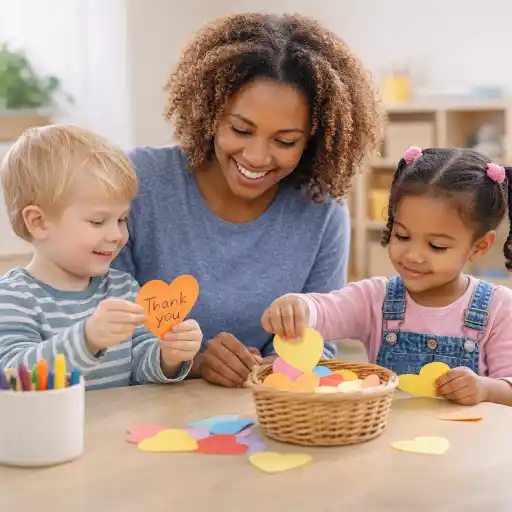
- Kindness and thanks cards: Invite children to make a card for a classmate, staff member, or family member, with drawing, dictated language, or early writing.
- Helper reflection: After a classroom job, ask, “How did our helper contribute to the group?” Let children take turns noticing one another’s efforts.
- 😊 Gratefuls and grumbles circle: Invite children to share one good moment and one challenging moment, while making passing an option. This acknowledges that gratitude and hard feelings can exist together.
These activities can support early literacy and fine-motor practice, but avoid turning the experience into a worksheet or a finished-product contest. Process matters: children are reflecting, making choices, listening, and building a classroom community. For a hands-on project example, see ChildCareEd’s Thankfulness Tree activity.
How can gratitude become part of daily classroom routines?
Small, predictable moments are easier to sustain than elaborate seasonal projects. Add a brief reflection to arrival, snack, circle time, or dismissal. For example, during closing circle ask, “What is one thing someone did that helped our group today?” The question can be answered with words, pictures, a gesture, or a pass.
Adults’ language is a powerful teaching tool. Narrate what you appreciate and why: “I’m glad you waited while Mia finished speaking. That helped her share her idea.” Specific examples show children how actions affect others. They also help staff reinforce social skills without relying on vague praise or external rewards.
Use visual and routine supports to make participation easy. A gratitude jar can hold children’s drawings or dictated notes; a class book can be revisited during reading time; a helper chart can prompt conversation about shared contributions. Keep activities brief, flexible, and voluntary. If a child is upset, tired, or reluctant, acknowledge that experience rather than insisting on a positive answer.
Consistency matters more than complexity. A two-minute routine repeated across the week provides repeated chances to notice and communicate appreciation. Educators can share simple scripts during staff meetings so that children hear respectful, consistent language from the adults around them.
How can programs make gratitude practices inclusive and family-connected?
Families may express appreciation in different languages, traditions, and ways. Ask caregivers what language or practices feel familiar to their child, and avoid assuming that every family celebrates the same holidays or shares the same customs. Keep classroom activities focused on broadly accessible experiences—help, care, friendship, belonging, and community—rather than tying gratitude to one cultural or religious event.
Offer multiple routes for participation. Children can name a person, place, routine, pet, or experience; a child who does not want to discuss family can choose something from the classroom or natural world. Make sure the activity does not require families to buy supplies, attend an event, or share personal information. When sending projects home, explain the purpose simply and invite, rather than require, a family response.
- Share a short note describing the activity and its social-emotional purpose.
- Invite families to contribute a word for appreciation in a home language, if they wish.
- Offer an at-home prompt that takes little time, such as “Who helped you today?”
- Respect privacy when displaying children’s work or photographs; follow program policy and family permissions.
Family partnership helps educators understand what children value and how they communicate. It can also help children experience continuity between home and care settings. When planning family projects or community collections, state requirements vary - check your state licensing agency and program policies.
What common pitfalls should providers avoid?
Gratitude activities are most effective when they preserve children’s agency and emotional honesty. A child who does not want to say thank you in front of a group is not necessarily ungrateful. They may need time, a different communication method, or a quieter setting. Adults can model appreciation without demanding that children copy a particular response.
- Forcing a response: Avoid pressuring children to say a scripted phrase or share publicly. Offer choices and model gently.
- Making it a one-time event: A holiday craft alone is unlikely to establish a lasting routine. Build brief moments into ordinary days.
- Focusing only on possessions: Include people, effort, relationships, nature, and shared experiences.
- Using gratitude to dismiss hard feelings: Do not respond to distress with “You should be grateful.” Listen first; appreciation does not erase disappointment or need.
- Assuming every child has the same family or cultural context: Use open-ended language and let children choose what they want to share.
Progress does not require a formal score. Observe whether children increasingly notice helpful actions, use appreciation language or gestures, listen to peers, and participate in cooperative routines. Share observations with colleagues and families as examples of emerging skills, not as judgments about a child’s character.
Conclusion: How can gratitude activities strengthen readiness?
Gratitude activities can support kindergarten readiness by giving children repeated, approachable practice in noticing others, communicating feelings, and contributing to a group. Their value lies not in getting every child to say the right words, but in creating a caring environment where appreciation can grow through relationships, routines, play, and choice.
Start with one small step: model a specific thank-you during a routine, invite children to add a leaf to a class gratitude tree, or include a voluntary reflection at closing circle. Offer different ways to participate, honor family and cultural differences, and make room for difficult feelings alongside positive ones. These practical habits help providers nurture the social-emotional foundations children draw on as they move toward kindergarten.
For a deeper professional learning experience, explore Social Foundations and Responsive Classrooms Buy Now $24.00, focused on relationships, self-regulation, and social competence, or Open Heart, Open Art Buy Now $16.00 to learn how open-ended art can support children’s emotional expression. Choose training that fits your team’s learning goals and verify any training-hour requirements with your licensing agency.
- CDA Subject Area 3
- CDA Home Visitor Subject Area 3 Part 3 Birth to 5
- Reading Aloud and Storytelling
- Roots & Resilience: Understanding What Shapes a Child
- Social Foundations and Responsive Classrooms
- From Play to Planning: Building Culturally Competent, Child-Centered Curriculum
- Are They Ready for Kindergarten?
- Connections That Count: Building Relationships in Child Care
- Letter & Number Planning in Child Care
- Supporting Children's Independence
- CDA Certification en Español: Recursos y Consejos para Educadores Bilingües
- Ready, Set, Kindergarten!
- 🔍 ¿Qué ves cuando observas a un niño aprender?
- 💛🧩 ¿Cómo puedo hacer que mi enseñanza sea inclusiva para los niños con autismo?
- Cómo Celebrar el Día Nacional del Kindergarten
- Temas y Actividades para el Día Nacional del Kindergarten para Proveedores
- How can we prepare preschoolers for kindergarten success?
- What Kindergarten Readiness Skills Should My Program Build?
- How can child care programs build strong readers before kindergarten?
- Is Your Child Ready for Kindergarten? A Kindergarten Readiness Checklist
- Snip, Stick, Celebrate! What Easy Labor Day Crafts Can Toddlers Make?
- Is My Preschooler Ready for Kindergarten? Milestones Beyond ABCs and 123s
- How Can Child Care Programs Build Meaningful School Readiness?
- How Can Child Care Programs Build Meaningful Kindergarten Readiness?
- How Can Teachers Support Children Starting Kindergarten This Fall?
- What Should a 5-Year-Old Know Before Kindergarten?
- How Can Fall Activities Build Kindergarten Readiness Skills?
- How Can Simple Fall Activities Support Kindergarten Readiness Through Play?
- How Can Gratitude Activities Support Kindergarten Readiness?
- How Can November Classroom Activities Help Preschoolers Build School Readiness Skills?
