A Thanksgiving puzzle adventure can build far more than problem-solving: it can help preschoolers practice listening, patience, and noticing how peers contribute—without turning the room into a race. Explore the Lesson Planning for Preschoolers course  Buy Now $24.00 to strengthen your understanding of developmentally appropriate goals and activity design, then use the ideas below to plan a welcoming mystery children solve together.
Why choose a cooperative mystery instead of a contest?
Preschoolers are still learning to wait, manage frustration, share materials, and understand another person’s perspective. A competitive puzzle format can unintentionally make speed or being first seem more important than curiosity and effort. A shared mystery changes the message: each child can contribute, and the group’s progress depends on listening and working together.
Collaborative problem-solving offers meaningful practice in language, reasoning, persistence, and social-emotional learning. Children may compare picture clues, explain what they notice, test an idea, or ask a peer for help. The adult’s role is not to solve the puzzle for them, but to make the challenge accessible and keep the group’s purpose clear.
A Thanksgiving theme can connect this shared work to appreciation and helpfulness without requiring children to perform a scripted expression of gratitude. The ChildCareEd resource Harvest Treasure Adventure: Thanksgiving Puzzle Stations and Gratitude Activity Buy Now $2.00 offers three independent puzzle stations, clue cards, tokens, and a treasure chest board. Its shared message—“We are grateful when we help one another!”—makes cooperation part of the activity’s story.
How do you plan stations with clear goals and flexible participation?
Start with one or two learning intentions rather than trying to teach everything at once. A station might invite children to compare picture clues, describe a strategy, match images, or contribute to a common solution. Planning with a specific intention and room for flexibility is consistent with guidance in lesson planning for preschoolers.
Prepare three compact stations, each with a distinct challenge and shared outcome. For example, children might solve a picture-clue mystery, match harvest images, and assemble a simple group puzzle. Include a visual direction card, a small set of materials, and a way for children to show what they notice. Keep the tasks brief enough to sustain engagement, while allowing children to revisit a station if they need more time.
- Choose a shared goal: “Let’s discover the clues and open the class treasure chest.”
- Define a few roles children can choose or rotate: clue-noticer, piece-finder, idea-sharer, or materials helper.
- Provide ways to participate through speech, pointing, signs, home-language words, drawing, or placing a piece.
- Use picture cues and demonstrate one example before children begin.
Think of the stations as invitations, not tests. The purpose is to make meaningful #problem-solving possible through play, with varied routes to success.
How can educators guide children without taking over?
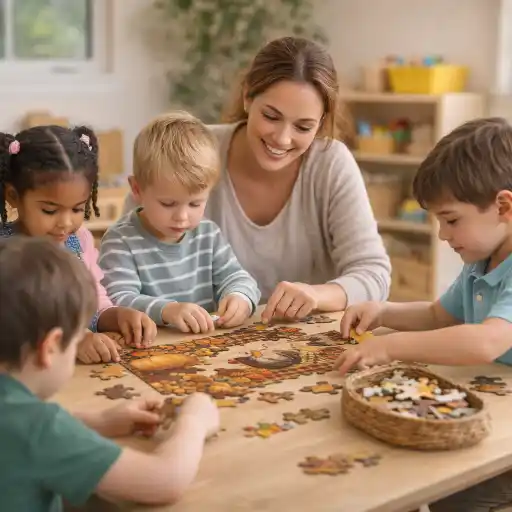
Before the activity, tell the story in a few sentences: a mystery needs solving, and the class will gather clues together. Model how to look carefully and think aloud—“This picture has a leaf. I wonder which card shows the same shape”—then pause so children can contribute. Open questions such as “What do you notice?” and “What could we try next?” invite reasoning without giving away the answer.
During play, observe who is participating, who may need more time, and whether the materials or directions are creating an unnecessary barrier. If children disagree, describe what you see and reframe the moment around the group’s shared goal: “You both have an idea. How can we check which clue fits?” This kind of guidance supports children’s own thinking and peer communication. ChildCareEd’s article on teaching problem-solving skills to young children similarly emphasizes modeling, open-ended prompts, and opportunities for trial and error.
Offer just enough support to keep the challenge manageable. You might reduce the number of choices, place a sample beside the puzzle, or invite a peer to explain their thinking. Avoid praise that ranks children by speed or correctness. Instead, name observable efforts: “You checked the picture again,” or “You listened to your friend’s idea and tried it.” Those comments build #cooperation and help children notice learning behaviors.
How can the activity welcome different abilities, cultures, and family experiences?
Inclusive planning begins by offering multiple ways to understand and respond. Some children may use words; others may point, gesture, communicate with pictures, or watch before joining. Use large, easy-to-handle pieces when helpful, reduce visual clutter, and allow children to work with a partner or educator. A child can be a thoughtful participant without completing every step independently or speaking in front of a group.
Make the station story warm and flexible rather than assuming that all families celebrate Thanksgiving in the same way. Keep attention on helping, noticing good things, and building classroom community. Invite family contributions only as optional possibilities, and avoid asking any child to speak for a culture or tradition.
Gratitude should not become a demand to feel happy or say a particular phrase. Children can communicate appreciation in different ways, and they can also have other feelings. Consider closing with an open invitation: “Did someone help you during the mystery?” Children may answer, draw, point to a classmate, or pass. For additional context, see ChildCareEd’s guidance on age-appropriate ways to teach gratitude.
For another professional-learning option, the English-language From Play to Planning: Building Culturally Competent, Child-Centered Curriculum Buy Now $55.00 course explores play, problem-solving, scaffolding, and inclusive curriculum planning.
What common pitfalls can you prevent before the mystery begins?
Even a fun seasonal activity can become stressful if it moves too quickly or puts children on display. A brief planning check helps the experience stay playful and genuinely collaborative. The goal is not a perfectly quiet group or a single correct performance; it is a chance to practice thinking together in a supportive setting.
- ❌ Turning it into a race: Avoid timers, winner labels, or rewards for finishing first. Celebrate shared discoveries and persistence instead.
- Giving too many directions at once: Break instructions into short steps, show the first action, and keep picture cues visible.
- Letting one child dominate: Offer rotating roles and invite quieter children to contribute in their preferred way.
- Correcting too quickly: Give children a moment to test ideas, compare clues, and revise their thinking before stepping in.
- Equating gratitude with compliance: Model appreciation but do not require a child to say thank you, share publicly, or appear cheerful.
Watch for signs of fatigue or frustration. A child who steps away may need a break, a simpler entry point, or another way to join. Keep small pieces appropriate for the children’s ages and supervise closely. State requirements vary - check your state licensing agency.
Afterward, reflect briefly with staff: Which prompts encouraged children to collaborate? Which station was too easy, too hard, or hard to access? A few notes can help you adapt the next #activity without adding a burdensome documentation task.
How can you close the mystery and carry the learning forward?
Bring the groups together when the stations are complete, or when children have had a fair chance to explore. Invite them to place their tokens on the shared board or reveal the treasure message as a class. The ending should recognize the process: children looked closely, shared ideas, tried possibilities, and helped one another. That collective accomplishment gives the mystery its meaning, whether or not every child solved every clue.
Use a short reflection to make the learning visible. Ask, “What clue helped us?” “What did someone else notice?” or “What did you do when a puzzle felt tricky?” Accept spoken responses, gestures, drawings, or quiet observation. Children’s answers can inform future small-group activities and help educators notice emerging communication, reasoning, and peer skills.
Extend the theme with a gratitude picture, a class-made clue, or a new puzzle inspired by children’s ideas. The Great Harvest Mystery printable logic puzzle cards and mats Buy Now $2.00 is another fall resource with picture-clue mysteries and teacher prompts for comparing choices and explaining reasoning. Keep any follow-up child-centered: repeat a favorite challenge, adjust its complexity, or invite children to invent a clue for classmates to solve.
Conclusion: What makes Thanksgiving puzzle stations truly cooperative?
A cooperative Thanksgiving mystery is built around a shared purpose, accessible choices, thoughtful adult support, and a celebration of effort rather than speed. Plan a few clear stations, model curiosity, make room for different ways to contribute, and let preschoolers test ideas together. When children discover that listening and helping move the group forward, the puzzle becomes a practical experience in community as well as problem-solving.
With intentional planning, the activity can support reasoning, communication, persistence, and appreciation without forcing competition or a holiday script. Consider the Lesson Planning for Preschoolers course Buy Now $24.00 for a deeper learning experience on setting goals and making activities developmentally appropriate. Then bring the mystery to life with flexible stations where every child’s contribution counts.
Additional English-language ChildCareEd courses:
- Turning Behavior Around for Toddlers and Preschoolers
- What Makes Me Special: An Overview of Autism and ADHD
- The ABCs of Behavior: Turning Challenges into Learning Opportunities
- CDA Bridge Bundle: Preschool
- Pediatric RSV First Aid & CPR/AED
- CDA Bridge Bundle: Preschool without Portfolio Review
- Building Equity: Inclusionary Practices in Preschool
- Mysteries of Challenging Behavior Solved
- Lesson Planning for Preschoolers
- Texas Director Credential
- CDA Certification en Español: Recursos y Consejos para Educadores Bilingües
- 💛🧩 ¿Cómo puedo hacer que mi enseñanza sea inclusiva para los niños con autismo?
- Requisitos Para Ser Maestra Principal En Un Daycare: Lo Que Necesitas Para Empezar
- ¿Cómo afecta la dopamina a los niños: señales, efectos e influencias diarias?
- 10 Ejemplos de Cómo la Cultura Influye en el Desarrollo Infantil
- Proporciones de Cuidado Infantil y Tamaños de Grupo por Edad en Nueva Jersey (Guía Rápida para Centros y Hogares)
- Proporciones de Cuidado Infantil y Tamaños de Grupo por Edad en Virginia (Guía Rápida para Centros y Hogares)
- Cómo Trabajar en el Cuidado Infantil en Carolina del Norte: Requisitos y Pasos
- Cómo Ser Maestra de Preescolar en Illinois
- Cómo Ser Maestra de Preescolar en Maryland
- Celebrando la amistad en el cuidado infantil durante el Día de los Mejores Amigos
- Diversión fresca de verano: actividades del Día Nacional del Helado para niños
- Canciones, juegos y preguntas de círculo para niños
- La mejor manera de hacer seguimiento a la capacitación de su equipo de daycare How to Organize Staff Training for Your Child Care Center Cómo organizar la capacitación del personal para su centro de cuidado infantil
- Cómo simplificar la capacitación para sus empleados de daycare
- What Should You Review Before Sending Home a Thanksgiving Activity?
- How Can Preschool Thanksgiving Activities Avoid Stereotypes?
- Clue or Guess? How Can You Teach School-Age Children to Use Evidence in a Fall Mystery?
- What Disappeared from the Fall Tray? How Can Preschool Detective Games Build Memory?
- How Can Preschool Puzzle Stations Turn a Thanksgiving Mystery into Teamwork?
