Counting can happen while children collect leaves, build a block tower, or pass out snack—not just at a worksheet table. For practical strategies that connect number sense, patterns, and mathematical reasoning with play and routines, explore Early Mathematics Through Play Buy Now $24.00; it can help you strengthen classroom practice with developmentally appropriate ideas. Read on for ten adaptable activities for children ages 3–5, plus ways to make each experience accessible to different learners.
Why does everyday math matter for preschoolers?
For preschoolers, mathematics is not limited to naming numerals or reciting a counting sequence. It also means noticing how many items are present, matching one number word to one object, comparing quantities, sorting by attributes, recognizing patterns, and using position and measurement language. These ideas take shape when children engage with familiar materials and solve real, manageable problems.
For example, children can determine whether there are enough cups for snack, decide which tower is taller, or notice that the class line follows the same routine each day. Educators build understanding by naming the mathematical idea and inviting children to explain, demonstrate, or try a different approach. Short, repeated interactions throughout the day support learning without turning play into a test.
Washington educators can use the Washington State Early Learning and Development Guidelines as a local resource when planning experiences responsive to children’s development. NAEYC also describes how math concepts emerge through play, everyday exploration, and intentional teacher language. The aim is not to rush children toward formal arithmetic; it is to help them see themselves as capable mathematical thinkers.
That shift matters for classroom practice: every child should have a meaningful way to participate, whether by counting aloud, pointing, moving objects, using a communication system, or observing before joining in.
How can teachers make activities hands-on and inclusive?
Begin with materials children can touch, move, compare, and use in more than one way. Keep the learning goal clear, but let children explore and make choices. A three-year-old might count a small set with adult modeling, while a five-year-old could match a numeral to a quantity or explain a sorting rule. These are flexible examples, not fixed expectations for every child.
Use concrete objects before expecting children to interpret written numerals or explain their reasoning verbally. Pair a brief prompt with a demonstration: “Let’s touch one leaf for each number we say.” Then give children time to respond. Familiar materials, gestures, visuals, and home-language vocabulary can make the concept clearer for multilingual learners and children who communicate in different ways.
- Offer a smaller set of objects or begin with quantities of one to three.
- Use large, easy-to-grasp pieces, a tray, or a nonslip surface when motor access is a consideration.
- Invite children to answer by pointing, matching, signing, speaking, or using their communication tools.
- Increase or reduce the challenge by changing the quantity, adding a second sorting feature, or introducing numerals.
Safety is part of planning. Inspect natural materials, supervise collecting, and avoid small loose objects with children who may mouth them. For seasonal inspiration, try ChildCareEd’s Autumn Leaf Math: Sorting, Matching & Pattern Activities Buy Now $0.00 alongside real, safely gathered leaves.
What are ten everyday math activities for ages 3–5?
Use these activities as brief invitations during play and routines. Repeat them with familiar materials so children can revisit ideas and grow their strategies over time.
- Leaf collection and count: On a supervised walk, collect safe, dry leaves. Count a small group together, touching one leaf per number word. Compare which group has more or fewer.
- Sort nature finds: Group leaves, large stones, or twigs by one visible feature, such as color, shape, or size. Invite children to suggest another way to sort. Use only safe items and follow program rules for outdoor collection.
- Build a repeating pattern: Arrange two types of large natural objects or classroom counters in an AB sequence—leaf, stone, leaf, stone. Ask, “What comes next?” Children can copy, continue, or invent a pattern.
- Snack helper counting: Children help count napkins, cups, or portions needed for a meal. For food, follow allergy and choking-safety plans; an adult remains responsible for serving and supervision.
- More, fewer, or the same: Compare two small snack sets or groups of counters. Ask children to explain how they know, then check by matching one item from each group.
- Block tower quantities: Roll a die or choose a numeral card, then build a tower with that many blocks. Count together and compare towers by height.
- Measure a structure: Measure a block bridge or stuffed animal using blocks as informal units. Ask how many blocks long it is, then compare measurements.
- Move and count: Clap, jump, march, or take steps to a landmark while counting each movement. Children can choose a movement or count alongside a partner.
- Classroom-object number hunt: Find a numeral on a calendar, cubby label, or classroom sign, then match it to a group of objects or a dot card.
- Cleanup sorting and counting: Sort toys into their usual containers, count a small group, or check whether each item has a place. Use words such as in, out, more, and empty.
🧱 Try a block challenge: “Can we build a bridge with five blocks? How could we check?” A child may count, point, or place one block at a time; the thinking matters more than speed.
How can routines and play build counting and number recognition?
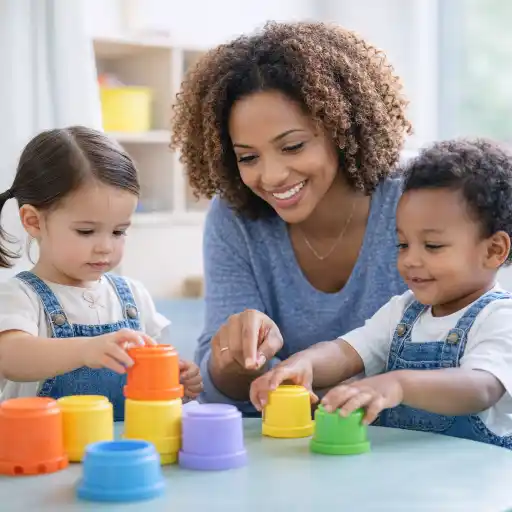
Routines offer repeated, meaningful occasions to connect number words, quantities, and numerals. During arrival, children can count name cards or notice how many classmates are present. At snack, they can help distribute one napkin per place setting. During transitions, count steps, claps, or children waiting in line. Cleanup naturally supports sorting and matching objects to locations.
Introduce number recognition in context rather than as a disconnected drill. Point out a numeral on the daily schedule and connect it to a quantity: “This is the number 4. Can we find four blocks?” Pairing a symbol with objects, fingers, dots, or a movement pattern gives children multiple ways to make sense of the number.
Use conversational math language throughout the day: one more, the same, fewer, next, behind, taller, and full. Ask questions that invite thinking, such as “What do you notice?” or “How could we find out?” If a child loses track while counting, model pointing to one item at a time and offer to count together. Avoid making every interaction a quiz; notice children’s ideas and extend them gently.
For more ways to make play intentional and engaging, educators can explore No Such Thing as Boring Math  Buy Now $24.00. The course focuses on developmentally informed, playful approaches to early mathematics.
How can educators adapt activities and observe progress?
Adapt the activity to the child, not the child to a single activity format. One child may be ready to count a set independently; another may take part by matching, pointing, moving one object at a time, or watching a model before trying. Participation in mathematical thinking does not depend on speaking or writing numerals.
- For children building early number concepts: Start with one to three objects, model touching each once, and repeat the final total.
- For children ready for more complexity: Ask them to match quantities to numerals, compare two sets, create a pattern, or solve a “one more” problem with objects.
- For motor or sensory access: Offer larger pieces, a scoop, a tray, visual choices, or a quieter workspace; follow each child’s support plan.
- For multilingual learners: Use objects, pictures, gestures, repeated key words, and family-provided words when available. Children can show mathematical understanding while developing English.
- For children who benefit from peer interaction: Pair them with a supportive partner and make turn-taking roles clear.
Observe the strategy, not only whether the answer is correct. A concise note might say, “During cleanup, Jordan sorted vehicles by type and counted four cars, touching each once.” That record can guide your next step: offer a second sorting attribute or compare the car group with another set. Photographs of a child’s pattern or construction, paired with their words or gestures, can also document thinking.
Keep materials safe, accessible, and culturally familiar. State requirements vary - check your state licensing agency when determining program requirements or training expectations.
Conclusion: How can counting become part of every day?
Washington preschool educators do not need a worksheet for every math goal. Counting, sorting, patterns, and number recognition can grow from the natural materials, snack routines, blocks, movement, and classroom objects children already encounter. The most effective moments are playful and intentional: offer a clear invitation, use concrete materials, name the math, and give children several ways to respond.
Choose one activity to try this week, then repeat it with small adjustments. Notice whether children count objects one at a time, compare groups, recognize a numeral, or create a pattern. Use those observations to plan a manageable next challenge and to make sure every child can participate meaningfully.
For a deeper professional learning experience, Early Mathematics Through Play Buy Now $24.00 offers strategies spanning counting, number sense, patterns, geometry, measurement, and reasoning. To extend playful exploration, consider No Such Thing as Boring Math Buy Now $24.00. Small, joyful math moments—repeated across the day—help children build understanding and confidence without making learning feel like a worksheet task.
Related ChildCareEd courses:
- Early Mathematics Through Play
- From Play to Planning: Building Culturally Competent, Child-Centered Curriculum
- 45 Hour Preschool Methods and Materials
- What Makes Me Special: An Overview of Autism and ADHD
- CDA Bridge Bundle: Family Child Care without Portfolio Review
- Art from the Heart for Preschoolers: Open Ended Art Projects that Build Self-Esteem
- CDA Bridge Bundle: Preschool without Portfolio Review
- Building Equity: Inclusionary Practices in Preschool
- Connections That Count: Building Relationships in Child Care
- Texas Director Credential
- CDA Certification en Español: Recursos y Consejos para Educadores Bilingües
- Requisitos Para Ser Maestra Principal En Un Daycare: Lo Que Necesitas Para Empezar
- Cómo Trabajar en el Cuidado Infantil en Carolina del Norte: Requisitos y Pasos
- Cómo Ser Maestra de Preescolar en Illinois
- Cómo Ser Maestra de Preescolar en California
- Cómo Ser Maestra de Preescolar en Maryland
- Celebrando la amistad en el cuidado infantil durante el Día de los Mejores Amigos
- How Can I Use Fun Math Activities for Preschoolers Every Day?
- How can I use simple math activities for preschoolers every day?
- How Can Washington After-School Providers Support Homework, Social Skills, and Family Stability?
- Washington Child Care Ratios and Group Sizes by Age: Home Daycare Guide
- How can preschool classrooms effectively support early math skills?
- How Can Preschool Math Become Meaningful, Playful, and Part of Every Day?
- How Can Printable Activities Save Teachers Hours of Prep Time?
- What Makes a Preschool Curriculum Meaningful, Inclusive, and Effective?
- How Can Child Care Providers Integrate Counting into Seasonal Art Activities?
- How Can Preschool Teachers Build Number Sense Before Introducing Worksheets?
- How Can Preschool Programs Prepare Children for Kindergarten Without Pushing Academics Too Early?
- How Can Washington Preschool Teachers Document Children’s Development Without Extra Stress?
- How Can Washington Preschool Educators Teach Counting Without Worksheets?
