Fall can bring lively classroom discoveries, but not every family celebrates the same holidays—or celebrates them in the same way. The Bridging Cultures: Family Communication & Collaboration  Buy Now
$55.00$42.00 course can strengthen your culturally responsive listening and partnership skills, while Family Voices Matter: Tools for Meaningful Collaboration Buy Now $55.00 offers further strategies for using family input thoughtfully. Read on for practical ways to shape a welcoming autumn with choice, respect, and room for every child’s experience.
Why does a sense of belonging matter in fall planning?
Seasonal activities communicate whose lives and stories are welcome in the classroom. When a program assumes every child celebrates a particular holiday, enjoys the same customs, or wants to talk about home in a group, some children may feel overlooked or put on the spot. A belonging-centered approach recognizes that families’ observances and preferences differ, including among families who share a cultural or religious identity.
Children benefit when educators make participation welcoming without making it compulsory. They can notice changing leaves, explore seasonal weather, create art, or listen to a story without being asked to celebrate a holiday or explain a family tradition. Family knowledge can enrich these experiences, but it should guide planning only in ways families choose.
NAEYC’s guidance on holidays in a diverse world distinguishes learning about a holiday from treating the whole class as celebrants. That distinction helps providers make intentional decisions about curriculum and representation.
- Ask families before centering a holiday or custom.
- Make sharing, attendance, and contributions optional.
- Offer different ways to join, observe, or pass without judgment.
How can you invite family perspectives without pressure?
Start with a brief explanation: you are learning what families would like you to know so autumn experiences feel welcoming and comfortable for their children. Use open-ended, neutral questions about each family’s preferences rather than assumptions based on a child’s name, appearance, language, or background. A questionnaire or planning map can make the invitation consistent, but it should be an opening for dialogue—not a test or permission slip.
The Family Fall Traditions Questionnaire and Planning Map can help providers organize optional family input and translate it into practical decisions. Keep responses voluntary, explain who will see them and how they will be used, and allow families to skip any question. When feasible, offer paper, digital, and private-conversation options, as well as communication in the family’s preferred language or format.
Try prompts such as:
- “Are there seasonal routines, stories, or activities you would like us to know about?”
- “Are there themes or activities you would prefer us to adapt or avoid?”
- “What helps your child feel comfortable when classroom routines change?”
- “How would you prefer to share an idea—with a note, conversation, or another method?”
A family’s response—or choice not to respond—should not determine a child’s access to classroom learning. Treat information as a starting point, protect privacy, and ask permission before displaying a family story, photograph, or object. A child or caregiver should never be expected to represent an entire community.
How can you design seasonal learning that includes different experiences?
Build autumn learning around topics with many possible entry points: leaves, weather, seeds, neighborhood changes, nature, friendship, and community. These themes invite inquiry without implying that every household observes the same holiday. A class might compare leaf shapes, chart the weather, make a collaborative mural, or listen to stories about how people spend time together.
Offer multiple roles so children can participate according to their interests and comfort. During a leaf investigation, a child might observe, sort picture cards, draw, listen, point, or explore real leaves using a tool. Families may optionally suggest a book, share a seasonal word, or describe an outdoor routine. If they do, identify it as that family’s perspective rather than a universal practice.
Use language that makes difference ordinary and respectful: “Families have different traditions,” “Some families enjoy this,” and “Would you like to share, listen, or pass?” Representation is strongest when it appears across the year in books, play materials, classroom conversations, and everyday relationships—not only on a seasonal display.
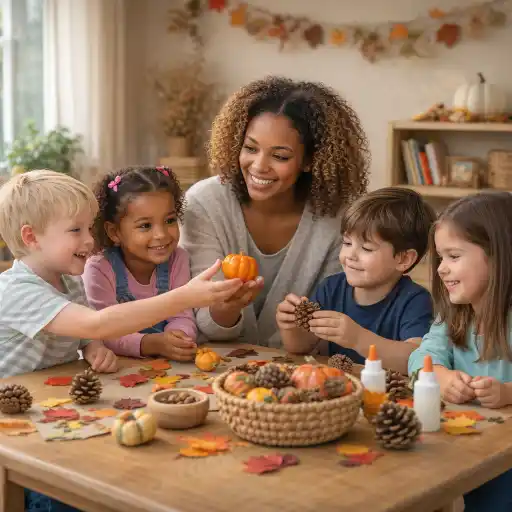
- Choose open-ended experiences that do not require personal disclosure.
- Use family contributions only with clear permission and accurate context.
- Represent many family structures, languages, and experiences in ordinary classroom life.
- 🍂 Invite children to add drawings or observations to a “What do we notice outside?” board.
How can you make autumn activities accessible and comfortable?
Inclusive planning considers culture, sensory preferences, developmental stages, communication, and physical access. Fall activities may include crunchy textures, strong smells, busy gatherings, outdoor noise, or unfamiliar routines. Children respond differently; hesitation is not evidence of disinterest or a lack of pride. Keep the learning goal while adjusting the space, materials, pace, or steps.
A useful planning lens is “space, materials, and steps.” A quieter corner or smaller group may make the space more comfortable. Picture choices, larger tools, or a tray within reach can adapt materials. Demonstrating one action at a time, previewing a visual schedule, and allowing extra processing time can clarify the steps. Children may communicate with words, gestures, home languages, signs, communication devices, or attentive observation.
Choice supports agency: a child can watch first, take a short turn, direct an adult, or return later. Make a calm area available as a regular option rather than a consequence. If a family shares a comfort or access need, use that information in coordination with the child’s care plan and program procedures.
- Preview unfamiliar activities with photos, objects, or a visual sequence.
- Make touching, tasting, speaking publicly, and bringing items from home optional.
- Provide accessible tools and more than one way to communicate or respond.
- For food activities, review documented allergy and medical plans and follow safety procedures.
State requirements vary - check your state licensing agency, especially for food, supervision, and health and safety practices.
What common pitfalls should providers avoid?
Good intentions do not automatically prevent children from feeling singled out. Avoid treating a familiar holiday as universal, asking a child to explain “their culture,” or asking a caregiver to teach the class about an entire group. Do not infer family beliefs from identity markers. Instead, invite individual families to share only what they wish and describe contributions specifically as their own experiences.
Another pitfall is making participation depend on time, money, or disclosure. Families should not have to bring food, buy supplies, attend an event, provide photographs, or share private information for their child to participate. Provide program materials and equivalent alternatives. If food is included, follow program procedures for allergies, medical plans, preparation, and cross-contact; tasting should never be required.
A one-time “culture day” or display cannot represent the full range of family lives. Keep representation ongoing, and respond to concerns with listening and a willingness to adjust. If a family declines an invitation or does not reply, leave the door open without judgment.
- Instead of “Everyone celebrates this,” say, “Families mark the season in different ways.”
- Instead of “Tell us what your culture does,” ask, “Is there anything your family would like us to know?”
- Instead of requiring one shared project, offer varied materials, roles, and ways to participate.
How can your team reflect and improve its approach?
Inclusive planning is a continuing cycle of listening, trying, observing, and adjusting—not a questionnaire completed once each fall. After an activity, staff can reflect on who chose to participate, what communication methods children used, and whether any part of the experience created an avoidable barrier. Keep notes factual and strengths-based: “Picture choices helped children share observations,” rather than guessing why a child declined.
Invite feedback through communication methods families already use. A short follow-up might ask, “What felt welcoming for your child?” or “What would you suggest for next time?” Thank families and, when appropriate, explain how their ideas informed plans. Small changes—clearer previews, shorter activity windows, or a quieter option—can improve the next experience.
Directors can support consistent practice by reviewing seasonal invitations, privacy expectations, language access, and participation choices with staff. The ChildCareEd guide to planning fall activities without assumptions offers additional ideas for applying family input respectfully.
Conclusion: How can fall planning help every family feel they belong?
Providers can create a season of belonging by asking families what they want to share, keeping participation voluntary, and building learning around flexible seasonal themes. Children should be able to explore, talk, observe, create, or pass without being asked to celebrate a holiday or serve as a spokesperson. Family perspectives can guide meaningful planning while privacy, choice, and individual differences remain central.
Use the Family Fall Traditions Questionnaire and Planning Map as a practical starting point, then revisit your approach with families and staff. The goal is not for every family to celebrate in the same way; it is for every child to experience respect, welcome, and meaningful access to classroom life.
Five relevant ChildCareEd courses
- Bridging Cultures: Family Communication & Collaboration Buy Now
$55.00$42.00 - Family Voices Matter: Tools for Meaningful Collaboration Buy Now $55.00
- Family Connections: Creating Inclusive Relationships Buy Now $55.00
- Building Bridges for Dual Language Learners Buy Now $16.00
- Cultures in the Classroom Buy Now $24.00
- Building Bridges for Dual Language Learners
- Building Bridges for Dual Language Learners: For Workforce Solutions
- What Makes Me Special: An Overview of Autism and ADHD
- Family Connections: Creating Inclusive Relationships
- CDA Bridge Bundle: Family Child Care
- CDA Bridge Bundle: Family Child Care without Portfolio Review
- Texas Director Credential
- Building Bridges for Dual Language Learners
- Bridging Cultures: Family Communication & Collaboration
- IEPs and IFSPs in Family Child Care
- Capacitación en Salud y Seguridad Preventiva en Línea para Proveedores de Cuidado Infantil
- Regulaciones de Licenciamiento de Cuidado Infantil en California para Centros y Hogares de Cuidado Infantil Familiar
- Proporciones de Cuidado Infantil y Tamaños de Grupo por Edad en Maryland (Guía Rápida para Centros y Hogares)
- Proporciones de Cuidado Infantil y Tamaños de Grupo por Edad en Virginia (Guía Rápida para Centros y Hogares)
- Lista para Abrir una Guardería en Casa en Georgia: Cómo Empezar
- Lista para Guardería en Casa en Texas: Cómo Iniciar una Guardería en el Hogar
- Capacitación CDA gratuita en Illinois
- Celebrando la amistad en el cuidado infantil durante el Día de los Mejores Amigos
- Cómo simplificar la capacitación para sus empleados de daycare
- How Can Child Care Providers Celebrate Fall Without Assuming Every Family Shares the Same Traditions?
- How Can You Create a Fall Story Basket That Reflects Every Family in Your Classroom?
- How Can Warm-Climate Child Care Programs Make Fall a Season of Discovery?
- How Can Fall Read-Alouds Reflect the Lives of All Children?
- How Can Child Care Providers Plan a Fall Season Where Every Family Belongs?
- How Can Fall Classroom Requests Welcome Every Family—not Just Those Who Bring a Pumpkin?
- How Can Families Share Fall Discoveries at Home Without Homework?
- How Can You Safely Decorate a Child Care Classroom for Fall at Children’s Height?
- How Can Preschool Classrooms Simplify Fall Learning Centers Without Losing the Joy of Play?
- How Can You Plan Fall Celebrations Every Child Can Follow, Including Children With Different Hearing Needs?
- How Can Child Care Programs Celebrate the Quiet Helpers During a Busy Fall Season?
