When work schedules, transportation, or caregiving responsibilities keep parents away from a fall event, they should still have a meaningful way to connect with their child’s learning. A flexible plan can turn one classroom celebration into an invitation families can join on their own time; Building a Community of Families  Buy Now $16.00 offers further strategies for developing lasting partnerships and welcoming family contributions in different ways. Read on for a practical event plan—and explore Families, Communities, and Classrooms: Working Together for Children Buy Now $55.00 for additional ideas on making family knowledge visible even when caregivers cannot be physically present.
For more focused professional learning, consider Bridging Cultures: Family Communication & Collaboration Buy Now $55.00, Family Voices Matter: Tools for Meaningful Collaboration Buy Now $55.00, and Family Connections: Creating Inclusive Relationships Buy Now $55.00. These courses support practical skills for two-way communication, respectful collaboration, and inclusive family partnerships.
Why should a fall family event include options beyond attending in person?
A family event can create joyful connections, but a single date and time will not work for everyone. Caregivers may be working, caring for other children, managing transportation challenges, or simply unable to leave home. Treating attendance as the main measure of engagement can unintentionally make committed families feel excluded.
Instead, design the event so participation is possible before, during, and after the gathering. NAEYC’s guidance on reciprocal partnerships with families emphasizes regular two-way communication, respect for family preferences, and multiple opportunities to participate. Head Start similarly describes engagement as shared, strengths-based work with families—not something educators do to or for them (PFCE Framework).
This shift matters because family knowledge is valuable whether it arrives in person, in a note, or through a child’s story. A flexible fall event can:
- Help children connect classroom experiences with their #family lives and interests.
- Invite caregivers to contribute without requiring time off, travel, or purchases.
- Give educators a broader understanding of children’s strengths, languages, and routines.
The goal is not to recreate the same event in several formats. It is to offer genuine choice and make clear that every family’s perspective matters.
How can you design one fall event with several ways to participate?
Start with one simple theme—such as “Noticing Autumn”—and build a shared activity that children can explore at the center and at home. Keep the materials accessible and the invitation brief. A fall nature investigation, for example, can include sorting leaves, observing seasonal changes, sharing a favorite outdoor memory, or drawing something a child notices.
Offer participation options that do not depend on being present at a particular time:
- Join a short classroom drop-in at arrival, pickup, or another convenient time.
- Respond to a paper or digital prompt, such as “What is one thing your child likes to notice outdoors?”
- Send a drawing, a seasonal word, a short voice message, or a story suggestion—only if the family chooses.
- Explore a simple no-cost observation together at home, such as looking for different leaf shapes on a regular walk.
- Invite children to share a classroom-made picture or dictated observation with caregivers afterward.
- 🍂 Create a class display that combines children’s drawings and optional family contributions.
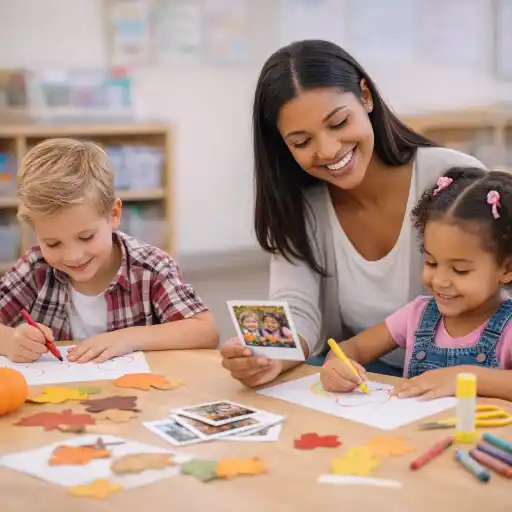
Be specific about what families are being asked to do, how long it may take, and how their contribution will be used. Make clear that there is no required purchase and no expectation to share personal traditions. For activity inspiration, see ChildCareEd’s fall activities for strengthening family engagement. Adapt ideas to children’s ages, abilities, and program policies.
How can communication make the invitation welcoming and accessible?
Good communication reduces uncertainty. Share the purpose of the event, its date and length, what children will do, and every available way to take part. Use plain language, short messages, and communication channels families already use. If families need translated information or interpretation, arrange support where available and avoid asking children to interpret sensitive messages.
Ask caregivers what works for them rather than assuming. Some may prefer a brief conversation at pickup; others may respond more comfortably by text, email, paper note, or a secure program platform. Offer asynchronous ways to contribute so a family can participate when time allows. NAEYC recommends communication that is frequent, reciprocal, and responsive to each family’s preferences.
- Invite participation with a low-pressure question: “Would you like to share a fall word, picture, or idea?”
- Say explicitly that attending and contributing are both optional.
- Offer a no-response-needed option, such as receiving a short event recap.
- Explain how you will use or display anything a family shares, and ask permission first.
- Close the loop by telling families how their suggestions shaped the activity.
A caregiver’s limited response does not necessarily mean a lack of interest. Work demands, language access, technology, previous experiences, and family responsibilities all affect communication. Keep the invitation open and respond without judgment. A short, positive message about a child’s participation can also make the event meaningful to a caregiver who could not attend.
How can the event respect different family experiences and children’s needs?
Fall is not experienced the same way by every family. Some celebrate particular holidays or seasonal traditions; others do not. A welcoming event can focus on observable changes in nature, children’s questions, creativity, or community rather than assuming every child shares a specific custom. Invite families to share what they wish, and never ask one caregiver or child to represent an entire culture.
Accessibility also includes sensory, mobility, communication, and developmental needs. A crowded gathering, unfamiliar materials, or strong smells may be exciting for some children and uncomfortable for others. Preserve the learning goal while offering different ways to participate: touching, watching, drawing, describing, pointing, using a communication device, or choosing to pass.
- Provide a quieter area or smaller-group option alongside busier activities.
- Use visual cues or a simple schedule to show what will happen.
- Offer accessible tools and alternatives to handling natural objects.
- Use inclusive terms such as “family,” “caregiver,” and “important grown-up.”
- Ask permission before sharing names, photos, recordings, or family stories.
Respecting choice is part of a strengths-based approach: families and children know what feels appropriate for them. State requirements vary - check your state licensing agency for applicable rules on supervision, outdoor materials, food, records, and privacy.
What common planning mistakes can you avoid?
One common mistake is relying on a single evening event and interpreting attendance as a measure of family commitment. Another is making participation depend on bringing food, buying supplies, sharing a photograph, or volunteering. These requirements can create barriers even when families are eager to connect. Instead, use program materials and provide several voluntary ways to contribute.
Long, jargon-heavy invitations can also make a simple event feel like an obligation. Keep the message clear: what is happening, why it matters for children, what families may choose to do, and how they can respond. Avoid repeatedly contacting families who have not replied; offer a comfortable alternative and leave room for them to decline.
Protect privacy and represent family contributions accurately. Ask before displaying an image or recording, and do not present one family’s experience as universal. Afterward, reflect with staff:
- Did families have more than one realistic way to participate?
- Could children join the learning even if no caregiver responded?
- Did family ideas influence the activity or follow-up?
- What barrier could we remove next time?
Measure the event by the quality of connection and the accessibility of the invitation—not simply by attendance numbers. A brief family comment, child’s retelling, or adjustment prompted by caregiver feedback can be evidence that partnership is growing.
How can you make the event part of an ongoing family partnership?
A fall event works best as one moment in a continuing relationship, not a one-time test of family participation. Before the event, ask families what formats are useful. During it, listen to children and caregivers without pressure. Afterward, share a short recap that explains what children explored and how family ideas informed the experience.
For example, if several children become curious about changing leaves, the classroom might continue the inquiry by comparing colors, reading a nature story, or drawing observations. A caregiver who sends a voice note or answers a prompt has contributed to the learning even if they could not join the gathering. When you acknowledge that contribution, children see that their family’s knowledge belongs in the classroom.
Keep the next step manageable. Consider one brief feedback question: “Was there a way to participate that worked well for your family?” Share a change you made in response when possible. This kind of follow-through reflects the collaborative, goal-oriented approach described in the Head Start PFCE Framework and NAEYC’s family partnership guidance.
Conclusion: What makes a fall family event work for parents who cannot attend?
A successful fall family event does not depend on every caregiver being in the room. It offers flexible, voluntary ways to take part; communicates clearly; honors different family experiences; and gives children meaningful access to the activity whether or not an adult can attend.
Choose one simple seasonal idea, invite family input through more than one channel, and close the loop by showing how that input shaped children’s learning. When programs value a note, a drawing, a brief conversation, or a child’s home observation as legitimate participation, more families can feel connected. The central question is not “Who made it to the event?” but “How did we make every family’s knowledge welcome?”
- CDA Certification en Español: Recursos y Consejos para Educadores Bilingües
- 💛🧩 ¿Cómo puedo hacer que mi enseñanza sea inclusiva para los niños con autismo?
- 10 Ejemplos de Cómo la Cultura Influye en el Desarrollo Infantil
- Capacitación en Salud y Seguridad Preventiva en Línea para Proveedores de Cuidado Infantil
- Cómo Empezar una Guardería en Casa: Requisitos y Pasos
- Proporciones de Cuidado Infantil y Tamaños de Grupo por Edad en Virginia (Guía Rápida para Centros y Hogares)
- Retraso del Habla en la Guardería: Cómo Pueden Ayudar los Proveedores
- Las Mejores Ideas de Excursiones para Guarderías en Texas
- Celebrando la amistad en el cuidado infantil durante el Día de los Mejores Amigos
- Canciones, juegos y preguntas de círculo para niños
- Do You Need a Childcare License to Watch Kids in Your Home?
- How Can Child Care Providers Build Stronger Connections With Families From the First Day?
- How Can Childcare Programs Encourage Meaningful Family Participation?
- How Can Child Care Providers Understand and Support Individualized Education Programs?
- How Can Child Care Providers Create Inclusive Father’s Day Activities for Diverse Family Structures?
- How Can Child Care Programs Represent Families Who Rarely Attend Classroom Events?
- How Can You Plan Family Participation When Work Shifts Change Every Week?
- How Can Preschool Teachers Use Fall Activities to Strengthen Family Engagement?
- How Can Fall Classroom Projects Build Stronger Family Partnerships?
- How Can You Create a Fall Family Event for Parents Who Cannot Attend?
