When two children both want the same toy or have different plans for a game, a calm moment of adult coaching can turn tension into a lasting social skill. The focused You’re Not My Friend Anymore: Learning Conflict Resolution  Buy Now $16.00 course offers child care providers developmentally appropriate strategies for guiding peer disagreements, while Social Foundations and Responsive Classrooms Buy Now $24.00 broadens that learning with practical approaches to social-emotional development, positive guidance, and problem-solving. Explore these courses as a next step, then use the strategies below to help children practice compromise in everyday play.
Why is compromise an important skill for young children?
Compromise is more than taking turns or giving up a preferred toy. It is the developing ability to express an idea, consider another person’s perspective, and help find a solution that feels workable and safe. These skills support #communication, #empathy, self-regulation, and relationships. They take time to develop; young children may know what they want before they have the language or flexibility to negotiate for it.
A disagreement over blocks, outdoor materials, or a pretend-play role is therefore not automatically a failure of classroom management. It can offer authentic practice in listening and collaborative problem-solving. NAEYC’s three-step approach to helping children navigate conflict recommends describing behavior, explaining its impact, and guiding children toward an appropriate alternative. The point is not to make every conflict disappear, but to teach safer and more constructive ways forward.
- Children learn that their own ideas matter and that peers have ideas, too.
- They practice finding solutions rather than relying on an adult to decide every outcome.
- Providers gain insight into what classroom routines, materials, or communication supports may help.
Remember that a fair outcome does not always mean both children get exactly what they first requested. It means each child has a meaningful chance to participate and the agreed plan respects safety and boundaries.
How can providers prepare children to negotiate?
Children are more likely to use negotiation skills during a frustrating moment when they have practiced them during calm play. Teach a small set of short, concrete phrases and revisit them often with puppets, picture books, or role-play. For example: “I have an idea,” “Can we try both?” “Can I have a turn next?” and “I need help.” Modeling the language gives children a starting point without requiring them to memorize a script.
Make communication accessible to every child. Pair spoken language with gestures, pictures, signs, home-language expressions, or augmentative communication when appropriate. Give children time to respond; a child may point to a choice, show an idea through play, or need an adult to supply words. The goal is meaningful participation, not perfect speech.
Prepare the environment as well as the children. Observe when disagreements tend to occur. Crowded play areas, limited high-interest materials, rushed transitions, or insufficient time to complete a play idea can make compromise harder. Try practical adjustments:
- Use timers or visual turn cards to make waiting more predictable.
- Offer duplicate or alternative materials when feasible.
- Arrange clear play areas with enough space for children to work together.
- Use puppets to rehearse a familiar conflict and brainstorm several possible solutions.
- 🌱 Build in sustained play time so children can develop, revise, and share their ideas.
These preparations help children practice #cooperation before strong feelings make flexible thinking more difficult.
What should an educator do during a disagreement?
Begin with safety and a calm presence, not a quick judgment about who is right. Move close enough to prevent harm, stop unsafe actions, and check whether anyone needs care. Use brief, neutral language: “You both want the blue truck, and you have different plans.” Describing what you see avoids blame and helps children focus on the shared problem.
If a child is overwhelmed, pause the negotiation. A long discussion is unlikely to help while feelings are intense. Acknowledge emotion while holding a clear limit: “You’re frustrated. I won’t let you grab the truck. We’ll make a plan when everyone is ready.” Then give children space and support to settle, using familiar strategies such as a quiet moment, a breath together, or a visual feelings card.
When children are ready to participate, guide them one step at a time:
- Name the problem in simple, observable terms.
- Listen to each child’s idea without deciding whose idea is best.
- Ask what each child wants or needs, and allow time for a response.
- Invite possible solutions, offering a few choices if children are stuck.
- Check that the plan is safe and that both children understand what happens next.
Adult support should match children’s developmental and communication needs. One child may need a phrase modeled; another may be ready to suggest a solution independently. For more guidance on turning disagreements into learning moments, see teaching preschoolers conflict resolution.
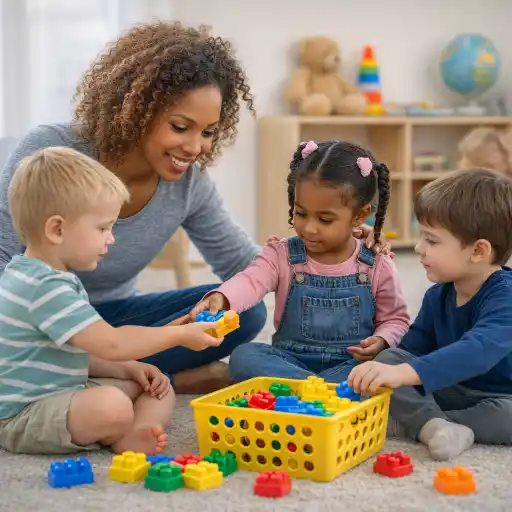
How can children find a compromise that works?
Help children move from competing positions toward a shared problem to solve. First, reflect both ideas fairly: “You want to build a road; your friend wants to make a house.” Then invite possibilities: “How could we make room for both ideas?” Children might connect the structures, divide the materials, take turns choosing what to add, or try one plan and then the other.
Brainstorm before evaluating. Accept unusual ideas when they are safe and workable; children’s own solutions may not be the ones an adult would choose. If they cannot think of options, offer a few rather than imposing a single answer. A simple visual routine can help:
- What is the problem?
- What are our ideas?
- What could we try so both children can participate?
- Does the plan feel safe and okay to both children?
- Did it work, or should we adjust it?
Compromise is not the same as forced sharing or requiring children to agree. Sometimes parallel play, separate materials, a turn later, or a respectful boundary is the best solution. Check that each child understands the next step, then notice the process: “You listened to each other and decided to connect your buildings.” Specific feedback helps children recognize #problem-solving strategies they can reuse.
If the first plan does not work, treat that as information rather than failure. Help children revise it and try again, or pause and return to the issue later if their attention or regulation is fading.
How can programs avoid common pitfalls and build consistent support?
Well-intentioned adults can unintentionally take over the learning. “Just share” does not explain what a child can do, and immediately deciding who gets the toy may leave children without practice negotiating. Likewise, a forced apology or a long lecture during distress may end the moment without teaching a useful replacement skill. Set clear safety limits, then coach when children are able to participate.
- Instead of “Use your words,” model: “You can say, ‘Can I have a turn next?’”
- Instead of “You’re being mean,” describe the action: “You pulled the block from your friend.”
- Instead of insisting on one solution, offer choices such as taking turns, combining ideas, or playing alongside each other.
- Instead of requiring an immediate apology, support meaningful repair, such as returning a material, rebuilding, checking on a peer, or giving space.
Directors and teaching teams can agree on a few consistent phrases and review how adults support safety, emotion regulation, wait time, and child-led solutions. When conflicts recur in a particular place or routine, record objective observations and consider whether the environment, schedule, group size, or communication demands need adjustment. Partner with families using strengths-based, specific examples rather than labels. Adapt strategies for children’s languages, abilities, and ways of communicating. State requirements vary - check your state licensing agency for applicable guidance.
For additional reading, NAEYC’s peacemaking guidance for early childhood classrooms highlights modeling problem-solving, listening carefully, and recognizing children’s efforts to make peace.
Conclusion: How can providers help children learn to compromise?
Children learn compromise through repeated, supported practice—not through a single reminder to share. Prepare them with accessible language and playful rehearsal, design routines and spaces that reduce avoidable friction, and coach active disagreements by prioritizing safety, naming feelings, and helping children develop a workable plan together.
Some days, compromise may look like combining two play ideas; other days, it may mean taking turns, playing separately, or asking an adult for help. Each safe attempt to listen, express a need, consider another perspective, and revise a plan is meaningful progress. With patient, consistent support, children can grow more confident in solving problems with peers and maintaining respectful relationships.
Providers seeking a deeper learning experience can explore You’re Not My Friend Anymore: Learning Conflict Resolution Buy Now $16.00, the focused course introduced above, or consider complementary learning through these relevant ChildCareEd courses:
- 45 Hour Child Growth and Development
- You're Not My Friend Anymore: Learning Conflict Resolution
- 45 Hour Preschool Methods and Materials
- What Makes Me Special: An Overview of Autism and ADHD
- Pediatric RSV First Aid & CPR/AED
- 45 Hour School Age Methods and Materials
- Texas Director Credential
- Matchmaking for Mentors
- CDA Certification en Español: Recursos y Consejos para Educadores Bilingües
- Why Safe Sleep Training Matters: Preventing SIDS and Promoting Infant Well-Being
- Proporciones de Cuidado Infantil y Tamaños de Grupo por Edad en Virginia (Guía Rápida para Centros y Hogares)
- Celebrando la amistad en el cuidado infantil durante el Día de los Mejores Amigos
- How Can Child Care Providers Help Children Build Healthy Friendship Skills?
- How Can Child Care Providers Calm an Overstimulated Child in a Busy Classroom?
- How Can Preschool Teachers Recognize and Respond to Sensory Overload in the Classroom?
- How Can Child Care Providers Handle Bossy Behavior in Preschool?
- How Can Providers Respond When a Child Constantly Corrects Other Children’s Play?
- What Is the Difference Between Parallel Play and Cooperative Play?
- What Can Preschool Teachers Learn from a Child’s Play Preferences?
- When Parents Say Their Baby Sleeps Better on Their Stomach: How Should Child Care Providers Respond?
- How Can Educators Support Peer Language Help Without Making One Child the Classroom Interpreter?
- How Can Teachers Help Children Practice Negotiation During Pretend Play?
- How Can Child Care Providers Help Children Negotiate Shared Outdoor Play?
- What Should Infant and Toddler Teachers Record During Everyday Play?
- How Can Teachers Support Children Who Become Frustrated When a Friend Changes the Game?
- How Can Child Care Providers Help Children Learn to Compromise With Peers?
