When one child repeatedly tells peers they are playing “the wrong way,” the room can quickly feel tense—and the child may be trying to express a real need for predictability, control, or connection. The The ABCs of Behavior: Turning Challenges into Learning Opportunities  Buy Now
 $55.00$45.00 course can help you look beyond the correction to its context and practice positive, consistent responses. Keep reading for classroom-ready language and ways to protect everyone’s opportunity to play.
Why might a child keep correcting other children’s play?
A child who says, “That’s not how you do it,” or repeatedly assigns roles may be trying to organize an exciting play idea, preserve a familiar sequence, or make sure others understand the rules in their mind. The behavior may also reflect a desire to participate, emerging leadership, anxiety about changes, difficulty with flexible thinking, or a communication skill that is still developing. One explanation should not be assumed from a single incident.
Begin with curiosity rather than a label such as “bossy.” Notice what happens before and after the corrections: Which play area is involved? Does the child correct everyone or only certain peers? Does it happen when the story changes, materials move, or another child takes a role? Observe whether the child is engaged, worried, frustrated, or trying to enter the group.
Peer play requires children to share ideas, listen, negotiate roles, and adjust plans. These abilities develop over time and are not equally easy for every child. The Hanen Centre notes that successful entry into peer play can be challenging even for typically developing children; persistence and trying another approach are part of learning. A child’s repeated directions may therefore be a starting point for teaching reciprocity—not proof of bad intent.
Hold two truths together: peers deserve room to contribute, and the child correcting them may need support to communicate an idea more flexibly. When adults understand the function and context, they can set a clear boundary while preserving the child’s dignity.
How can observation guide your response?
Brief, objective observation helps distinguish a one-time disagreement from a recurring pattern and prevents adults from reacting only to the most noticeable words. Write down what you can see and hear, not an interpretation of character or motive. For example: “During pretend restaurant play, Eli told two peers where to stand and corrected the menu they made. When one peer suggested a new role, Eli repeated, ‘No, you have to be the cook.’”
Look for patterns using a simple ABC lens:
- Antecedent: What was happening just before the correction—was the play changing, crowded, noisy, or hard to follow?
- Behavior: What exact words, gestures, or actions did the child use?
- Consequence: What happened next—did peers leave, comply, argue, or invite the child to continue?
Also note the child’s strengths: imaginative ideas, detailed knowledge, enthusiasm, persistence, or a wish to organize. Consider communication access, sensory comfort, temperament, cultural expectations, and whether the child understands that pretend play can have several valid storylines. The Hanen Centre’s guidance on supporting peer interaction reinforces the value of creating manageable, intentional opportunities for children to connect.
Observation is not a diagnosis. It helps your team choose a practical teaching step and check whether it improves participation. If the behavior is persistent or significantly limits relationships, partner with the family and appropriate specialists, using specific examples rather than assumptions.
What can you say in the moment without taking over?
When play is safe, pause briefly and give children a chance to respond to one another. If a child’s corrections are shutting down peers or escalating conflict, intervene calmly and describe the issue without shaming: “You have a plan for the game. Maya has an idea too.” Then make the expectation concrete: “In our play, everyone can share an idea. We can try both ideas or choose one together.”
Offer a short script the child can use instead of issuing commands:
- “I have an idea. Do you want to hear it?”
- “What should happen next?”
- “You can choose that role, and I’ll choose this one.”
- “Can we try your idea first, then mine?”
- “Let’s make room for both ideas.”
Model the words in a warm, neutral tone, then allow time for children to use them. If the child becomes upset, keep language brief: “You wanted the story to stay the same. The group is changing it. You can stay and try the new idea, suggest another plan, or choose a different activity.” This offers structure without requiring the child to surrender all preferences.
✅ Notice and name the skill when it appears: “You told your idea and listened while Sam chose the next part.” Specific feedback helps children recognize what successful cooperation looks and sounds like. The CSEFEL training module highlights modeling, practice, and reinforcement as ways to teach friendship and problem-solving skills. Teach these phrases during calm moments, too; the heat of conflict is rarely the easiest time to learn a new social skill.
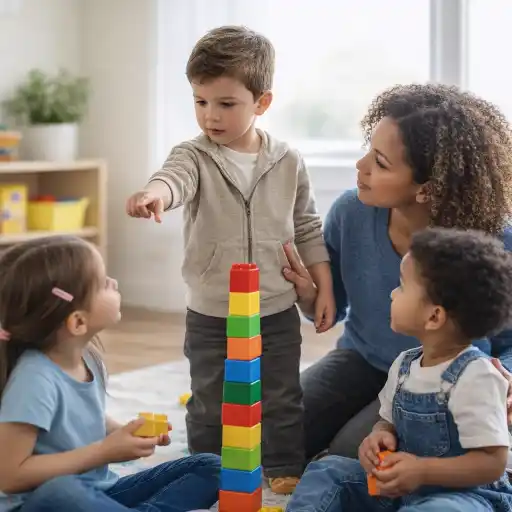
How can Flexible Play Language Cards support practice?
Flexible Play Language Cards can give children and adults a shared set of words to draw on when play plans differ. Introduce only a few cards at a time, with pictures and short phrases that match your classroom’s routines. For example, cards might prompt children to share an idea, ask a peer’s preference, negotiate a role, or try a different plan. Keep them accessible near dramatic play or blocks so they function as gentle reminders—not public behavior charts.
Use the cards proactively:
- At a small-group meeting, model two puppets who want different roles and practice a phrase from a card.
- Before free play, invite children to choose one phrase they might use if plans change.
- During play, point to a card or quietly offer a verbal cue, then step back so children remain authors of their play.
- Afterward, reflect briefly: “Which words helped everyone keep playing?”
Accept spoken language, gestures, signs, home languages, and communication devices as ways to share ideas. Some children may need extra processing time, a visual choice between two phrases, or rehearsal with an adult before joining peers. The goal is not scripted performance; it is making useful communication available in a way that fits the child.
Cards work best alongside an environment that supports shared play. Provide open-ended materials, enough space, and appealing roles that let several children contribute. The NAEYC discussion of social-emotional health emphasizes trusting relationships and intentional teaching; visual prompts should therefore complement responsive adult relationships rather than replace them.
How can you support flexible, inclusive peer play over time?
Practice both sides of the interaction. The child who often corrects peers can learn to offer ideas and make room for others; classmates can learn to respond, negotiate, and set respectful boundaries. Make clear that inclusion does not mean every suggestion must be accepted or that a child must give up a chosen role. Children can say, “I want to finish this part first,” or “Let’s hear your idea after we build the bridge.”
Plan brief, low-pressure role-play activities in which children take turns proposing a play idea, listening to a different idea, and choosing a next step. During real play, use the least intrusive support that works: wait, gesture to a card, offer one concise phrase, or model a response. Fade adult prompting as children become more able to negotiate for themselves.
Review the room and routines as well as the individual child. Crowding, scarce popular materials, abrupt transitions, or a confusing play setup can make disagreements more likely. Smaller play groups, duplicate materials, clear center boundaries, and uninterrupted play time may reduce friction and make it easier for children to contribute. Cognitive flexibility grows through stable routines paired with safe opportunities to try new approaches.
Common pitfalls to avoid include:
- Calling the child “bossy” or publicly correcting their personality instead of teaching a specific behavior.
- Expecting immediate compromise without modeling what flexible language sounds like.
- Letting one child control the group—or requiring that child to accept every peer idea.
- Taking over the story with lengthy adult explanations rather than offering a small prompt.
- Assuming that the same strategy will work for every child, communication style, or play context.
Share patterns and successful scripts with colleagues and families using neutral, strengths-based examples. State requirements vary - check your state licensing agency for applicable guidance on documentation and program procedures.
Conclusion: How should providers respond when a child constantly corrects play?
Respond with both empathy and a clear limit: a child’s ideas matter, and peers’ ideas matter too. Observe the context before deciding what support is needed, describe what is happening without labeling the child, and teach practical phrases for sharing ideas, listening, and negotiating. Use Flexible Play Language Cards as a light-touch prompt, alongside modeling, rehearsal, inclusive materials, and time for children to lead their own play.
Track progress in small, meaningful ways: Does the child invite a peer’s idea, tolerate a change in the play story, or return to play after disagreement? Celebrate attempts, not only smooth outcomes. For a deeper look at behavior patterns, positive guidance, self-regulation, and sensory influences, explore the ABCs of Behavior course Buy Now $55.00$45.00. With thoughtful observation and consistent coaching, repeated corrections can become opportunities to build flexible communication and more reciprocal play.
More ChildCareEd courses for professional learning:
- Bienvenido! Welcoming All Families
- Pediatric RSV First Aid & CPR/AED
- 45 Hour School Age Methods and Materials
- CDA Bridge Bundle: Family Child Care
- The Best Promotion is Play
- Play, Learn, Grow
- Risk Reduction: Infants and Toddlers in Family Child Care
- Texas Director Credential
- Access for All: Inclusion and the ADA
- CDA Certification en Español: Recursos y Consejos para Educadores Bilingües
- 🪁¿Cómo puede el juego apoyar de manera poderosa a los niños con autismo?🧩
- 💛🧩 ¿Cómo puedo hacer que mi enseñanza sea inclusiva para los niños con autismo?
- Recursos en Español sobre el Sueño Seguro del Bebé
- 10 Ejemplos de Cómo la Cultura Influye en el Desarrollo Infantil
- Capacitación en Salud y Seguridad Preventiva en Línea para Proveedores de Cuidado Infantil
- Regulaciones de Licenciamiento de Cuidado Infantil en California para Centros y Hogares de Cuidado Infantil Familiar
- Proporciones de Cuidado Infantil y Tamaños de Grupo por Edad en Maryland (Guía Rápida para Centros y Hogares)
- Proporciones de Cuidado Infantil y Tamaños de Grupo por Edad en Nueva Jersey (Guía Rápida para Centros y Hogares)
- Proporciones de Cuidado Infantil y Tamaños de Grupo por Edad en Virginia (Guía Rápida para Centros y Hogares)
- Por Qué la Supervisión Activa Es Clave para la Seguridad en el Cuidado Infantil
- Retraso del Habla en la Guardería: Cómo Pueden Ayudar los Proveedores
- Cómo Trabajar en el Cuidado Infantil en Carolina del Norte: Requisitos y Pasos
- Cómo Trabajar en el Cuidado Infantil en California: Requisitos y Pasos
- Requisitos para Guarderías en Casa en Georgia
- Celebrando la amistad en el cuidado infantil durante el Día de los Mejores Amigos
- Canciones, juegos y preguntas de círculo para niños
- Cómo simplificar la capacitación para sus empleados de daycare
- How Can Providers Respond When a Child Constantly Corrects Other Children’s Play?
- Why Does a Child Become the Rule Keeper When an Adult Joins Play?
