When a preschooler insists on directing every game, interrupting peers, or rejecting others’ ideas, the behavior can strain friendships and classroom routines—but it also signals skills that are still developing. Start with the practical guidance below, then deepen your practice through Staying Positive: Guidance for Preschoolers  Buy Now $24.00, which helps providers use positive discipline to support social-emotional development and earn relevant professional learning hours. For a more targeted look at self-regulation, explore From Tantrums to Triumphs: Equipping Preschoolers with Self-Regulation Skills Buy Now $25.00.
Why should “bossy” behavior be understood as communication?
“Bossy” is an adult label, not a developmental explanation. A child who says, “You have to be the baby,” grabs materials, or rejects a peer’s idea may be practicing leadership without yet understanding collaboration. The behavior may also reflect frustration, insecurity, difficulty entering play, language limitations, sensory overload, or a need for predictability. Teach Early Years notes that confidence can become controlling behavior when empathy and perspective-taking are still emerging.
Head Start and the Illinois Early Learning Project emphasize that behavior communicates needs and develops within relationships. Reframing the child from “bossy” to “a child who needs support with flexible play and respectful communication” protects dignity and clarifies the teaching goal. It also helps adults avoid power struggles.
This does not mean permitting hurtful or unsafe actions. A respectful boundary can sound like: “You have an idea for the game, and your friends have ideas too. I will not let you grab. Let’s practice asking.” The goal is to preserve the child’s confidence while building #empathy, flexibility, and #cooperation.
How can observation reveal what triggers controlling behavior?
Before selecting an intervention, observe patterns across activities, peers, times of day, and adults. The ABC framework—antecedent, behavior, and consequence—helps teams move from assumptions to usable information. NAEYC describes the framework as a way to identify what happens before a behavior, what the child does, and how others respond afterward.
- Antecedent: Is the child entering an established game, waiting for a turn, transitioning, or facing limited materials?
- Behavior: Record observable actions: “The child told peers where to sit, took the truck, and shouted when a peer disagreed.”
- Consequence: Did peers leave, an adult negotiate, or the child get control of the activity?
Also consider fatigue, hunger, noise, language demands, changes at home, and the child’s experience with siblings or peers. Ask families whether similar behavior occurs elsewhere, using curiosity rather than blame. State requirements vary - check your state licensing agency when documentation, referrals, or individualized plans are involved.
What classroom practices prevent bossy behavior before it escalates?
Prevention makes cooperation easier. Create predictable routines, define play areas, and provide enough open-ended materials for several children to participate. Visual cues can show “ask to join,” “take turns,” “listen,” and “make room for another idea.” Review these expectations when children are calm, then rehearse them through puppets and role-play.
Use positive, specific language. Instead of “Stop being bossy,” say, “Tell your friend your idea, then ask what they want.” Instead of “Let her play,” say, “You can say, ‘Can I join your game?’” During group discussions, teach a visible routine for listening: wait, look toward the speaker, and respond respectfully.
- Offer leadership roles that serve the group, such as materials helper or game starter.
- Use timers, name cards, or turn-taking objects for highly preferred materials.
- Plan cooperative goals: build one structure, create a group mural, or act out a shared story.
- Notice children who wait, compromise, invite others, or accept a different idea.
These supports channel confidence into responsible leadership rather than removing opportunities to lead.
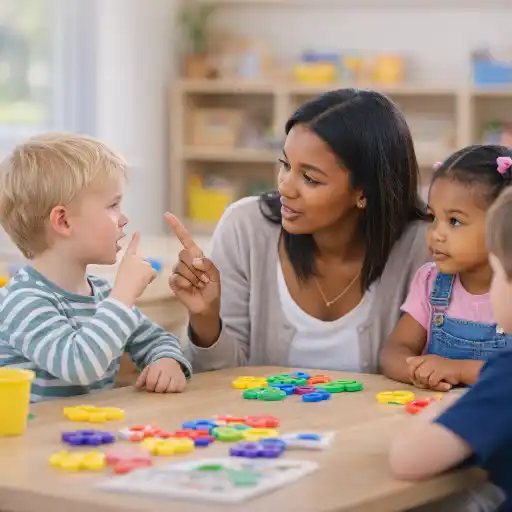
How should educators respond in the moment?
Respond briefly, calmly, and consistently. First protect safety and stop grabbing, insulting, or destroying materials: “I will not let you take the blocks from her.” Then acknowledge the child’s intention: “You really want the game to go your way.” Follow with a replacement skill: “Ask, ‘Would you like to build a house or a bridge?’”
When emotions are high, long explanations rarely teach effectively. Use a short sequence inspired by NAEYC’s conflict guidance: state the behavior, explain its impact, and offer an alternative. For example: “You told Maya she was stupid. That can hurt her feelings. Try, ‘I have a different idea,’ or listen while she explains.”
During play entry, model language directly: “You can ask, ‘What can I do in your game?’” If peers reject the request, help the child tolerate the answer: “They said they need one more minute. You may watch, choose another role, or start a nearby game.” Reinforce even partial success: “You waited and asked with a calm voice.”
Use selective attention thoughtfully. Briefly avoid rewarding attention-seeking interruptions while actively praising children who wait; however, never ignore aggression, exclusion, or distress.
How can providers teach empathy, negotiation, and repair?
Empathy is not learned through lectures alone. Build it into books, dramatic play, daily conversations, and real conflicts. Ask, “How might your friend feel when their idea is rejected?” Then connect the answer to an action: “What could help them feel included?” Keep questions concrete and developmentally appropriate.
Teach a simple problem-solving routine:
- Stop and make bodies safe.
- Name the problem and feelings.
- Let each child share an idea.
- Generate two or three solutions.
- Choose a plan everyone can try.
- Repair and return to play.
Repair may involve rebuilding a knocked-down structure, returning a material, inviting a peer back into play, or saying, “I was frustrated. I will ask next time.” Do not require a forced apology before a child is regulated; teach authentic responsibility after calm returns.
Give children repeated practice with cooperative games, partner jobs, shared art, and role-play. Collaboration is a skill, not a personality trait. A child who leads confidently can learn to lead inclusively when adults provide language, time, and meaningful opportunities to succeed.
How can teams partner with families and decide when more support is needed?
Share observations as strengths-based information: “Jordan is imaginative and confident during dramatic play. We are helping Jordan include peers and accept different ideas.” Ask, “What situations are easiest or hardest at home?” Coordinate language and strategies so the child receives consistent messages.
Keep a brief team plan with one prevention strategy, one replacement skill, and one way to measure progress. For example: use a visual play-entry card, teach “Can I join?”, and record whether the child enters play without grabbing in three opportunities each day.
Seek additional support when behavior is persistent, escalating, unsafe, or significantly interfering with relationships and learning despite consistent guidance. Collaborate with families, administrators, and qualified specialists; do not diagnose from classroom behavior alone. Consider language development, disability-related needs, culture, trauma, sensory differences, and environmental demands without stereotyping.
Relevant professional learning options include The ABCs of Behavior: Turning Challenges into Learning Opportunities Buy Now $55.00, which examines antecedents, consequences, positive guidance, self-regulation, and sensory influences; Social Foundations and Responsive Classrooms Buy Now $24.00; and Classroom Management is Collaboration! Buy Now $16.00. Review course details and confirm whether training meets your local requirements.
Conclusion: How can preschool teachers turn bossiness into inclusive leadership?
Handle bossy behavior by looking beneath the label, observing patterns, setting firm but respectful limits, and explicitly teaching flexible play, listening, empathy, negotiation, and repair. A child’s desire to lead can become a strength when adults show how leadership includes other voices.
- Describe behavior objectively rather than labeling the child.
- Use ABC observations to identify triggers and reinforcing responses.
- Teach what children should say and do through modeling and role-play.
- Offer meaningful leadership roles that benefit the group.
- Praise compromise, inclusion, waiting, and respectful disagreement.
- Partner with families and seek support when concerns persist.
With consistent guidance, preschoolers can learn that being confident does not require being in charge of everyone. The long-term goal is not silence or compliance; it is a classroom where children can express strong ideas while making room for the ideas and feelings of others.
- 45 Hour Child Growth and Development
- CDA Preschool Credential with Portfolio Review
- Building Equity: Inclusionary Practices in Preschool
- 45 Hour Preschool Methods and Materials
- CDA Bridge Bundle: Preschool
- Pediatric RSV First Aid & CPR/AED
- 45 Hour School Age Methods and Materials
- CDA Bridge Bundle: Preschool without Portfolio Review
- Texas Director Credential
- Cómo ser director de cuidado infantil en Maryland
- 10 Ejemplos de Cómo la Cultura Influye en el Desarrollo Infantil
- Capacitación en Salud y Seguridad Preventiva en Línea para Proveedores de Cuidado Infantil
- Regulaciones de Licenciamiento de Cuidado Infantil en California para Centros y Hogares de Cuidado Infantil Familiar
- Proporciones de Cuidado Infantil y Tamaños de Grupo por Edad en Maryland (Guía Rápida para Centros y Hogares)
- Proporciones de Cuidado Infantil y Tamaños de Grupo por Edad en Virginia (Guía Rápida para Centros y Hogares)
- Lista para Guardería en Casa en Texas: Cómo Iniciar una Guardería en el Hogar
- Cómo Trabajar en el Cuidado Infantil en California: Requisitos y Pasos
- Cómo Trabajar en el Cuidado Infantil en Wisconsin: Requisitos y Pasos
- Cómo Ser Maestra de Preescolar en Illinois
- Cómo Ser Maestra de Preescolar en Wisconsin
- Cómo Ser Maestra de Preescolar en Maryland
- Cómo Ser Maestra de Preescolar en Virginia
- Capacitación CDA gratuita en Illinois
- Celebrando la amistad en el cuidado infantil durante el Día de los Mejores Amigos
- Diversión fresca de verano: actividades del Día Nacional del Helado para niños
- Cómo simplificar la capacitación para sus empleados de daycare
- How Can Child Care Providers Handle Bossy Behavior in Preschool?
- How Can Providers Respond When a Child Constantly Corrects Other Children’s Play?
- Why Does a Child Become the Rule Keeper When an Adult Joins Play?
