Everyday play is full of small decisions, experiments, and emerging skills that can be easy to miss in a busy room. A few specific, respectful notes can help you plan more responsive experiences and give families a vivid glimpse of their child’s day. Put these strategies into practice with ChildCareEd’s free Daily Observation Notes: Child Development Documentation Form Buy Now $0.00, a printable resource that helps educators record children’s actions, exact words, developmental progress, and meaningful learning moments while identifying possible next steps. For deeper professional learning, explore CDA Infants/Toddlers: Benefits to Observing  Buy Now $16.00, which focuses on observation and documentation, and Family Voices Matter: Tools for Meaningful Collaboration Buy Now
$55.00$45.00, which can help turn classroom observations into reciprocal, family-centered conversations. Together, these tools support more intentional teaching and stronger family partnerships.
Why record what children do during play?
Play is not a break from learning; it is one of the main ways infants and toddlers investigate people, objects, and ideas. A baby who repeatedly drops a spoon and watches it fall is exploring cause and effect. A toddler who carries a toy to a peer, pauses, and then offers it may be practicing social communication. These moments become useful when educators capture concrete evidence instead of relying on memory or broad judgments.
Documentation helps teachers recognize children’s interests, choices, strategies, and emerging abilities across time. It can inform decisions about what materials to offer, how to adjust the environment, and when to provide language or gentle support. It also helps families see that seemingly ordinary play is meaningful and that educators know their child as an individual.
Keep the purpose manageable: record selected moments that clarify what a child is exploring or practicing, rather than trying to write about every action. A brief note can support intentional teaching and a more trusting connection between home and the program. As NAEYC’s discussion of observation and documentation in infant and toddler settings emphasizes, observation becomes useful when educators reflect on what it means and decide how to respond.
What details make a play observation useful?
A helpful record lets another educator or family member picture the moment. Include basic context, then describe what the child did or said. When possible, record exact words, gestures, repeated actions, and what happened next. You do not need to capture every domain in every note; focus on details that illuminate the child’s interests, choices, persistence, communication, or interaction.
- Who and when: Child’s name, date, approximate time, and observer.
- Where and what: Play area, materials, and what was happening.
- Evidence: Observable actions, sounds, gestures, direct quotes, or creations.
- Response and next step: What the adult or peers did, and a possible follow-up opportunity.
For example: “At 9:40 in the block area, Mila placed a small car on a flat block, pushed it, and watched it roll off. She added a second block beneath one end and tried again. When the car stayed on, she smiled and said, ‘Go!’” This note preserves the child’s experimentation without claiming to know exactly what she was thinking. The Daily Observation Note for Infant and Toddler Routines and Play Buy Now $0.00 offers fields for context, observable details, strengths, interests, and possible supports.
How can teachers keep notes factual and respectful?
Separate what you observed from what you think it might mean. Objective language helps prevent a moment from becoming a label. Instead of writing “Leo was stubborn and refused to play,” describe what happened: “Leo moved the puzzle toward the shelf, looked at the teacher, and returned to the play mat.” Interpretations may be valuable during reflection, but keep them distinct from the record of evidence.
A useful test is to ask whether another observer could reasonably see or hear the details in your sentence. Replace assumptions about feelings, motives, or abilities with specific actions and direct quotes. Avoid words such as “always,” “never,” “good,” “bad,” or “bored” unless they are clearly attributed to a speaker and relevant to the record.
- Instead of “She loves music,” write: “She reached toward the shaker when the song began and shook it during the chorus.”
- Instead of “He is bad at sharing,” write: “He held the truck while another child reached for it; the teacher offered a second truck.”
- Instead of “He finally figured it out,” record the steps he tried and what happened.
Respectful #observation also means considering context: fatigue, transitions, unfamiliar materials, language, culture, and changes in routine can shape what you see. A single moment is one piece of information, not a full portrait of a child. Head Start’s guidance on writing objective and accurate observation notes offers examples of factual descriptions versus interpretation.
How can observations become meaningful family updates?
Families do not need a long report to understand a child’s play. Pair one specific moment with a plain-language explanation of what the child explored, then invite the family’s perspective. This keeps communication warm and evidence-based while recognizing that families know their child in settings educators do not see.
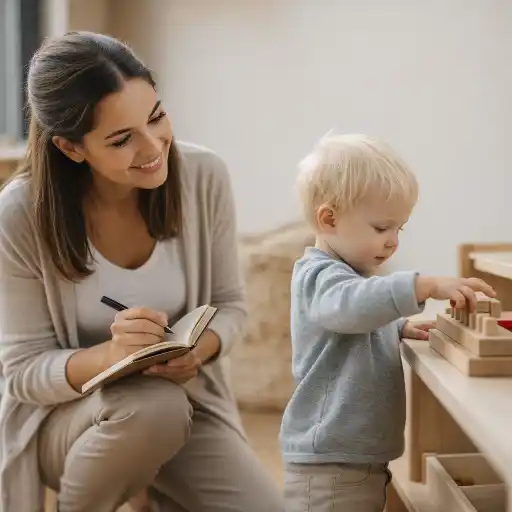
A simple three-part message works well:
- What happened: “During outdoor play, Mateo filled a cup with leaves, emptied it, and filled it again.”
- What you noticed: “He repeated the action several times and watched the leaves fall.”
- Invitation: “Have you noticed him collecting or carrying objects at home?”
Translate professional observations into familiar language rather than relying on jargon. “Practiced fine-motor coordination” may be less vivid than “used both hands to place small rings over the post.” Share communication in the family’s preferred language and channel when possible. Keep updates strengths-based without overstating what one observation proves; families can add context, correct a misunderstanding, or share a related interest.
For infants who communicate mainly through movement, gaze, sounds, and facial expression, describe those cues carefully. For toddlers, include choices, words, attempts at independence, and interactions with peers. Head Start notes that regularly sharing observations and inviting family input can strengthen the home-program connection; see its resource on observing to build relationships with families.
How should educators use notes to plan next steps?
Documentation earns its place when it changes what adults notice or offer. Review notes periodically for repeated interests, new strategies, and conditions that support participation. One observation may suggest a possibility; several moments across days and settings provide a more grounded basis for planning. Ask: What materials might extend this interest? What language could I model? Would a different arrangement make it easier for the child to participate?
For example, if a toddler repeatedly transports objects between play areas, you might add baskets, bags, or varied objects to explore carrying and sorting. If an infant returns to a textured ball, you might place similar safe materials within reach and observe how the infant explores them. Offer opportunities, not tests; children may respond differently depending on the day and context.
Use a simple cycle: observe, reflect, plan a modest response, and observe again. Share relevant patterns with the teaching team so support is consistent, while keeping records confidential and accessible only to authorized people. Photos or videos can supplement notes when program policy and family permissions allow, but do not interrupt engaged play or compromise supervision to capture an image.
If repeated observations raise a developmental concern, document the evidence over time and follow program procedures for discussing it with the family and considering screening or referral. Observation notes are not diagnoses. State requirements vary - check your state licensing agency.
What common documentation pitfalls can teams avoid?
Busy schedules can make documentation feel like one more demand, and educators may worry they are not recording enough. A sustainable system is more valuable than an elaborate one that staff cannot maintain. Directors can support the team with a shared short form, secure storage, planned observation rotations, and brief time to review notes together.
- 📌 Writing only about problems: Include interests, choices, attempts, and successful supports so each child’s record is balanced.
- Using vague summaries: Replace “played well” with a concrete action, quote, or interaction.
- Guessing at motives: Record what was seen and heard; place professional interpretation separately.
- Drawing conclusions from one event: Look for patterns across time, routines, and settings before deciding what a moment suggests.
- Letting note-taking disrupt care: Make quick reminders when appropriate and complete them only when supervision is secure.
- Sharing sensitive information casually: Use approved channels and protect confidential records.
Remember the five practical anchors: #play, #choices, #strengths, #families, and #planning. The aim is not perfect prose or constant documentation. It is to notice meaningful moments, preserve the facts, and use them to make learning visible and relationships stronger.
Conclusion: What should teachers record during everyday play?
Record specific, observable moments that reveal what infants and toddlers attend to, choose, communicate, attempt, repeat, and do with others. Include context and direct evidence; distinguish facts from interpretation; and use notes to plan responsive experiences and share concise, inviting updates with families. Over time, these small records create a richer picture of each child’s interests and emerging abilities.
Start with one meaningful moment, one factual note, and—when appropriate—one genuine question for the family. This steady practice turns everyday play into a useful bridge between observation, responsive teaching, and family connection.
Explore five relevant English-language courses:
- CDA Infants/Toddlers: Benefits to Observing Buy Now $16.00
- Family Voices Matter: Tools for Meaningful Collaboration Buy Now
$55.00$45.00 - Tracking Progress, Shaping Futures: Observation & Assessment Skills Buy Now
$55.00$45.00 - Privacy Matters: Documentation and Observation in Early Learning Buy Now
$55.00$45.00 - CDA Infant/Toddler: Parent Relationships Buy Now $16.00
- 45 Hour Child Growth and Development
- 45 Hour Preschool Methods and Materials
- Birth to Five CDA Credential with Portfolio Review
- 45 Hour Infant and Toddler Methods and Materials
- Pediatric RSV First Aid & CPR/AED
- 45 Hour School Age Methods and Materials
- CDA Bridge Bundle: Infant/Toddler without Portfolio Review
- Texas Director Credential
- 45-Hour Infant and Toddler Curriculum
- 😫🧸 ¿Qué hacer cuando un bebé no quiere dormir la siesta en el aula?
- ❄️ ¿Qué actividades al aire libre funcionan bien para los niños de Illinois en cada estación? 🌷🍂
- 🚨 Reporte Obligatorio en Nevada
- Recursos en Español sobre el Sueño Seguro del Bebé
- Cómo usar tu certificación de 90 horas en Maryland para completar tu CDA
- 45 horas para infantes y niños pequeños: cómo certificarse en línea
- ¿Qué es la Certificación de 90 Horas para Cuidado Infantil en Maryland?
- ¿Cuáles son los pasos, requisitos y opciones en línea para la certificación de 90 horas en cuidado de Infantes/Toddlers en Maryland?
- ¿Cómo pueden los equipos de cuidado infantil practicar habilidades rápidas de primeros auxilios en situaciones reales?
- Consejos de Supervisión Activa para Salones de Preescolar y el Juego al Aire Libre
- Celebrando la amistad en el cuidado infantil durante el Día de los Mejores Amigos
- 45 Hour Infant and Toddler Certification: Is 45 Hours Enough to Be a Lead Teacher in Maryland?
- How Can Child Care Providers Plan Infant Activities Around Developmental Milestones?
- How Can Infant and Toddler Rooms Use Daily Communication Logs Effectively?
- How Can Teachers Support Language Development in Toddlers?
- How Can One Material Spark Different Discoveries for Infants and Toddlers?
- How Can Everyday Fall Routines Support Infant and Toddler Development?
- What Should Infant and Toddler Teachers Record During Everyday Play?
- How Can District of Columbia Infant and Toddler Teachers Introduce STEM Through Everyday Play?
