Fall celebrations can bring children joy—and leave staff sorting last-minute bags, tracking food allergies, and responding to uneven contributions. Clear, warm expectations help families participate without pressure and keep the event manageable; Building a Community of Families  Buy Now $16.00 offers focused learning on strengthening family partnerships, while Community and Family Engagement in Childcare Buy Now $24.00 can help you build practical, inclusive engagement habits. Read on for simple guidelines, message templates, and ways to make a celebration welcoming without shifting the planning burden onto families or staff.
Why can donation requests create more work than they solve?
Seasonal parties are often planned with generous intentions: families are invited to bring a treat, decoration, or activity material so children can share in the fun. But an open-ended request can quickly produce more logistics than support. Staff may receive duplicate items, unlabeled foods, supplies that do not fit the plan, or contributions that arrive after the activity. Providers then need to store, sort, check, communicate, and sometimes replace what was donated—all while supervising children.
There is also an equity concern. A contribution that seems small to one household may be difficult for another family managing tight finances, limited transportation, or unpredictable work hours. Family engagement should be reciprocal and respectful, not measured by the ability to purchase goods or attend an event. NAEYC’s Five Rs for Promoting Positive Family Engagement emphasizes respect, responsiveness, relationships, reciprocity, and reflection—principles that help programs frame requests as invitations rather than obligations.
Clear limits protect staff time and help families understand exactly what is useful. They also keep the celebration centered on children’s connection, play, and belonging rather than on who brought what. A simple contribution plan can support a joyful event while reducing avoidable stress for everyone.
How do we set donation expectations that are clear and fair?
Start by deciding what the program can provide before contacting families. Set a modest budget, choose a simple activity plan, and identify only the items that are genuinely needed. Avoid asking families to bring “whatever they can” unless you have a process for managing an unpredictable mix of materials.
When you do request contributions, specify the item, quantity, deadline, delivery method, and whether it is optional. Make clear that families are welcome at the event whether or not they contribute. Consider offering non-purchase ways to help, such as sharing a seasonal story, helping children choose a song, or simply joining the celebration.
- Keep the list short: request only items that match the activity plan.
- Set a maximum quantity so staff are not left managing excess supplies.
- Offer program-provided alternatives for families who prefer not to contribute.
- Invite family input early, through a brief survey or conversation, rather than assuming what families can provide.
- Use inclusive words such as “family,” “caregiver,” and “important grown-up.”
These practices align with ChildCareEd’s guidance on inclusive family celebrations: plan with families, offer flexible participation, and remove barriers. Clear expectations are not unwelcoming; they make participation more predictable and accessible.
What should a practical contribution guideline include?
A one-page guideline can prevent repeated clarification and help staff communicate consistently. Keep it plain-language, welcoming, and specific. Explain the purpose of the party, what the program will provide, what families may optionally contribute, and how the program will handle safety and privacy.
For fall events, consider centering the gathering on a low-cost shared experience—such as a leaf collage, seasonal story time, or classroom movement game—rather than a potluck or elaborate décor. Contributions might be optional and limited to a short list: a clean paper bag of leaves gathered with children, a family-favorite fall book title, or a small number of approved craft materials. If the program requests food, make the request precise and follow existing allergy and food-handling procedures.
- Purpose: “We are hosting a short classroom celebration focused on seasonal stories and art.”
- What the program provides: State that staff will supply core materials, supervision, and alternatives.
- Optional requests: List exact items and quantities, with no expectation to contribute.
- Deadline and delivery: Specify when and where items should arrive.
- Safety: Explain ingredient labeling, allergy checks, and any restrictions.
- Participation choices: Include attending, sharing a story, or simply letting the child take part.
State requirements vary - check your state licensing agency, especially for food, allergies, supervision, and event procedures. Clear policy language supports trust because families can see the boundaries and the program’s plan.
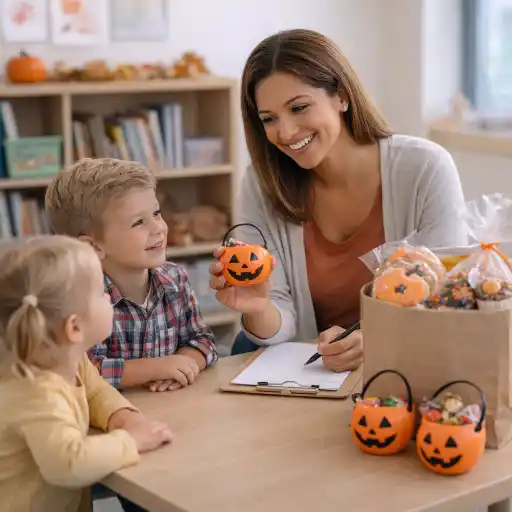
How can staff communicate requests without creating pressure?
Use direct, appreciative language that separates an invitation from an obligation. Families should not have to interpret whether “please bring” is optional. State explicitly that participation or donations are voluntary, and do not single out families who cannot contribute. Offer translation or interpretation where possible and use the communication channel families prefer.
Template: Optional classroom contribution
“Our class will enjoy a fall story and art celebration on [date]. The program will provide the main materials. If your family would like to contribute, we can use [specific item and quantity] by [deadline]. This is completely optional; every child will participate whether or not a family contributes. You are also welcome to share a book title or simply join us.”
Template: Food-related request
“To help us plan safely, please do not send food unless it is on the approved list and labeled with ingredients. We will check all items against children’s documented needs and our program procedures. Non-food contributions and participation are welcome too.”
- 😊 Thank families for their time and ideas, not just for donated goods.
- Send one reminder with the deadline, rather than multiple urgent messages.
- Offer private ways to ask questions or discuss accommodations.
For additional partnership practices, see the ChildCareEd guidance on family engagement strategies. Respectful communication makes the request easier to understand and protects family dignity.
How can we avoid common donation and celebration pitfalls?
Most problems are not caused by families; they arise when requests are vague, last-minute, or disconnected from a realistic plan. Staff may feel pressure to accept every item graciously, even when it creates extra work or cannot be used. Setting a boundary early is kinder than making families guess what is appropriate.
- Pitfall: “Bring anything you can.” Replace it with a short, optional list and a clear limit.
- Pitfall: Making food the center of the event. Offer non-food activities so allergies, dietary practices, cost, and sensory needs do not prevent participation.
- Pitfall: Assuming every household can contribute. State plainly that no donation is required and provide the materials yourselves when feasible.
- Pitfall: Asking families to explain a culture or tradition. Invite voluntary sharing without making any child or caregiver a spokesperson.
- Pitfall: Collecting items without a storage or safety plan. Name who will receive and review contributions and what happens to unused materials.
Food safety deserves particular attention. Check current child records and program policies, maintain ingredient information, and do not serve a donated food item if its contents or safe handling are unclear. ChildCareEd’s allergy safety and prevention toolkit Buy Now $0.00 includes checklists and family forms that can support organized planning. Protect children’s safety while keeping a meaningful non-food route into the celebration.
How can a program keep celebrations manageable and meaningful?
Choose a scale your team can sustain. A short, predictable classroom activity may create more connection than a large event requiring extensive setup and cleanup. Assign staff responsibilities in advance, prepare a simple schedule, and limit the number of materials and stations. A calm, well-organized experience helps children focus on the shared activity rather than waiting through long transitions.
Gather feedback afterward with one or two questions, such as “What felt welcoming?” and “What would make the next event easier to join?” Offer a paper, digital, or verbal option. Reflect with staff on whether the plan stayed within the intended workload, whether contributions were useful, and whether children had accessible ways to participate. This is a practical form of continuous improvement, not a test of whether the event was perfect.
Helpful next steps include:
- Choose one simple fall activity and decide what the program will provide.
- Share a concise, optional request with quantities and a deadline.
- Prepare a no-cost participation option for every child and family.
- Confirm food, allergy, privacy, and licensing procedures before the event.
- Thank families and staff, then use their feedback to adjust the next celebration.
Directors and providers seeking further learning may explore Building a Community of Families Buy Now $16.00, Community and Family Engagement in Childcare Buy Now $24.00, Bridging Cultures: Family Communication & Collaboration Buy Now $55.00, Family Voices Matter: Tools for Meaningful Collaboration Buy Now $55.00, and Open Ears: Listening in Child Care Buy Now $16.00. These English-language courses address family partnership, communication, and collaboration from complementary angles.
Conclusion: How can clear expectations make fall parties easier?
Fall party donations create extra work when requests are vague, contributions are assumed, or safety and storage are left to chance. Programs can reduce that burden by choosing a manageable event, deciding what staff will provide, and making any family contribution specific, limited, and explicitly optional. Include non-purchase ways to participate and communicate in accessible, respectful language.
The goal is not to collect more supplies; it is to create a positive experience where every child and family feels welcome. Clear guidelines and thoughtful message templates help providers protect staff capacity, respect family circumstances, and keep the celebration focused on connection and play. Start with one simple plan, invite family voice without pressure, and make the program’s expectations easy to understand.
- 45 Hour Child Growth and Development
- 45 Hour Preschool Methods and Materials
- Legal & Ethical Essentials in Child Care
- 45 Hour Infant and Toddler Methods and Materials
- 45 Hour School Age Methods and Materials
- CDA Bridge Bundle: Family Child Care without Portfolio Review
- Texas Director Credential
- 45-Hour Infant and Toddler Curriculum
- CDA Certification en Español: Recursos y Consejos para Educadores Bilingües
- Recursos en Español sobre el Sueño Seguro del Bebé
- ¿Qué Calificaciones Necesitas para Trabajar en Cuidado Infantil?
- Capacitación en Salud y Seguridad Preventiva en Línea para Proveedores de Cuidado Infantil
- ¿Cómo solicito la licencia para una guardería en California?
- Normas de Licenciamiento de Cuidado Infantil en Virginia para Centros Diurnos Infantiles y Hogares Diurnos Familiares
- Proporciones de Cuidado Infantil y Tamaños de Grupo por Edad en Maryland (Guía Rápida para Centros y Hogares)
- Proporciones de Cuidado Infantil y Tamaños de Grupo por Edad en Nueva Jersey (Guía Rápida para Centros y Hogares)
- Proporciones de Cuidado Infantil y Tamaños de Grupo por Edad en Virginia (Guía Rápida para Centros y Hogares)
- ¿Cuál es la Diferencia Entre la Crianza Respetuosa y la Crianza Permisiva?
- Temas y Actividades para el Día Nacional del Kindergarten para Proveedores
- Cómo Trabajar en el Cuidado Infantil en Wisconsin: Requisitos y Pasos
- Cómo Ser Maestra de Preescolar en Maryland
- Capacitación Previa al Servicio para Proveedores de Cuidado Infantil en Dakota del Norte
- Capacitación Previa al Servicio para Proveedores de Cuidado Infantil en Nevada
- Capacitación Previa al Servicio para Proveedores de Cuidado Infantil en Wisconsin
- Celebrando la amistad en el cuidado infantil durante el Día de los Mejores Amigos
- Canciones, juegos y preguntas de círculo para niños
- Cómo simplificar la capacitación para sus empleados de daycare
- How Can Child Care Programs Set Clear Expectations for Fall Party Donations Without Creating Extra Work?
