Healthy mouths are essential to children’s overall health, comfort, development, and ability to participate fully in classroom activities. This article offers practical, evidence-informed strategies that child care directors and providers can use to support children’s oral health through daily routines, nutritious food and drink choices, age-appropriate toothbrushing practices, staff training, family education, and clear procedures for responding to dental pain, injuries, or other concerns. It also explores realistic and culturally responsive ways to make oral-health education part of a busy early learning program. To strengthen your program’s approach to lifelong wellness, explore ChildCareEd’s self-paced online courses Healthy Habits from the Start  Buy Now $24.00 and Health and Nutrition Buy Now $24.00, which help providers promote healthy routines, nutrition, and positive wellness practices for young children. For more in-depth guidance on meal planning, reducing sugary exposures, and integrating nutrition education into your curriculum, see the ChildCareEd article Nutrition in Early Childhood.
Throughout the article, we link to trusted resources — including ChildCareEd materials you can use immediately — and to national guidance so you can explain the rationale to families and licensing bodies. Remember: state requirements vary - check your state licensing agency.
1) What are the most important oral health risks for young children, and why does it matter?
- Key risks (short list):
- Frequent exposure to sugary drinks or prolonged bottle use (including nighttime bottles).
- Poor daily cleaning (infant gum wiping through supervised brushing when teeth erupt).
- Lack of fluoride protection (toothpaste, varnish, or community water fluoridation).
- Limited access to preventive dental care and sealants for older preschoolers.
- Evidence-based impacts:
- Fluoride varnish reduces cavities in primary teeth by about one-third and dental sealants prevent most molar cavities; see CDC oral health tips and program guidance on school sealant programs.
- Equity note: Children from low-income families have higher rates of untreated cavities; prevention in programs can reduce disparities (see Oral Health Kansas).
2) When and how should toothbrushing and fluoride be used in an early childhood setting?
- Start early and be consistent:
Wipe infant gums twice daily and begin brushing as soon as the first tooth appears. This mirrors public health guidance; the CDC recommends dental visits by the first birthday and early cleaning routines (CDC oral health tips).
- Daily toothbrushing routine (center-based):
- Supervise brushing after meals/snacks when practical; younger children need help until they can brush well (usually ~6–8 years).
- Toothpaste amounts: grain-of-rice for under 3; pea-sized for ages 3–6.
- Do not rinse out — spitting is fine; leaving a small amount of fluoride in the mouth increases protection.
- Fluoride varnish and water fluoridation:
Encourage families to learn whether their water is fluoridated and to work with pediatric providers about varnish where local rules allow. Fluoride varnish application in community settings is recommended by public health and often delivered through partnerships; see CDC prevention.
- Infection control and storage:
- Label and store individual toothbrushes; replace brushes every 3–4 months or after illness.
- Follow your state licensing infection control rules and program policies.
3) How can programs create oral health policies, screenings, and community partnerships?
- Adopt a written oral health policy that includes:
- Daily hygiene routines (who brushes, when, supplies), food/beverage limits, and referral steps for observed concerns.
- Privacy and documentation procedures — dental notes belong in the child’s health record.
- Screening and referral protocol:
Train staff to do basic visual checks (not clinical diagnoses) and to document findings. For programs funded by Head Start, formal dental exams and tracking are required; for other programs, screening can still be valuable. For an operational overview, see National Childcare Authority.
- Build partnerships:
- Contract with local hygienists, mobile clinics, or FQHCs for on-site sealant or varnish events.
- Link families without dental homes to community resources; UCLA’s children’s oral health center emphasizes dental homes and community collaboration.
- Train staff and involve families:
- Provide brief hands-on training and scripts for family communication; share materials such as the ChildCareEd Oral Health Activity Book for Children Buy Now $0.00.
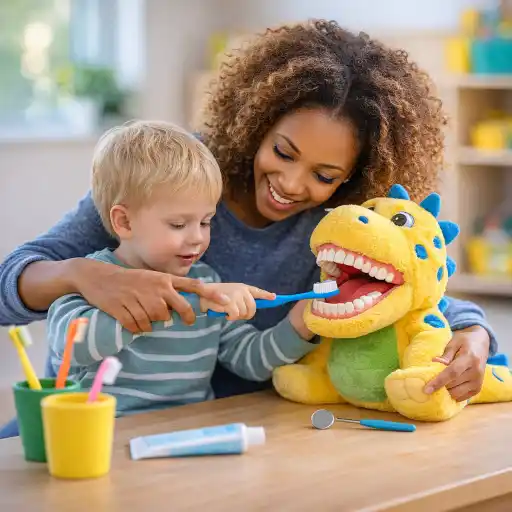
- Provide brief hands-on training and scripts for family communication; share materials such as the ChildCareEd Oral Health Activity Book for Children Buy Now $0.00.
- Regulatory note: state requirements vary - check your state licensing agency before implementing clinical activities (e.g., varnish by non-dental staff).
4) What classroom activities and family engagement approaches build lasting oral health habits?
Programs are powerful places to normalize healthy routines and engage families in prevention. Combine play-based learning with practical supports.
- Classroom strategies (mixed-age friendly):
- 🪥 Toothbrushing practice: Use a dental dramatic play center, toothbrush painting, or a mirror-based routine to teach technique. See preschool activity ideas at Pre-K Printable Fun and the ChildCareEd activity book (ChildCareEd oral health activity Buy Now $0.00). For arts-integrated ideas that combine storytelling, music, and movement with oral-health themes, see Story Tapestries' activities and event guides.
- 🍎 Food sorting games: Happy teeth vs. sad teeth food sorting and science experiments showing acid effects help kids connect eating to teeth health (activity examples at Preschool Plan-It).
- 📚 Story and share: Invite families or local dental professionals to visit and read dental-themed books.
- Family engagement (practical steps):
- Send home simple visual tips (toothpaste amounts, when to see the dentist) and links to printable resources (e.g., CDC oral health resources and ChildCareEd PDFs).
- Offer a family workshop or short demo during pick up/drop off about brushing technique and how to reduce sugary sips at night. During seasonal celebrations, offer healthy, tooth-friendly cooking demonstrations and low-sugar summer crafts for families — see our Kick-off Summer activities for child care-friendly ideas.
- Use culturally responsive messaging: adapt materials to families' languages and traditions — ChildCareEd’s guidance on culturally responsive practices is a helpful starting point (Culturally Responsive Practices Buy Now $0.00).
- Make it fun and routine: Regular songs, timers, and a rotated “oral health helper” job make daily brushing predictable and joyful for children and staff.
5) How should staff document concerns, avoid common mistakes, and respond to dental problems?
Clear documentation and respectful family collaboration are essential when you observe problems.
- Documenting observations:
- 📑 Use objective notes: date, time, setting, what you saw (e.g., visible brown spots on upper front teeth), and how the child was affected (pain, difficulty eating).
- 🔁 Track patterns over time rather than a single event before recommending next steps.
- When to refer:
- If decay or pain affects eating, sleep, or participation, contact the family immediately and provide written guidance and community referrals.
- When classroom supports don’t reduce a pattern of concern, suggest pediatric or dental evaluation and consider early intervention referrals where developmental concerns coexist.
- Common mistakes and how to avoid them:
- ❌ Mistake: labeling behavior as “bad” rather than checking for pain — fix: document and ask families about feeding, sleep, and home care.
- ❌ Mistake: inconsistent toothbrushing routines — fix: assign roles, schedule brushing after a snack or lunch, and keep supplies simple and ready.
- ❌ Mistake: not partnering with families — fix: share observations kindly, offer resources, and ask about home routines.
- Quick FAQ for providers:
- Q: When should a child first see a dentist? A: By the first birthday or within 6 months of the first tooth, per pediatric dental guidance and resources like CDC guidance.
- Q: Can child care staff apply fluoride varnish? A: Some states permit it with training and authority; state rules vary — check your state licensing agency and local public health partners.
- Q: How do we handle a child who refuses brushing? A: Use small steps, peer modeling, sensory-friendly tools, and family strategies; ChildCareEd has classroom activity support (oral health activity Buy Now $0.00).
- Q: Who to contact for on-site sealant or varnish events? A: Local health departments, dental schools, mobile clinics, or FQHCs often run school-based programs; see CDC school sealant resources (CDC school sealants).
Conclusion
Oral health promotion in early childhood programs is practical, impactful, and equitable when it combines daily routines, written policies, partnerships, and family engagement. Start with small system changes that are easy to sustain: a supervised brushing routine, a labeled toothbrush storage system, a simple screening and referral process, and culturally responsive family outreach. Use free resources (such as the ChildCareEd activity book and printable materials) and CDC public health guidance to make the case to families and funders. Addressing tooth decay early prevents pain, supports learning, and saves families time and money — a true win for children and programs.
Key resources cited in this article: ChildCareEd Oral Health Activity Book Buy Now $0.00, CDC Oral Health Tips for Children, CDC School Sealant Programs, and community-focused pages like National Childcare Authority on oral health policy.
- CDA Home Visitor Subject Area 3 Part 3 Birth to 5
- Balancing Physically Active Play in Child Care
- Language and Literacy Foundations in Pre-K
- Early Emotional Wellness
- Nutrition Essentials for Child Care Providers
- CDA Bridge Bundle: Family Child Care without Portfolio Review
- CDA Bridge Bundle: Infant/Toddler without Portfolio Review
- Balancing Active Play in Child Care
- Preventative Health and Safety
- On My Plate: Children's Nutrition
- Free Vocabulary Kit for your Classroom!
- Cultivating Literacy, Language, and Cultural Awareness: The Hanukkah Minibook in Early Childhood Education
- First Aid & CPR ~ Empowerment Through Lifesaving Skills
- CDA Certification en Español: Recursos y Consejos para Educadores Bilingües
- Cómo Trabajar en el Cuidado Infantil en Carolina del Norte: Requisitos y Pasos
- How can early childhood programs effectively support children's oral health?
- How Can You Celebrate Black Culture and Music Effectively in Your Program?
- How can child care providers build early literacy skills through play?
- How Can Child Care Programs Build Healthy Teeth Habits for Young Children?
- How can child care providers build early literacy skills through play?
- How Can Picture Task Cards Support Emerging Readers?
- How Can Child Care Providers Support Early Writing Without Using Worksheets?
- How Can Simple Music and Movement Activities Build Early Literacy Skills?
- How Can Providers Support Families Who Rely on Head Start?
- How Can Kindergarten Teachers Strengthen Sight Word Recognition with Low-Prep Activities?
- How Can Child Care Providers Teach Beginning Sounds with Tracing, Pictures, and Repetition?
- How Does Word Sorting Build Phonics and Vocabulary Skills?
- How Can Themed Vocabulary Strengthen Beginning-Sound Awareness in Preschool?
- How Can Familiar Real-Life Processes Help Preschoolers Learn Sequence Words?
