California teachers and directors know how busy days can be. Watching children on purpose helps you see what they know, what they need next, and how to plan. This short guide shows clear steps you can use today in your #classroom to make observation a simpl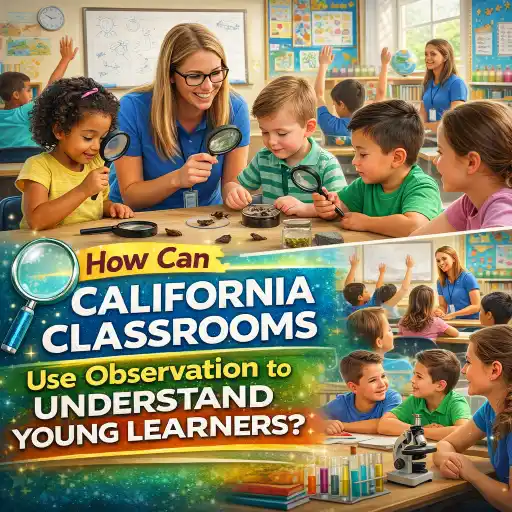 e habit. Why it matters: Observation helps you spot strengths early, plan fair teaching, and build trust with families. For quick tools and a checklist, see How do I run effective classroom observations (Checklist included)? and the practical ideas in How do we observe with purpose in early childhood assessment?. Remember: state requirements vary - check your state licensing agency.
What does observation look like in a California classroom?
- 🔎 Pick one focus (1 skill or routine). Example: language at circle, sharing at snack.
- 🕒 Choose a time (5–15 minutes for a quick check; longer for routines).
- 📅 Do short checks often and one deeper observation each month.
- 📝 Note date, time, setting, and exact words or actions.
Why this works:
- It keeps notes short and useful.
- It shows patterns when you repeat the same checks.
- It makes planning clearer for staff and #families.
For hands-on examples and a step-by-step plan, visit ChildCareEd’s guide at How can teachers observe children's development effectively? and the classroom examples in Observations in Childcare. These resources help you choose a focus and keep notes short.
Which simple tools and methods can we use?
- ⏱ Time sampling — check if a behavior happens during set time blocks (good for routines).
- 🎯 Event sampling — write each time a specific event happens (for example: offering help).
- 🧾 Anecdotal notes & portfolios — short stories, photos, or work samples over time.
Helpful steps:
- 📌 Use a short form (date, setting, action). See the Anecdotal Record template at Anecdotal Record Observation Form Template Buy Now $0.00.
- 📷 With family permission, use a photo or short video to capture details.
- 🔁 Occasionally have two staff observe the same moment to check agreement.
Need more tools? ChildCareEd’s resources for assessing through observation list free templates and guides at Assessing through Observation. Start with one tool and make it part of your daily routine.
How do we keep notes fair and turn them into goals?
- 🔍 Write only what you see or hear. Example: "Ava stacked 6 blocks" not "Ava is good at building."
- 🧾 Include date, time, location, and who was nearby.
- 👥 Use another observer sometimes to reduce bias.
Common mistakes and quick fixes:
- ❗Writing opinions — Fix: stick to facts and quotes.
- ❗Watching only hard moments — Fix: observe play and routines so you see strengths too.
- ❗Using just one tool — Fix: combine notes, checklists, and photos for a fuller view.
Turn notes into small goals with this 3-step plan:
- 📑 Summarize the moment in one short paragraph (who, what, when).
- 🎯 Make 1–3 short measurable goals. Example: "Will name 3 colors during art time in 3 of 5 tries."
- 🛠 List 2–3 teacher supports tied to routines and re-check in 2–4 weeks.
See ChildCareEd’s guidance on using observations to set goals in How do I run effective classroom observations (Checklist included)? and for more ideas on documentation, see 5 Ways Observation and Documentation Help. Turning observation into clear #goals supports each child’s #development and honors their #strengths.
How do we share observations with families and staff?
Sharing should be short, kind, and concrete. Use examples and start with strengths.
- 🙂 Start with one strength and one short example (photo or sentence).
- 🤝 Invite family input: ask what they notice at home and what helps.
- 📌 Keep it short: show a photo or one sentence plus the next small step.
- 🔒 Protect privacy: store records securely and follow program policy.
When to refer: If goals do not show progress, document carefully and consult specialists. For steps on referral and documentation, see ChildCareEd courses like How can teachers observe children's development effectively?. Also, keep in mind state processes — state requirements vary - check your state licensing agency.
Program supports that help staff:
- 📚 Offer short trainings and coaching (examples at Staff Supervision, Observation & Feedback Buy Now $20.00).
- 🗓 Make a simple schedule for who observes when so all children get noticed.
- 🎉 Celebrate small wins to keep staff motivated.
Conclusion
Action steps to start this week:
- 1) Pick one routine and one clear focus.
- 2) Use a simple tool (anecdotal note or time sampling) and record one sentence after each check.
- 3) Turn notes into 1–2 #goals, share one short example with families, and re-check in 2–4 weeks.
For more training and templates, explore ChildCareEd courses like Tracking Progress and free resources at Assessing through Observation resources. Your careful #observation of #children helps teachers plan better learning and strengthens partnerships with #families. Start small, keep notes factual, and celebrate progress every day.
Objective notes build trust with families and help staff plan. Follow these simple rules every time you write a note:Observation is focused on watching. Use these steps to make it simple and steady:Pick easy tools your staff will actually use. Try one or two methods for a month and keep what works.- 45 Hour Child Growth and Development
- CDA Home Visitor Subject Area 3 Part 3 Birth to 5
- 45 Hour Infant and Toddler Methods and Materials
- Pediatric RSV First Aid & CPR/AED
- CDA Bridge Bundle: Family Child Care without Portfolio Review
- CDA Bridge Bundle: Infant/Toddler without Portfolio Review
- CDA Bridge Bundle: Preschool without Portfolio Review
- Texas Director Credential
- Anxiety: Signs & Strategies
- Building Quality Early Childhood Education Programs
- Support Services from ChildCareEd for our Learners
- 🔍 ¿Qué ves cuando observas a un niño aprender?
- Early Childhood Education in California ☀️
- 10 Ejemplos de Cómo la Cultura Influye en el Desarrollo Infantil
- How can positive guidance make indoor transitions calm in California early childhood classrooms?
- How can California early childhood educators communicate respectfully with diverse families?
- How can California early childhood classrooms build strong parent partnerships?
- How can California early childhood educators support preschoolers through behavior challenges?
- Childcare Workshops That Support Professional Growth
- How can California classrooms use observation to understand young learners?
- How can we celebrate diversity and inclusion in California early childhood classrooms?
- What Did California Educators Take Away from the 2026 CAAEYC Conference in Pasadena?
- Canciones, juegos y preguntas de círculo para niños
- Pasadena Playbook: Fresh Classroom Ideas Inspired by California’s 2026 Early Childhood Education Conference
- How can California child care providers prepare for wildfire smoke, power outages, and closed classrooms?
- California Child Care Ratios and Group Sizes by Age: Daycare Center Guide
