When a preschooler guesses “fox,” the richest learning may come from asking, “What clue helped you know?” A few well-chosen prompts can turn a playful woodland game into practice with vocabulary, reasoning, and conversation; explore Language Development in Early Childhood  Buy Now $16.00 for broader strategies to support children’s verbal and nonverbal communication. For an activity you can put into practice, the Animal Guessing Game Teaching Guide Buy Now $1.75 offers clues, cards, and turn-taking ideas, while the course provides a more complete learning experience for strengthening language-rich classroom practices.
Why invite children to explain how they know?
A guess is more than a right-or-wrong answer. When children explain, “It has a bushy tail,” or point to an animal’s ears, they show how they use observations, prior knowledge, and clues to make sense of an idea. These moments help educators see children’s developing reasoning, even when a child’s spoken response is still brief.
Explaining also gives children meaningful practice in #language, listening, and social exchange. Head Start describes language development as both receptive—understanding what is heard—and expressive—communicating thoughts and ideas. A guessing game draws on both: children listen to clues, connect words with images, and share a response. As NAEYC’s oral-language resources emphasize, rich interactions create opportunities for children to contribute ideas and build communication skills.
Keep the aim playful rather than evaluative. A child who points, gestures, uses a communication aid, or answers in a home language is participating meaningfully. Treat each response as information about what the child noticed and what support might help next.
- Builds opportunities to hear and use descriptive words.
- Helps children connect evidence with a possible answer.
- Creates natural moments for listening and peer conversation.
- Gives educators insight into children’s interests and strategies.
How can you prepare a purposeful woodland guessing game?
Start with a small set of familiar woodland animals—perhaps a fox, owl, rabbit, deer, bear, and squirrel. Use clear picture cards, toy animals, or photographs, and introduce the images before play. A manageable set lets children focus on the clues instead of scanning a crowded display. ChildCareEd’s Animal Guessing Game Teaching Guide Buy Now $1.75 includes animal and clue cards, a sorting mat, and options for small-group or whole-class play.
Choose one learning focus for a round: recognizing animals, understanding descriptive words, or giving a reason for a choice. Select clues that are accurate and sufficiently distinctive, but leave room for children to think. For instance, “This animal has feathers and can call from a tree” offers more information than “It lives outside.” Some clues may fit more than one animal; that can become a useful conversation rather than a problem.
Explain the routine and model one turn: listen, look, make a guess, then share a clue that informed it. Show children how to pass the card or wait while a classmate responds. Keep rounds brief and materials visible so children can follow along.
- Use a few target words, such as feathers, burrow, antlers, or nocturnal, and explain them in child-friendly language.
- Pair spoken clues with pictures, gestures, or toy animals.
- Prepare a shared board or sorting mat for children who prefer group participation.
- Invite children to make a clue after they understand the routine.
Which prompts help preschoolers explain their reasoning?
Move gradually from recognition to reasoning. First ask children to find or name an animal. Then invite them to describe what they notice and explain how a clue connects to their guess. One clear prompt at a time gives children room to process; a quiet pause is often more useful than another question delivered immediately.
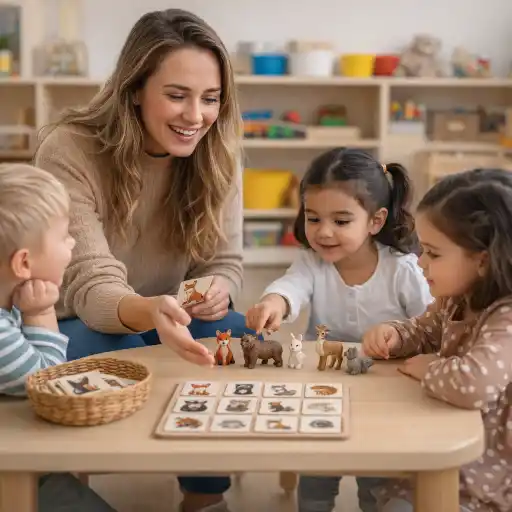
Try prompts such as:
- “What did you notice in the picture?”
- “Which clue helped you decide?”
- “What makes you think it might be an owl?”
- “Can you show me the feature you noticed?”
- “What else could fit that clue?”
Respond to the child’s idea by reflecting and extending it. If a child says, “Fox—big tail,” you might say, “You noticed the fox’s bushy tail. That clue helped you recognize it.” This validates the child’s thinking and models a fuller sentence without requiring repetition. A useful approach described in ChildCareEd’s guidance on encouraging children to explain their thinking is to listen, restate the idea, and ask one purposeful follow-up.
Accept uncertainty and alternate answers when a clue could reasonably match more than one animal. Invite children to compare features or ask what additional clue would help. The goal is to make thinking visible, not to make every turn feel like a quiz.
How can you make the game inclusive and supportive?
Children vary in expressive language, processing time, sensory preferences, and comfort speaking in a group. Make participation flexible: children can say an answer, point to a picture, gesture, sign, use an augmentative and alternative communication (AAC) tool, draw, or share with a partner. The idea can be communicated in a home language, too. Head Start notes that language skills develop in any language and that supporting a child’s home language can support learning English.
Adjust the activity without losing its purpose. Offer fewer picture choices, enlarge the cards, reduce background noise, or allow extra time. A child may understand a clue before being ready to explain it in a sentence. A picture choice or gesture can show comprehension and give the educator a helpful starting point for modeling words.
- Preview the sequence with a brief demonstration or picture schedule.
- Offer pair or small-group play as an alternative to whole-group turns.
- Use cooperative play, where everyone helps solve the clue, rather than emphasizing speed or winners.
- 🦉 Invite children to act out a movement or sound as another way to share an idea.
- Ask families about familiar animal names, stories, or words in their home languages.
Notice effort, careful observation, and listening—not only correct guesses. If a child becomes frustrated while waiting, acknowledge the feeling and provide a predictable cue for the next turn. State requirements vary - check your state licensing agency when determining whether a particular training meets a professional-development requirement.
How can educators notice learning and extend it beyond the game?
Use the game as one informal opportunity to observe children, not as a stand-alone test. Notice whether each child attends to a clue, matches a picture, names an animal, uses a descriptive word, explains a choice, or responds through another communication mode. Record what happened in context. For example: “During the woodland game, Sam pointed to the deer after hearing ‘antlers’ and said ‘on its head’ when asked what helped.” This is more useful than a broad label such as “good at language.”
Use patterns across several activities to plan a next step. A child who recognizes animals may be ready for more specific clues; a child who points accurately may benefit from modeled phrases such as “I think it is ___ because ___.” Revisit the same animal words in picture books, dramatic play, art, or outdoor observation. ChildCareEd’s Preschool Woodland Animal Observation Journal Buy Now $2.00 offers another way for children to notice features and share ideas through drawing, words, gestures, or dictated text.
Keep extensions connected to children’s curiosity: sort pictures by coverings or movement, build a forest habitat, or invite children to create clues for a friend. Repeated, meaningful encounters help vocabulary travel beyond the game, as discussed in the Hanen Centre’s guidance on building vocabulary through classroom activities.
Conclusion: What makes a woodland guessing game a language-rich experience?
A woodland animal guessing game helps preschoolers explain how they know when educators pair clear clues with wait time, thoughtful follow-up prompts, and genuine listening. The most valuable outcome is not a fast or perfect answer; it is a child’s opportunity to notice a feature, connect it with a clue, and communicate that thinking in a way that works for them.
Keep the game accessible, affirm children’s varied communication styles, and carry interesting words into books, play, and observation. Start with one prompt—“What clue helped you decide?”—and build from each child’s response. For a ready-to-use activity, explore the Animal Guessing Game Teaching Guide Buy Now $1.75. For broader strategies to strengthen communication across early childhood settings, consider ChildCareEd’s Language Development in Early Childhood Buy Now $16.00 course.
Related professional learning
- 45 Hour Child Growth and Development
- 45 Hour Preschool Methods and Materials
- What Makes Me Special: An Overview of Autism and ADHD
- CDA Bridge Bundle: Preschool
- CDA Bridge Bundle: Family Child Care without Portfolio Review
- CDA Bridge Bundle: Infant/Toddler without Portfolio Review
- CDA Bridge Bundle: Preschool without Portfolio Review
- Lesson Planning for Preschoolers
- Texas Director Credential
- CDA Certification en Español: Recursos y Consejos para Educadores Bilingües
- 💛🧩 ¿Cómo puedo hacer que mi enseñanza sea inclusiva para los niños con autismo?
- Juegos de Motricidad Gruesa
- Actividades de Motricidad Gruesa que Desarrollan el Equilibrio, la Coordinación y la Fuerza
- 10 Ejemplos de Cómo la Cultura Influye en el Desarrollo Infantil
- Proporciones de Cuidado Infantil y Tamaños de Grupo por Edad en Maryland (Guía Rápida para Centros y Hogares)
- Proporciones de Cuidado Infantil y Tamaños de Grupo por Edad en Nueva Jersey (Guía Rápida para Centros y Hogares)
- Cómo Trabajar en el Cuidado Infantil en Carolina del Norte: Requisitos y Pasos
- Capacitación Previa al Servicio para Proveedores de Cuidado Infantil en Nevada
- Celebrando la amistad en el cuidado infantil durante el Día de los Mejores Amigos
- Canciones, juegos y preguntas de círculo para niños
- How Can Fun Bingo Games Teach Colors, Shapes, and Animals to Preschoolers?
- Why Is Animal Bingo a Great Way to Introduce Habitats and Classification?
- How Can We Explore Animal Habitats Beyond Farm-and-Wild Labels?
- How Can a Preschool Lost-and-Found Become a Fall Learning Invitation?
- How Can Fall Pretend Play Help Preschoolers Rescue Woodland Toys and Build Hand Skills?
- How Can You Build a Pretend Animal Burrow That Combines Fall Movement With Route Planning?
- How Can Woodland Mail Make Fall Dramatic Play a Meaningful Writing Experience?
- Who Eats What in the Fall Forest? How Can After-School Programs Teach Food Chains?
- How Can a Woodland Animal Guessing Game Help Preschoolers Explain Their Thinking?
