Fall brings a changing forest full of visible clues—seeds, fallen leaves, and animals preparing for colder weather—that can make ecology feel tangible for school-age children. Use the Woodland Camouflage Activity Pack Buy Now $2.00 to spark close observation, then build a purposeful sequence with [course link 2: Lesson Planning to Meet School Age Needs]. The ideas below help children investigate who eats what while giving staff a practical framework for engaging, age-responsive after-school learning.
Lesson Planning to Meet School Age Needs  Buy Now $16.00 offers providers strategies for developing relevant content and differentiating instruction. For an additional classroom-ready activity, explore Woodland Camouflage Activity Pack Buy Now $2.00, which includes a teacher guide, matching, searching, and sorting activities.
Why does a fall forest food-chain lesson matter?
After-school time offers something valuable: room to follow a question beyond a quick classroom explanation. “Who eats what?” invites children to connect familiar fall observations to a larger ecological idea: energy moves through living things, and organisms depend on one another. A tree’s seeds or leaves may feed an insect, a squirrel, or a deer; those consumers may, in turn, become prey for another animal. The specific relationships vary by species, location, and season, so the goal is not to memorize one universal chain but to investigate plausible connections.
Food-chain activities also support skills beyond science. Children practice sorting, sequencing, vocabulary, listening, collaboration, and evidence-based explanation. They can test ideas with picture cards, model energy flow with arrows, and revise their thinking when a peer asks a thoughtful question.
Most importantly, a playful investigation respects school-age children as curious problem-solvers. Some may enjoy drawing or movement; others may prefer discussion, puzzles, or quiet observation. Offering multiple ways to participate helps more children contribute and makes the experience richer for the whole group.
How can educators explain food chains accurately and accessibly?
Start with a clear model. A food chain shows one pathway through which energy passes as one organism eats another. In a forest, a plant such as an oak tree is a producer: it uses sunlight to make its own food. A caterpillar or mouse may be a consumer that eats plant material or seeds. A predator may eat that consumer. Fungi and other decomposers break down dead organic matter and return nutrients to the environment. A familiar example might be sunlight → oak leaves → caterpillar → songbird, while reminding children that the chain is a simplified model.
Use arrows to show the direction of energy transfer: from the organism being eaten to the organism that eats it. Children often reverse arrows if they think they point toward the food source, so model one example aloud: “The leaf provides energy to the caterpillar; the arrow goes from the leaf to the caterpillar.”
- Producer: a plant that makes its own food using sunlight.
- Consumer: an organism that gets energy by eating plants or other animals.
- Decomposer: organisms such as fungi and many microscopic life forms that break down dead material and recycle nutrients.
- Food web: many connected feeding relationships, more realistic than a single line.
Explain that animals can have varied diets and may occupy different roles in different relationships. A squirrel may eat seeds, fruit, and insects; a fox may eat small mammals, insects, or fruit. The forest is not a tidy row of cards—it is a connected #ecosystem.
What hands-on activities make food chains memorable?
Choose an activity format that fits the group, available time, and indoor or outdoor space. A short sequence can move from noticing, to matching, to explaining. The ChildCareEd resource Woodland Camouflage Activity Pack Buy Now $2.00 offers a woodland search, matching worksheet, and cut-and-sort activity that can support observation and vocabulary. Pair it with a food-chain puzzle, homemade cards, or a nature journal.
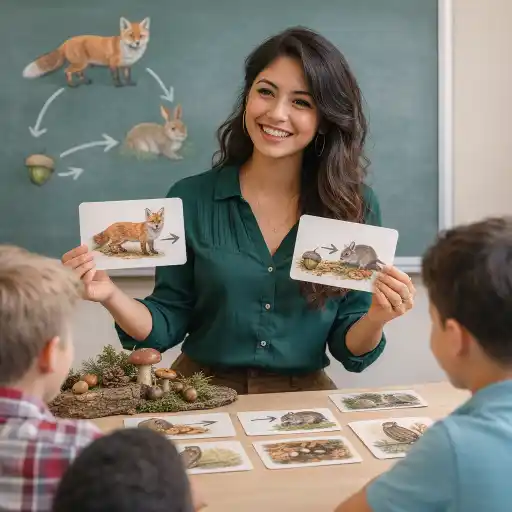
- Forest food-chain puzzle: Provide picture cards for sunlight, plants, insects, small animals, and predators. In pairs, children arrange a plausible chain and add arrows. Ask them to explain what evidence or prior knowledge informed their choices.
- Who eats what? matching station: Match an organism with a food source, then add a “How do you know?” prompt. Accept more than one scientifically plausible match where appropriate.
- Living food web: Give each child an organism card. Use yarn to connect feeding relationships, then invite the group to notice how many links connect the web.
- Fall observation walk: Look for leaves, seeds, fruit, insects, tracks, or signs of animal activity without disturbing wildlife. Children can sketch what they see and form questions.
- 🍂 Leaf-litter detective: Observe leaf litter from a respectful distance or use a small sample with adult supervision; discuss how decomposing leaves provide habitat and nutrients.
Project Learning Tree and Green Schoolyards America offer environmental-learning activity collections, including ecosystem investigations and food-web play. Adapt the duration and materials to the group, and keep outdoor discovery safe, accessible, and respectful of living things.
How can staff adapt the lesson for different ages and learning needs?
School-age groups often include children with a range of reading levels, prior knowledge, languages, interests, and support needs. Preserve the central learning goal—understanding connections and energy flow—while varying the way children access and show their learning. Visual cards and real photographs can help children who benefit from concrete cues; spoken explanations, labels, and drawing offer different expressive routes.
For younger or beginning learners, use three or four picture cards and focus on “plant,” “eats,” and “animal.” Model arrows and invite children to explain a match in their own words. For older or experienced children, add omnivores, decomposers, multiple possible prey, and the distinction between a simple food chain and a food web. Challenge them to explain how a change—such as fewer seeds or insects—could affect other organisms, while avoiding claims that one change always produces a predictable outcome.
- Offer partner roles such as card sorter, arrow maker, recorder, and reporter.
- Provide large-print cards, tactile objects, or verbal descriptions as useful.
- Invite children to choose drawing, oral explanation, a short skit, or a written response.
- Use open-ended prompts: “What makes you think that?” and “Could there be another connection?”
NAEYC’s developmentally appropriate teaching strategies emphasize observing children, asking questions that extend thinking, giving specific feedback, and adjusting challenge. Those practices help staff scaffold without taking over children’s investigation. Intentional lesson planning is also a skill providers can strengthen through ChildCareEd’s Lesson Planning to Meet School Age Needs Buy Now $16.00 training.
What common mistakes should educators avoid?
One common pitfall is presenting a food chain as a fixed, complete picture of the forest. A simple chain is a useful starting model, but real organisms may eat several kinds of food, serve as prey for multiple predators, or rely on resources that change seasonally. Tell children that a model helps us focus on one question; it does not capture every relationship.
Another mistake is treating fall as a single uniform condition. Forests and species differ, and animals respond to seasonal change in different ways. Avoid saying every animal hibernates or stores food. Instead, ask children what evidence they have and distinguish observed signs from a hypothesis. If a local species example is uncertain, frame it as a question to research rather than a fact.
Keep the science supportive, not overly technical. Define terms in context, revisit them while children play, and make space for revision. When children disagree, guide them to compare reasoning and available information instead of treating the activity as a speed contest or a single-answer quiz.
- Do not point arrows from predator to prey; arrows show energy moving from food to eater.
- Do not label all animals as strictly herbivores or carnivores when diets are more varied.
- Do not collect or handle wildlife, fungi, or unknown plants; use images or safe, adult-selected materials.
- Do not equate a child’s first guess with failure—use it as a starting point for inquiry.
When using outdoors, plan boundaries, supervision, accessibility, and weather-appropriate clothing in advance. State requirements vary - check your state licensing agency.
How can programs extend learning and know what children understood?
Close with a quick reflection that makes children’s thinking visible. Ask each child to sketch one food chain, explain an arrow, or share one question they still have. A group map can capture links children discovered and connections they want to investigate next. The goal is not only correct vocabulary; it is whether children can explain a relationship and recognize that organisms depend on resources in their habitat.
Use observations to plan the next session. If children confidently match organisms but confuse energy-flow arrows, begin with a brief movement demonstration: one child holds a “leaf” card and passes an energy token to a “caterpillar,” then to a “bird.” If they already understand the basic chain, extend the activity by adding decomposers or comparing two possible food sources. Invite children to suggest a local tree, animal, or question for the next project.
Keep a simple record: note participation, vocabulary children used, explanations they offered, and what support helped. Share a photo of a group-created model or a child’s nature journal with families, following program policies. These small documentation habits help directors and staff connect a lively activity to purposeful curriculum planning.
Summary: To answer “Who eats what in the fall forest?” begin with plants as producers, explore consumers and decomposers, and use arrows to represent energy moving from food to eater. Hands-on matching, puzzles, outdoor observation, and group food webs make the concept engaging, while open questions and flexible participation support a range of learners. Treat each chain as a model—not the whole forest—and let children’s observations guide what you investigate next.
Explore five relevant ChildCareEd courses:
- CDA Preschool Credential
- CDA Preschool Credential with Portfolio Review
- Lesson Planning to Meet School Age Needs
- Emergent Learning & Development
- Key Elements of an After School Program
- CDA Family Child Care Credential with Portfolio Review
- Creating Environments that Nurture Growth and Community
- Texas Director Credential
- 45-Hour Infant and Toddler Curriculum
- CDA Certification en Español: Recursos y Consejos para Educadores Bilingües
- Cómo Abrir Una Quardería En Casa Sin Dinero?
- Requisitos Para Ser Maestra Principal En Un Daycare: Lo Que Necesitas Para Empezar
- Recursos en Español sobre el Sueño Seguro del Bebé
- 10 Ejemplos de Cómo la Cultura Influye en el Desarrollo Infantil
- Cómo Empezar una Guardería en Casa: Requisitos y Pasos
- ¿Cómo solicito la licencia para una guardería en California?
- Regulaciones de Licenciamiento de Cuidado Infantil en California para Centros y Hogares de Cuidado Infantil Familiar
- Normas de Licenciamiento de Cuidado Infantil en Virginia para Centros Diurnos Infantiles y Hogares Diurnos Familiares
- Proporciones de Cuidado Infantil y Tamaños de Grupo por Edad en Maryland (Guía Rápida para Centros y Hogares)
- Proporciones de Cuidado Infantil y Tamaños de Grupo por Edad en Nueva Jersey (Guía Rápida para Centros y Hogares)
- Lista para Guardería en Casa en Texas: Cómo Iniciar una Guardería en el Hogar
- Cómo Trabajar en el Cuidado Infantil en Carolina del Norte: Requisitos y Pasos
- Cómo Trabajar en el Cuidado Infantil en California: Requisitos y Pasos
- Cómo Ser Maestra de Preescolar en Illinois
- Cómo Ser Maestra de Preescolar en Wisconsin
- Celebrando la amistad en el cuidado infantil durante el Día de los Mejores Amigos
- How Can Fall Foods Help Children Explore Family Traditions?
- How Can Rainforest Animals Help School-Age Children Understand Adaptation?
- Who Eats What in the Fall Forest? How Can After-School Programs Teach Food Chains?
