For a simple invitation, place five apple counters beside two small baskets and ask, “How could we share all five?” Children can move, count, draw, and explain the different pairs that make five. The goal is not speed or memorization; it is helping children see and describe how parts relate to a whole.
Why does exploring number bonds with five apples matter?
Number bonds make the structure of a number visible. When children split five objects into two groups, they explore that five can be composed of parts such as one and four or two and three. This part–part–whole idea is a foundation for later addition and subtraction, but it begins with concrete experiences children can touch and discuss.
NAEYC’s guidance on number composition and everyday problem solving emphasizes using objects, stories, and play to help young children reason about how numbers can be broken apart and recombined. Research on kindergarten number sense also supports purposeful instruction that strengthens early number competencies, while recognizing that children bring different experiences and develop at different rates.
A fall apple center can make this learning feel welcoming rather than test-like. Children choose a way to arrange five apples, notice what changes and what stays the same, and share their thinking in words, gestures, pictures, or objects. These small moments nurture #number sense, confidence, and curiosity.
How can you set up a five-apples center?
Keep the setup inviting, uncluttered, and easy to reset. Use five identical apple counters if possible, or five large paper apple cutouts, along with a mat divided into two spaces. Add a simple whole-and-parts drawing or number-bond frame, and keep pencils or dry-erase markers nearby for children who want to record their ideas.
- Gather five safe, identical apple counters or large paper apples, two baskets or mat spaces, and a recording sheet.
- Show the children the whole collection first: count the apples together, touching or moving one item at a time.
- Invite one child to split the apples between the two parts. Ask, “How many are here? How many are there? How many altogether?”
- Record the child’s arrangement with dots, drawings, or numerals, depending on readiness.
- Return all five apples to the whole group before trying another arrangement.
Start with a brief demonstration, then leave room for independent exploration. The apple math mat activity offers an example of using a seasonal theme with objects and visual representations. For classroom safety, choose materials that are appropriate for the children’s ages and supervise closely; avoid small loose counters when they are not suitable for the group.
What combinations of five can children discover?
For two nonempty groups, children can find one and four, two and three, three and two, and four and one. They may also explore zero and five or five and zero when they are ready to think about an empty group. The pair is reversed when the groups switch places, but the total remains five.
Keep the exploration concrete. Children can move the apples between baskets, split a row of five linking cubes, or show a pair with their fingers. A dot drawing is another helpful bridge: the child can sketch two dots in one part and three in the other, then count all five. As children share, model language such as “Two and three make five” and “Five is the whole; two and three are the parts.”
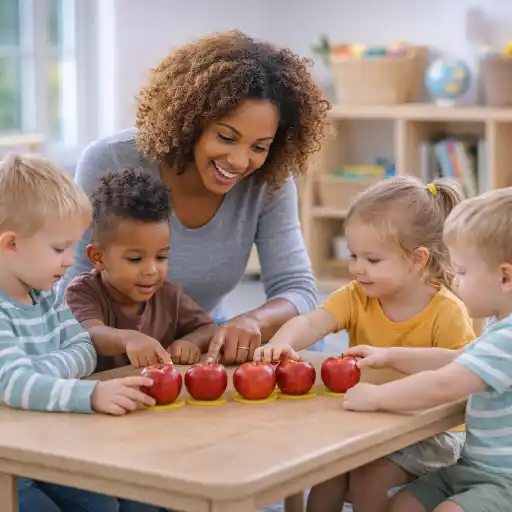
Let children repeat familiar combinations and revisit them on different days. The aim is meaningful recognition and reasoning, not a race to list every pair. If a child counts each group and then counts all the apples again, that is a useful strategy; you can also point out the combined total and invite the child to explain how they know. A resource on getting started with number bonds to five likewise highlights the value of context and manipulatives.
How can you guide the activity without taking over?
Your questions can make children’s mathematical thinking visible while allowing them to lead. Instead of asking only for the answer, invite them to show, compare, and explain. Give wait time, accept pointing or arranging as communication, and treat unexpected responses as information about what the child is noticing.
- “Can you show another way to split the five apples?”
- “What stayed the same when you moved one apple?”
- “How can we check that there are still five altogether?”
- “Can you show the same parts with dots, fingers, or a drawing?”
- 🍎 “If one apple is in this basket, how many are in the other basket?”
For a child who is still developing one-to-one counting, count slowly together and touch each apple once. If the child is ready for more, invite them to find all the different arrangements, match a drawing to a numeral, or describe what changes when the groups trade places. Children who use more than one language may benefit from hearing key terms and number words in their home language as well as English.
Keep the challenge responsive. NAEYC’s examples of playful number composition show how movement, stories, and visual representations can complement one another. Rather than requiring every child to complete the same worksheet, observe what each child can already do and offer a next step that feels achievable.
How can you extend the center and notice learning?
Once children have explored with real objects, invite them to represent their thinking. A simple number-bond worksheet can serve as a recording option after hands-on play, not as a substitute for it. The featured Make 5: Kindergarten Number Bonds and Dot Addition Worksheet can reinforce the connection between two groups of dots and a total of five. Pair a page with counters so children can build the quantity first, then draw or mark what they made.
Extend the same idea into classroom routines: count five pretend apples at the dramatic-play market, divide five napkins between two tables, or notice five leaves on a picture card. For small-group practice, invite children to create an apple story: “Three apples are in the basket and two are on the table. How many apples are there altogether?” Story contexts can help children connect the quantities to a meaningful situation.
As you observe, note specific strategies rather than labeling a child as good or weak at math. For example: “Matched five counters to the numeral 5,” or “Split the group into two and three, then counted the total.” These notes can guide your next invitation and help colleagues plan supportive experiences. You can also explore ChildCareEd’s ideas for adding math to the early childhood classroom for ways to connect number learning with everyday play.
What common pitfalls should you avoid?
A common pitfall is moving to written equations before children understand the quantities. If a child is asked to write 2 + 3 = 5 without seeing or making the groups, the symbols may feel disconnected from the math. Begin with objects and talk; add dots, drawings, and numerals gradually, following children’s interest and readiness.
Another trap is treating the activity as a speed test or correcting every response immediately. Children need time to count, rearrange, and reconsider. A calm prompt such as “Let’s check together” supports persistence better than rushing to supply an answer. Avoid changing too many features at once, too: keep the total at five while children are learning the central idea, then vary the materials or story context later.
- Use identical, age-appropriate materials when the focus is quantity, so color or shape does not distract from the number relationship.
- Offer different ways to respond: moving objects, speaking, pointing, drawing, or using fingers.
- Do not insist that every child find every possible pair in one sitting.
- Connect printables to hands-on exploration rather than relying on worksheets alone.
Children’s skills and experiences vary, and that variation is expected. If you are aligning activities with program policy or professional expectations, state requirements vary - check your state licensing agency.
Conclusion: What should providers remember about number bonds?
Five apples offer a simple, memorable way to explore a big mathematical idea: one whole can be made from different parts. In a thoughtfully prepared fall center, children can count, separate, recombine, draw, and explain pairs such as one and four or two and three. Concrete materials and patient conversation help make the relationship understandable.
Keep the experience playful and responsive. Model the whole and parts, ask open questions, notice each child’s strategy, and extend the learning into stories and daily routines. Use a worksheet as a recording or reinforcement tool after children have handled the objects. Above all, remember the guiding question: how can different groups make five? Invite children to investigate it in their own ways, and celebrate the reasoning they share along the way.
For deeper professional learning on playful early math, explore [Early Mathematics Through Play](https://www.childcareed.com/courses-early-mathematics-through-play_4160.html), [Math Foundations in Early Childhood](https://www.childcareed.com/courses-math-foundations-in-early-childhood-3916.html), [Letter & Number Planning in Child Care](https://www.childcareed.com/courses-letter-number-planning-in-child-care.html), [No Such Thing as Boring Math](https://www.childcareed.com/courses-no-such-thing-as-boring-math.html), and [Spicing Up the Classroom: Learning Centers](https://www.childcareed.com/courses-spicing-up-the-classroom-learning-centers.html).
- 45 Hour Child Growth and Development
- 45 Hour Preschool Methods and Materials
- Montessori Foundations
- Birth to Five CDA Credential with Portfolio Review
- Children at the Wheel: Emergent Curriculum
- The Science of Growing Up: Typical and Atypical Development
- Pediatric RSV First Aid & CPR/AED
- 45 Hour School Age Methods and Materials
- Lesson Planning for Preschoolers
- Texas Director Credential
- CDA Certification en Español: Recursos y Consejos para Educadores Bilingües
- 🔍 ¿Qué ves cuando observas a un niño aprender?
- 💛🧩 ¿Cómo puedo hacer que mi enseñanza sea inclusiva para los niños con autismo?
- 👶 ¿Cuáles son las proporciones y grupos requeridos en Dakota del Norte? 🏫
- Recursos en Español sobre el Sueño Seguro del Bebé
- Proceso CDA: Entrenamiento, Portafolio, Examen y Visita de Verificació
- ¿Cómo empiezo mi certificación CDA en Florida en línea?
- 10 Ejemplos de Cómo la Cultura Influye en el Desarrollo Infantil
- ¿Qué Preguntas Vienen en el Examen CDA de Nacimiento a los Cinco Años?
- Cómo Crear Tu Portafolio CDA Paso a Paso
- Proporciones de Cuidado Infantil y Tamaños de Grupo por Edad en Nueva Jersey (Guía Rápida para Centros y Hogares)
- Proporciones de Cuidado Infantil y Tamaños de Grupo por Edad en Virginia (Guía Rápida para Centros y Hogares)
- Cómo Trabajar en el Cuidado Infantil en Carolina del Norte: Requisitos y Pasos
- Celebrando la amistad en el cuidado infantil durante el Día de los Mejores Amigos
- Canciones, juegos y preguntas de círculo para niños
- Cómo simplificar la capacitación para sus empleados de daycare
- Rosh Hashanah Sensory Bin Ideas: Apples, Honey, Shofars, and Sweet New Year Play
- How Can Sorting Help Kindergarteners Understand Odd and Even Numbers?
- How Can an Apple Stand Become Meaningful Preschool Math?
- How Can Five Apples Help Kindergarteners Explore Number Bonds?
