A child’s “mine!” over a treasured autumn leaf can feel like a tiny storm in the middle of outdoor play—but it can also become a meaningful lesson in communication, choice, and cooperation. Build a supportive approach with Viewing Guidance in a Positive Light  Buy Now $24.00, a three-hour online course that explores developmentally appropriate guidance and classroom strategies; it can help you respond to disagreements with confidence while you keep reading for practical fall-ready ideas.
Why are leaf disagreements worth guiding?
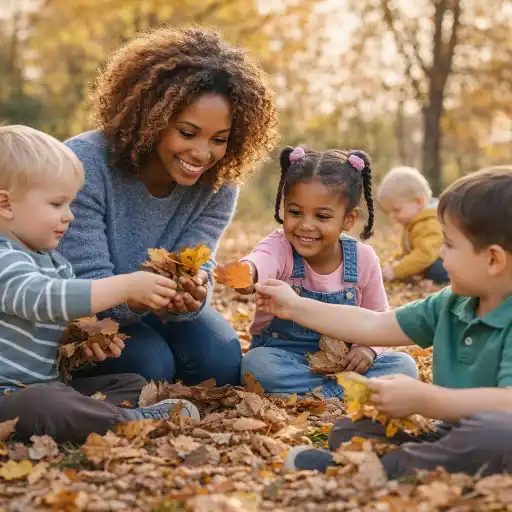
Leaves, seedpods, sticks, and stones are wonderfully open-ended. One child may see a leaf as a blanket for a pretend animal; another may want to line it up with a collection. Because children can invent many uses for the same natural material, disagreements may be about play ideas as much as possession. Research on nature-based play describes how outdoor environments and educator interactions can shape the quality of children’s play and learning (systematic review of nature play in early childhood education).
When a child protects a leaf or says “mine,” that moment does not automatically signal selfishness or failed teaching. Sharing and waiting draw on developing self-regulation, language, flexibility, and perspective-taking. Young children need adult support and repeated opportunities to practice; ZERO TO THREE’s guidance on helping young children with sharing emphasizes that these abilities emerge gradually.
Rather than expecting instant generosity, focus on the skills children can learn in the moment. A calm adult can protect safety, recognize feelings, and help children find a workable plan. Outdoor play then becomes a real setting for practicing #sharing, #turntaking, #empathy, #communication, and #problem-solving.
- Disagreements give children a reason to express an idea and listen to another.
- Natural materials invite flexible play: a leaf can be a roof, a plate, or part of a path.
- Respectful coaching shows children their ideas matter while setting limits around safe behavior.
How can providers prepare children before play begins?
Children are more likely to use helpful words when they have practiced them before a conflict. During a calm group moment, introduce two or three short phrases and act them out with puppets, leaves, or a pretend basket of nature treasures. Keep the language consistent across the teaching team and repeat it naturally in play.
- “I have an idea. Can I show you?”
- “Can we make two parts?”
- “Can I have a turn when you’re done?”
- “Would you like to build together or play beside me?”
- “I need help finding a plan.”
Give children more than spoken words to work with. Picture cards, gestures, signs, or communication devices can help a child express a choice or request. Allow processing time, and avoid making a child repeat a script perfectly. The goal is meaningful communication, not recitation.
Prepare the outdoor environment as well. Set clear boundaries for where natural materials may be gathered, and provide containers or tools only when they are safe and appropriate for the group. Make room for several play ideas where possible: a “leaf kitchen” and a “leaf path” can coexist. Thoughtful outdoor space and intentional adult presence can support richer play; NAEYC shares practical ideas in tips for teaching in the outside classroom.
What should an educator do when children disagree?
Begin with safety and a calm presence rather than deciding who is right. Move close enough to prevent grabbing, pushing, or throwing. Describe what you see without blame: “You both have a plan for these leaves. You want a nest, and you want a path.” Neutral narration helps make the problem clear while reducing the sense that one child is being judged.
Then acknowledge the feelings and set a brief limit if needed: “You’re frustrated. I won’t let you pull the leaves from your friend’s hands. Let’s find a safe plan.” If a child is too upset to participate, pause the negotiation and offer support for calming first. Keep your words short; a long lecture is hard to absorb when emotions are high.
- Protect everyone: “I won’t let you throw leaves at a friend.”
- Name the situation: “You both want to use this pile.”
- Recognize the feeling: “Waiting is hard when you have an idea.”
- Invite a next step: “What could we do so both ideas fit?”
- Stay nearby while children try the plan and help revise it if needed.
This sequence reflects the approach in NAEYC’s three-step approach to helping children navigate conflict: describe behavior and feelings, explain the impact when appropriate, and guide children toward a safer or more helpful response. Specific feedback can reinforce the process: “You told each other your ideas and made a plan together.”
How can children find a solution that respects both ideas?
Once children are ready to think together, help them identify the ideas and generate options. Your role is coach, not judge. Reflect each child’s perspective fairly: “You want a nest for the squirrel. You want a road for the trucks.” Then ask whether the plans can be combined, divided, or tried in sequence.
Offer children a chance to suggest their own solution first. If they need help, give a small menu of possibilities rather than imposing a single answer. A shared pile might become two sections, a nest beside a path, or a collection that children take turns arranging. Some children may prefer parallel play—working near each other without combining ideas—and that can be a fair, successful outcome too.
- “Could the pile have a nest on one side and a path on the other?”
- “Would you like to take turns choosing where the leaves go?”
- “Could you gather a few more leaves together?”
- “Would you rather play beside each other with separate piles?”
Check that both children understand what happens next: “You’ll make the nest here, and the path will go around it. Does that work for you?” If the plan is safe and acceptable to both, give it time. Children’s ideas may be unexpected; flexible play is part of what makes nature materials compelling.
A turn-taking board or picture-based solution choices can help children see options and anticipate what comes next. Use these supports as prompts, not tests or rewards. When children try a strategy, notice the effort specifically—listening, asking, waiting, trading, or adapting an idea. This kind of feedback helps make the social skill visible and repeatable.
How can the environment and staff team make shared play easier?
Repeated conflict can reflect an environmental challenge, not simply a child’s behavior. Notice where and when disagreements arise. Are several children crowded around one small collection area? Are there only a few baskets? Do children have enough uninterrupted time to develop a pretend story? A small adjustment—more gathering space, additional containers, or a longer play period—may reduce friction and make cooperation more possible.
- Offer plentiful, safe natural materials when available, while respecting the outdoor space.
- Mark gathering boundaries and teach children which items are okay to collect.
- Arrange play zones so children can work together or play alongside one another.
- Use consistent staff phrases, such as “Tell your idea” and “Let’s find a safe plan.”
- Provide accessible visual choices and different ways to communicate.
🌿 After outdoor play, invite staff to reflect: “What helped the children keep playing, and what might we adjust next time?” This question encourages prevention and shared learning rather than blame.
Children differ in communication, sensory preferences, mobility, and comfort with group play. Some may need a quieter area, a visual cue, extra time, or support from an adult to enter a game. Observe patterns objectively and share strengths-first information with families and colleagues when a child needs more consistent support. State requirements vary - check your state licensing agency for applicable supervision and safety expectations.
What common pitfalls can providers avoid?
One common pitfall is responding to every disagreement with “Just share.” The phrase does not tell children what to do or when a turn will happen. Another is immediately taking the material from one child and handing it to another. Unless safety requires intervention, this can replace children’s problem-solving with adult control and may leave both children feeling unheard.
- Instead of: “Give it to your friend.” Try: “Would you like to make two parts, take turns, or play together?”
- Instead of: “Use your words,” without support. Try: “You can say, ‘Can we make a nest and a path?’”
- Instead of: a lengthy discussion during distress. Try: a brief safety limit now and coaching when the child is ready.
- Instead of: insisting that all children play the same way. Try: making room for collaboration, parallel play, or separate materials.
Also avoid treating a child’s “mine” as a character flaw. A child may be deeply engaged, unsure whether a material will be returned, or still learning how to communicate. Start with curiosity: what support, clearer expectation, or environmental change might help?
If conflicts are frequent, intense, or unsafe, record objective observations: what happened before the disagreement, what each child did, and which response helped. Use the notes to plan and collaborate with families or appropriate specialists if needed. A strengths-based approach keeps the focus on teaching and inclusion.
Conclusion: How can we teach sharing during fall nature play?
When leaves become “mine,” providers can turn the moment into guided practice—not a test of generosity. Prepare children with simple scripts, stay close to keep play safe, acknowledge feelings, and help them consider practical options such as combining ideas, dividing materials, taking turns, or playing alongside one another.
Make the outdoor setting supportive by providing accessible materials, clear boundaries, sufficient time, and consistent adult coaching. Adapt language and visuals for different communication needs, and recognize small efforts as children learn. The central goal is not to eliminate every disagreement; it is to help children build the skills to express ideas, hear others, and find workable solutions together.
For a deeper professional learning experience, explore Viewing Guidance in a Positive Light Buy Now $24.00, which focuses on positive guidance, children’s social-emotional development, and developmentally appropriate responses to classroom behavior.
- Creating the Natural Outdoor Classroom
- 45 Hour School Age Methods and Materials
- CDA Bridge Bundle: Family Child Care without Portfolio Review
- CDA Bridge Bundle: Infant/Toddler without Portfolio Review
- The Best Promotion is Play
- Play with Purpose: Supporting Children with Autism
- Creating Engaging and Meaningful Learning Experiences
- Texas Director Credential
- Bridging Cultures: Family Communication & Collaboration
- Playing with a Purpose: Infant/Toddler Lesson Planning
- Actividades de Otoño Fáciles para Preescolares esta Temporada
- Celebrando la amistad en el cuidado infantil durante el Día de los Mejores Amigos
- Canciones, juegos y preguntas de círculo para niños
- Baby’s First Fall: Simple Ways to Explore the Season Through Play
- Too Wiggly to Sit? Fall Movement Activities Toddlers Will Love
- What’s Happening Outside? Fall Science Adventures for Preschoolers
- Hello, Fall! Cozy Activities to Help Babies Explore the Season
- Go on a Fall Hunt! Outdoor Learning Challenges for Preschoolers
- Can You Build a Leaf Bridge? Fall STEM Challenges for Pre-K
- Fall Detectives: 10 Questions Pre-K Kids Can Investigate This Season
- How Can Fall Classroom Activities Teach Positive Behavior?
- How Can Teachers Use Fall Classroom Experiences to Document Children’s Development?
- How Can Everyday Fall Routines Support Infant and Toddler Development?
- How Can Child Care Providers Involve Families in Observing Children’s Growth During Fall?
- How Can Preschool Teachers Use Fall Experiences to Support Individual Learning Needs?
- How Can You Plan a Fall Celebration That Welcomes Families with Different Holiday Beliefs?
- How Can You Create a Fall Family Event for Parents Who Cannot Attend?
- When Leaves Become “Mine”: How Can We Teach Sharing During Fall Nature Play?
- What Happens to Fallen Leaves? How Can Outdoor Observation Introduce Decomposition?
