Every child-care day is full of moments that can guide more responsive teaching—but only if the notes preserve what actually happened. Learn a practical, unbiased method for documenting children’s words and actions, and consider Observing & Assessing in Child Care  Buy Now $16.00 to build your observation skills; the course explores documentation and assessment methods that can help you plan experiences around children’s development, while the Teacher Self-Evaluation Checklist Buy Now $0.99 can support reflective practice by helping educators review their own teaching strategies, strengths, and areas for continued growth.
Why do objective observation notes matter?
Objective notes create dependable evidence of children’s learning, communication, relationships, and emerging skills. When educators record facts before interpreting them, they have a clearer foundation for planning, reflecting on teaching, and sharing meaningful examples with families. A single note is a snapshot—not a full assessment or diagnosis—but repeated observations across routines and settings can reveal patterns worth exploring.
Careful documentation also helps providers notice strengths that might otherwise be overshadowed by busy routines or immediate concerns. A child who quietly rearranges blocks, repeats a new sound, or watches peers before joining may be demonstrating important learning. Intentional, ongoing assessment can help educators adjust experiences and teaching approaches to support each child.
Objectivity does not mean ignoring emotion or context. It means separating visible evidence from an assumption about what the child feels, intends, or prefers. That distinction helps teams discuss their interpretations thoughtfully and avoid turning a moment into a label.
NAEYC emphasizes that observation and documentation should inform teaching and be responsive to each child’s development, language, culture, and experiences. In practice, this means gathering more than one piece of evidence and considering the context in which a child demonstrates a skill.
What belongs in a useful observation note?
A useful anecdotal note captures one specific event in enough detail that another educator can picture what happened. Include the child and relevant participants according to program policy, the date and approximate time, the setting or activity, and observable actions and words. Brief context—what was happening just before the event—can make the record easier to understand without turning it into speculation.
- Who: The child and relevant people involved; protect other children’s identities when appropriate.
- When and where: Date, approximate time, classroom area, routine, or outdoor setting.
- What: Specific actions, vocalizations, gestures, facial expressions, and direct quotes.
- Context: Materials, activity, or event immediately preceding the moment.
For example: “At 10:15 a.m. in the block area, Maya placed four blocks in a row. The structure fell when she added a fifth block. She looked at the blocks and said, ‘I need a bigger bottom,’ then placed two wide blocks underneath and stacked three smaller blocks on top.” This note describes observable behavior and exact language. It does not claim that Maya was frustrated, excited, or intentionally solving a particular problem.
Choose a method that fits your purpose and available time. A jotting is a brief reminder; an anecdotal record describes a specific event; a running record captures a detailed sequence during a defined period. Head Start’s overview of written observation methods explains these distinctions. Whatever method you use, record promptly and follow supervision and program procedures.
How can you keep language factual rather than judgmental?
Use the “video-camera test”: could another observer see or hear the words you wrote? If not, the sentence may include interpretation. Words such as “angry,” “shy,” “aggressive,” “bored,” “smart,” “always,” or “never” can imply judgments or conclusions that the note itself does not establish. Likewise, phrases such as “because she wanted” guess at motivation.
Try translating interpretations into evidence:
- Instead of “Leo was angry,” write: “Leo pushed the truck away, frowned, and said, ‘Stop.’”
- Instead of “Nina shared nicely,” write: “Nina handed the blue cup to Kai after he asked, ‘Can I use it?’”
- Instead of “Omar was distracted,” write: “Omar turned his head toward the doorway three times while the teacher read.”
- Instead of “Tess is good at puzzles,” write: “Tess rotated two puzzle pieces and placed each in the matching space.”
Specific wording does not make a note cold or deficit-focused. It helps preserve the child’s actions without substituting an adult’s interpretation. Record strengths, attempts, communication, and supports that helped—not only difficulties. As Head Start’s guidance on writing objective and accurate observation notes explains, educators can interpret observations later, after first collecting factual information.
Language and culture also matter. A child may demonstrate understanding through gestures, home-language speech, movement, or interaction with familiar people. Do not mistake a difference in communication style or setting for an absence of skill. Consider whose behavior is documented most often and whether observation opportunities are balanced across children and domains.
What practical steps make note-writing manageable?
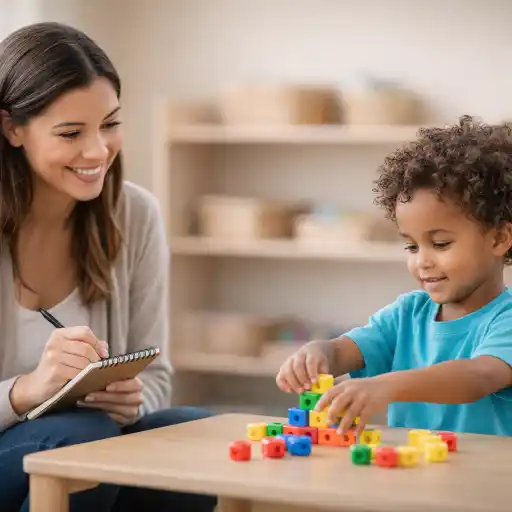
Objective documentation does not require writing a long narrative about every moment. A consistent routine can make notes more accurate and sustainable, even in a busy classroom. Decide what you are trying to learn, gather a brief record, then return to supervision and complete or clarify the note when it is appropriate.
- Set a focus. Choose a child, routine, interaction, or skill area to notice; avoid trying to record everything at once.
- Prepare a simple format. Use a paper form or approved digital system with fields for date, time, setting, context, and observation.
- Jot key evidence promptly. Capture exact words and actions as soon as supervision allows, then complete the note while details are fresh.
- Review for assumptions. Underline interpretations and rewrite them as observable actions or quotations.
- Organize and protect records. Follow program rules for secure storage, access, retention, consent, and sharing.
🌱 Small practice: Ask two educators to write separate notes about the same short, appropriate observation or video. Compare the descriptions. Differences can reveal missing context, assumptions, or useful details to include in a shared documentation approach.
Brief jottings may be enough for an everyday snapshot; a running record takes more time and requires coverage that supports active supervision. Do not let documentation pull attention away from children or staffing responsibilities. Use team routines to share the work, and follow program policies and applicable rules. State requirements vary - check your state licensing agency.
How do you use notes to guide teaching and partner with families?
Keep observation and interpretation distinct. First, preserve the factual record. Then, in a separate reflection, consider what the evidence might suggest about the child’s interests, strategies, communication, or next learning opportunities. Treat that interpretation as a working idea to check against additional observations—not as a conclusion drawn from one event.
For instance, if a child repeatedly tests how objects fit together, offer varied construction materials and observe again in another context. If notes show a child using new words with a familiar peer, plan low-pressure opportunities for conversation and pay attention to communication in the child’s languages. NAEYC’s guidance on using observation to guide teaching connects what educators notice with adjustments to teaching strategies and learning experiences.
Concrete examples also strengthen family conversations. Share a concise, respectful observation and invite the family’s perspective: “We noticed that Amira sorted the leaves by size during outdoor play. What kinds of collecting or sorting does she enjoy at home?” Family knowledge can add context and help educators understand a child’s experiences more fully.
Before sharing, protect confidentiality and follow consent and communication policies. Avoid comparing children or presenting an isolated note as a diagnosis. When concerns arise, document patterns across settings, consult program procedures, and collaborate with families and qualified professionals as appropriate. Objective notes support informed discussion; they do not replace screening, formal assessment, or professional evaluation.
What common mistakes should educators avoid?
Even skilled providers can slip into interpretation when the classroom is demanding or a behavior feels especially memorable. A quick review can help make records more fair, clear, and useful.
- Recording conclusions instead of evidence: Replace labels such as “defiant” with the child’s observable words and actions.
- Leaving out context: Note the activity, materials, time, and relevant events immediately before the behavior.
- Relying on memory too long: Jot a few keywords promptly, then complete the record as soon as practical.
- Documenting only challenging moments: Record everyday competence, interests, relationships, persistence, and emerging skills as well.
- Generalizing from one snapshot: Look for evidence across routines, days, people, languages, and settings before drawing conclusions.
- Sharing too broadly: Store documentation securely and share only with authorized people for an appropriate purpose.
Another common pitfall is confusing concise with vague. “Played well” offers little evidence; a short description of the materials used, actions taken, and words spoken is far more informative. Teams can support consistency by agreeing on a note format, reviewing samples together, and discussing potential bias without blame. Objective documentation is a professional skill built through practice and reflective teamwork.
Conclusion: What is the core practice for writing objective notes?
Write what you can see and hear, include enough context to make the moment understandable, record promptly, and separate the observation from your interpretation. Use direct quotes and specific actions in place of labels or guesses about feelings and motives. Review notes for balance, protect confidentiality, and collect evidence across more than one moment before making broader judgments.
Most importantly, let documentation serve children. Thoughtful notes help educators recognize strengths, plan responsive experiences, and communicate with families using concrete examples. Start with one manageable observation routine, reflect with colleagues, and use what you learn to guide the next opportunity for growth.
For a more complete learning experience, explore these relevant English-language ChildCareEd courses:
- Observing & Assessing in Child Care Buy Now $16.00
- Observations And Goal Setting in Childcare Buy Now $24.00
- Tracking Progress, Shaping Futures: Observation & Assessment Skills Buy Now $55.00
- Preschool Assessments & Observations Buy Now $24.00
- Privacy Matters: Documentation and Observation in Early Learning Buy Now $55.00
- CDA Preschool Credential with Portfolio Review
- 45 Hour Preschool Methods and Materials
- CDA Family Child Care Credential
- Birth to Five CDA Credential with Portfolio Review
- CDA Family Child Care Credential with Portfolio Review
- 45 Hour Infant and Toddler Methods and Materials
- CDA Bridge Bundle: Preschool
- CDA Infant/Toddler Credential with Portfolio Review
- CDA Bridge Bundle: Family Child Care
- Texas Director Credential
- CDA Certification en Español: Recursos y Consejos para Educadores Bilingües
- 🔍 ¿Qué ves cuando observas a un niño aprender?
- Proporciones de Cuidado Infantil y Tamaños de Grupo por Edad en Virginia (Guía Rápida para Centros y Hogares)
- What should Florida child care providers observe during play, learning, and transitions?
- How can Washington child care providers observe children during indoor and outdoor learning?
- How can observation help us better understand children in DC early childhood classrooms?
- What can DC early childhood educators learn by watching children play?
- How can California classrooms use observation to understand young learners?
- How can we make observation and assessment simple and useful in childcare?
- Celebrando la amistad en el cuidado infantil durante el Día de los Mejores Amigos
- How can child care providers track development without comparing children?
- Examples of Anecdotal Notes for Preschoolers: 10 Real Classroom Moments, Written the Right Way
- How Can Child Care Providers Support Infant Development?
- How Can Observation Be Made Easier Without Missing the Moment?
- How Can Infant and Toddler Rooms Use Daily Communication Logs Effectively?
- How Can You Observe Children Without Interrupting Their Play?
- What Is Anecdotal Documentation in Early Childhood Education?
- How Can You Write Objective Child Observation Notes?
- Is a Beginning Reader Decoding or Guessing from Pictures?
