When young readers can recognize familiar words quickly, they have more attention available for making meaning from what they read. Color-word games offer a playful way to revisit print, but they work best when paired with thoughtful teaching; Play Safe, Think Big: Literacy Through Play  Buy Now $10.00 offers child care providers a focused introduction to emerging literacy and safe, engaging learning experiences. Read on for practical ways to use color words without reducing early reading to memorization.
Introduction: What does reading automaticity mean for young children?
Reading automaticity is the ability to recognize words accurately and with increasing ease, rather than laboriously working through every encounter. For preschoolers and kindergarteners, the goal is not to rush children into independent reading. It is to give them rich, low-pressure opportunities to notice print, connect words with meaning, and revisit familiar language.
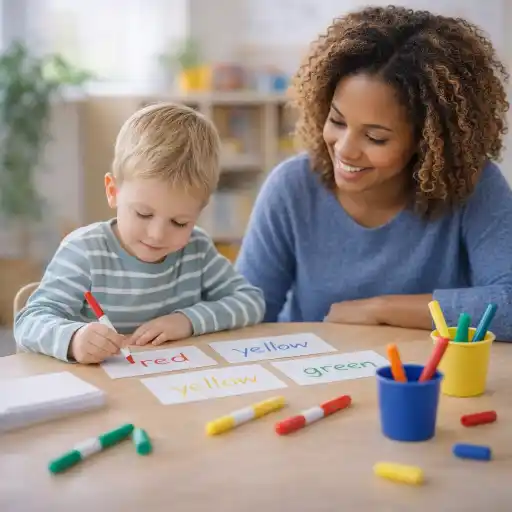
Color words can make this practice accessible. Children already encounter red, blue, yellow, and green in books, classroom materials, art, clothing, and conversation. A word search can invite children to locate these printed forms, but finding a word is only one step. Saying it, connecting it to an object or idea, and seeing it again in a sentence help make the activity a meaningful literacy experience.
Why can color words be a useful starting point?
Color words are concrete and easy to connect with a child’s everyday experiences. A child can hear “blue,” point to a blue block, and then look for the printed word BLUE. These varied encounters help link spoken language, print, and meaning. Repeated, purposeful exposure can support word recognition, vocabulary, and interest in written language.
However, educators should not assume that a word search alone teaches fluent reading. A systematic literature review reports that word-search puzzles have been used to support vocabulary learning, while noting that further research is needed. For early childhood settings, the practical takeaway is to treat puzzles as one engaging tool among many—not as a substitute for conversation, shared reading, sound play, or explicit attention to letters and words.
- Use familiar color words to connect print with real objects and experiences.
- Encourage children to say, describe, compare, or use each word in context.
- Keep the mood playful: participation and curiosity matter more than speed.
Color-word activities can also enrich a print-aware environment. NAEYC describes how literacy belongs across classroom areas and everyday play, rather than only at a worksheet table.
How can a word search help children notice and remember printed words?
A word search asks children to scan a page, compare letter patterns, and locate a target word among other print. For a child who is ready for this kind of task, finding RED or GREEN can prompt careful visual attention to the letters and their order. When the child then reads the found word aloud and connects it with a color swatch, picture, or object, the activity becomes more than a hunt.
Use the two-page Word Search - Colors Buy Now $1.49 as a short small-group or center activity. Preview a few words before starting, and let children point, circle, use a marker, or work with a partner. You might say, “You found BLUE. Let’s look at the letters from left to right. Where else do we see the word blue?” This brief exchange connects print recognition with language and meaning.
- Choose a small set of words that children have encountered before.
- Say each word together, then look closely at its letters.
- Offer visual supports, such as color cards or matching classroom objects.
- Invite children to find the word again in a book, label, or classroom sign.
Do not make speed the measure of success. Children may need time, pointing support, or a simpler page. The important practice is attentive, positive engagement with print.
How should educators pair word searches with strong literacy teaching?
Automatic word recognition grows through meaningful encounters with print and language. Pair the puzzle with activities that allow children to hear, say, read, and use color words. Before the game, read a color-rich picture book and pause to talk about the illustrations. During the activity, invite children to name the letters they notice, without expecting every child to know every letter. Afterwards, use the target words in a short shared sentence or playful conversation.
NAEYC’s guidance on playful literacy-rich environments highlights interactive read-alouds, writing for real purposes, and literacy materials across classroom centers. NAEYC also describes everyday word play as a way to build developing awareness of language sounds. Those practices complement word searches: puzzles focus children’s eyes on written forms, while talk, stories, songs, and sound play broaden their understanding of language.
- Read: Find color words in a familiar story and discuss what they describe.
- Move: Ask children to find something yellow or green in the room.
- Write: Invite children to draw an object and add a color label, with adult support as needed.
- Play with sounds: Notice the first sound in “red” or compare words that begin alike.
For a fuller professional learning experience, explore ChildCareEd’s Classroom Tools for Emergent Literacy Buy Now $16.00, which addresses classroom strategies and materials for emerging literacy.
How can activities be developmentally appropriate and inclusive?
Children’s print knowledge, attention, fine-motor control, and language experiences vary. Some will eagerly scan independently; others may benefit from a larger print format, fewer target words, a partner, or an adult who models how to search. Participation can also take different forms: pointing, naming, matching, describing, or communicating with a picture or assistive support.
For children learning English alongside another language, honor the languages they use with family and community. Color concepts and labels can be explored in a child’s home language as well as in English. Families may offer familiar words, books, or ways of talking about color that help connect school and home. Avoid assuming that a child’s quietness means limited understanding; provide wait time and multiple ways to respond.
Keep materials safe and comfortable: use age-appropriate writing tools, provide adequate space, and supervise small-group activities. If a printed grid feels visually crowded, enlarge it or use a simpler matching version. If a child has difficulty with the puzzle format, the learning goal can still be met through matching color labels to objects or finding a word together.
- 🌈 Offer choices: circle, point, match, say, or draw.
- Use large, clear print and reduce visual clutter when helpful.
- Celebrate effort and observation rather than comparing children’s speed.
- Invite families to share color words or books from home languages.
These adaptations keep the focus on access, connection, and joyful participation—not completing a page in one prescribed way.
How can providers tell whether the activity is helping?
Observe what children do before, during, and after the activity. Do they recognize a familiar color word in a new place? Do they look carefully at letters, ask about a word, or connect the printed form with an object? These small observations help educators decide whether to repeat the activity, offer another kind of support, or extend children’s interest.
Keep notes brief and descriptive rather than labeling children as “good” or “behind” readers. For example: “Maya found BLUE with a picture cue, said the word, and later pointed it out on the classroom label.” A few such observations over time are more useful than expecting one puzzle to demonstrate mastery. Share the learning goal with families and suggest a simple extension, such as noticing color words during a read-aloud or labeling a child’s drawing together.
Common pitfalls to avoid:
- Expecting children to memorize whole words without meaningful context. Pair print with sounds, conversation, and experiences.
- Turning the activity into a timed contest. Give children space to notice and think.
- Using puzzles as the only literacy practice. Balance them with books, storytelling, writing, songs, and play.
- Assuming every child should complete the same grid. Adjust the task to the child’s interests and access needs.
State requirements vary - check your state licensing agency when planning classroom activities and documenting professional training.
Conclusion: What should providers remember about color words and automaticity?
Color-word activities can support early reading automaticity by giving children enjoyable, repeated opportunities to attend to printed words and connect them with meaning. A word search is most useful as one part of a broader literacy routine: preview the words, look closely at letters, talk about what the words describe, and revisit them in books, classroom labels, play, and children’s own drawings.
Keep the experience responsive, brief, and pressure-free. Adapt the print and response options so every child can participate, and observe small signs of growing recognition rather than expecting instant fluency. For a ready-to-use activity, explore Word Search - Colors Buy Now $1.49. Providers seeking more structured ideas can also consider the relevant ChildCareEd trainings below.
- Understanding Print Knowledge in Preschool
- Creating the Natural Outdoor Classroom
- Power of Art: Bldg Self-Esteem & Positive Behavior for ALL Abilities
- Birth to Five CDA Credential with Portfolio Review
- Setting the Stage: Story Time
- CDA Bridge Bundle: Family Child Care without Portfolio Review
- CDA Bridge Bundle: Infant/Toddler without Portfolio Review
- CDA Bridge Bundle: Preschool without Portfolio Review
- Texas Director Credential
- Professional Integrity in Child Care
- 🔍 ¿Qué ves cuando observas a un niño aprender?
- 🥦✨ ¿Cómo apoyar a los niños selectivos a probar nuevos alimentos sin presión?
- 💛🧩 ¿Cómo puedo hacer que mi enseñanza sea inclusiva para los niños con autismo?
- 📖 ¿Cómo puedo hacer que la hora del cuento sea la parte más poderosa de mi día?
- Pascua En El Aula: Actividades Sencillas Para Aprender y Celebrar Con Seguridad
- ¿Cómo explicar los colores a un niño ciego? Actividades con tacto, sonido y emociones
- Recursos en Español sobre el Sueño Seguro del Bebé
- ¿Cuáles son las mejores actividades del Día de la Tierra para niños en casa o en el aula?
- Actividades de Motricidad Gruesa que Desarrollan el Equilibrio, la Coordinación y la Fuerza
- Capacitación en Salud y Seguridad Preventiva en Línea para Proveedores de Cuidado Infantil
- Actividades de Fiesta para Niños de Preescolar y Primaria
- Cómo Celebrar el Día Nacional del Kindergarten
- Lista para Guardería en Casa en Illinois: Cómo Iniciar una Guardería en el Hogar
- Lista para Guardería en Casa en Texas: Cómo Iniciar una Guardería en el Hogar
- Apoyo en Preescolar para Retrasos del Habla: Estrategias Simples que Ayudan
- Calabazas, hojas y manzanas: actividades de otoño para preescolares
- Diversión fresca de verano: actividades del Día Nacional del Helado para niños
- Cómo simplificar la capacitación para sus empleados de daycare
- How Can Kindergarten Teachers Strengthen Sight Word Recognition with Low-Prep Activities?
- How Do Color-Word Activities Support Reading Automaticity?
