When every child answers “fine,” circle time can feel more like a routine than a relationship-building opportunity. Thoughtful, open-ended prompts can help children share ideas, practice language, and feel genuinely heard; for deeper support, explore Creating Engaging and Meaningful Learning Experiences  Buy Now $55.00, which offers practical strategies for planning responsive activities and adapting participation for diverse learners.
Strong questions do not require children to perform for the group. They create invitations: to notice, imagine, remember, explain, and connect. The most effective prompts are brief, concrete, developmentally appropriate, and connected to children’s lived experiences. When paired with wait time, visuals, movement, and respectful follow-up, they transform circle time into a language-rich community experience.
Why do ordinary circle time questions so often produce one-word answers?
Questions such as “How are you?” or “Did you have a good morning?” are warm, but they are broad and predictable. Young children may not know which part of their morning to describe, may need more processing time, or may interpret the question as requiring a socially expected answer. A child who says “good” is not necessarily disengaged; the prompt may simply offer too little structure for a richer response.
Open-ended questions expand the possible response. They ask children to draw on memory, imagination, sensory awareness, or social understanding rather than identify one correct fact. The goal is not to make every child speak at length. It is to provide multiple meaningful entry points into communication.
- Replace “Did you play outside?” with “What did your body do outside today?”
- Replace “Do you like this book?” with “Which part caught your attention?”
- Replace “Are you happy?” with “What kind of feeling is visiting you today?”
- Replace “Is this heavy?” with “What do you notice when you lift it?”
These prompts also give educators useful information about children’s interests, vocabulary, reasoning, and emotional experiences. They align with the broader purpose of circle time: building communication, turn-taking, belonging, and social-emotional #development rather than testing recall.
How can educators design questions children actually want to answer?
Begin with children’s immediate experiences. A prompt connected to a puppet, snack, weather change, block structure, or story illustration is easier to understand than an abstract question. ChildCareEd’s guidance on circle time songs, games, and questions similarly emphasizes brief, repeatable questions supported by choices, pictures, props, and alternate response modes.
A useful question has three qualities: it is understandable, genuinely interesting, and open enough for more than one response. Consider organizing prompts into predictable categories so staff can select one quickly without turning circle time into an extended interview.
- Notice: “What do you see, hear, or feel?”
- Remember: “What happened first, and what happened next?”
- Imagine: “What might be behind this door?”
- Explain: “How did you make your tower stay up?”
- Connect: “What does this remind you of?”
- Reflect: “What helped you when the puzzle felt tricky?”
Offer choices when a question may feel too demanding. “Would you rather show an answer with a picture, gesture, or words?” preserves agency while still supporting participation. For dual language learners, invite home-language responses, use photographs and objects, and accept drawing, pointing, or demonstration as legitimate communication.
Which playful prompts invite imagination, humor, and curiosity?
Children often answer more enthusiastically when a question contains a small mystery or a playful possibility. Imaginative prompts are not merely entertainment; they encourage symbolic thinking, narrative language, perspective-taking, and flexible problem-solving. They also reduce the pressure associated with personal disclosure because children can respond through pretend scenarios.
- “If our classroom rug could travel, where would it take us?”
- “What job would a very tiny teacher have?”
- “If your shoes could talk, what would they tell us about today?”
- “What would happen if rain fell upward?”
- “Which animal would make the best classroom helper, and why?”
- “What could we build with ten blocks and one cardboard box?”
- “If you invented a new color, what would you name it?”
Make imagination collaborative. After one child responds, ask peers to add, revise, or act out the idea: “Who has another possibility?” or “How could we test that?” A puppet, mystery bag, picture card, or unusual object can provide a concrete starting point. This approach reflects developmentally appropriate practice because young children often reason more successfully with tangible materials than with purely hypothetical language.
Keep the pace lively. One compelling prompt followed by movement, partner talk, or a quick drawing may be more productive than asking five questions in succession. A question should open a door, not become a worksheet spoken aloud.
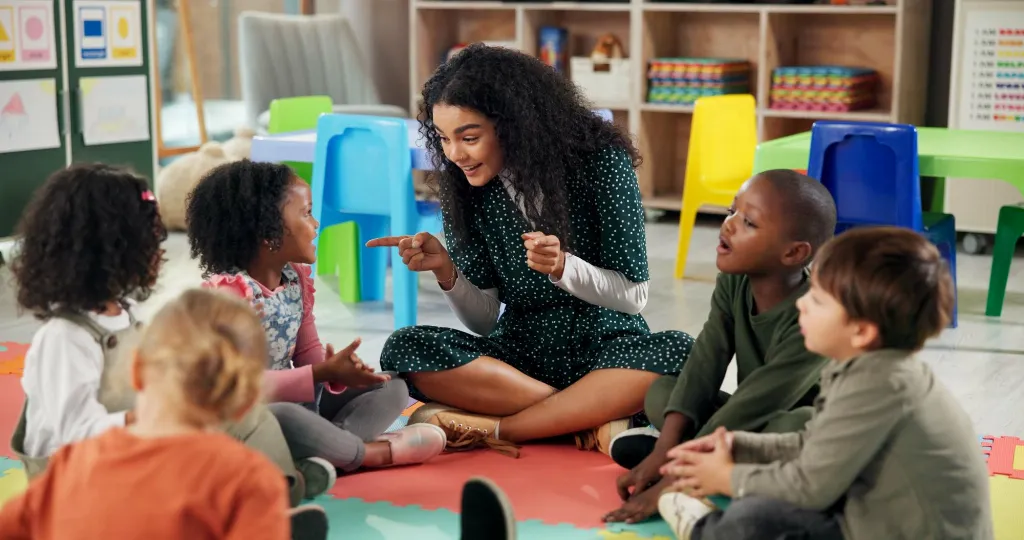
How can questions strengthen emotional literacy without pressuring children?
Feelings questions are most effective when they make room for complexity. Asking children to name a single emotion publicly can feel exposing, especially for children who are still developing emotional vocabulary or who are experiencing stress. Instead, offer metaphors, visual choices, and the option to observe without sharing.
- “Is your body feeling fast, slow, or somewhere in between?”
- “What might help a worried puppet feel safer?”
- “When something feels hard, what could a friend do?”
- “What does excitement look like in your hands, face, or feet?”
- “What helps you get ready to try again?”
- “How might two friends feel differently about the same event?”
Use stories, puppets, photographs, and emotion cards so children can discuss characters before discussing themselves. This indirect route supports empathy and emotional literacy while protecting privacy. Educators can model the process: “My body feels a little rushed, so I am going to take one slow breath.” Such language validates feelings without labeling children or demanding emotional disclosure.
ChildCareEd’s article on helping quiet children participate recommends low-pressure entry points, private responses, helper jobs, and gradual steps from observing to speaking. These practices are especially valuable during feelings check-ins. A child may hold an emotion card, point to a picture, whisper to the teacher, or simply listen. Each can be meaningful participation.
How can teachers make participation equitable during circle time?
Equity does not mean requiring every child to respond in the same way. It means designing the experience so each child has a reasonable, dignified way to contribute. Start by establishing that children may pass, answer later, respond nonverbally, or share with a partner first. This communicates that participation is invited rather than extracted.
Use a range of response formats:
- 🗣️ Speaking, repeating a sentence stem, or completing a familiar phrase
- ☝️ Pointing to a picture, object, symbol, or choice card
- 🎨 Drawing an idea before sharing it
- 🤝 Turning and talking with a peer or trusted adult
- 🕺 Showing an answer through movement, mime, or facial expression
- 🧸 Holding a prop or completing a helper task
Monitor who speaks, who is interrupted, and whose ideas receive follow-up. A talking object can clarify turn-taking, but it should not become a requirement that forces reluctant children to speak. Invite children who have not participated without announcing their silence: “You may show us, tell us, or pass.” Protect children from comparison and avoid praising only verbal fluency.
Inclusive practice also includes cultural and linguistic responsiveness. Ask families about meaningful names, home-language words, traditions, and interests, then incorporate them authentically. State requirements vary - check your state licensing agency. For targeted professional learning, Building Bridges for Dual Language Learners Buy Now $16.00 can help providers strengthen language support, family partnerships, and culturally responsive participation.
What common mistakes weaken otherwise good circle time questions?
Even thoughtful prompts can lose their impact when the surrounding interaction communicates haste or evaluation. One common mistake is asking a question and answering it immediately. Children need processing time to understand the language, formulate an idea, and decide how to express it. Quietly count to ten before rephrasing or offering a scaffold.
Another mistake is asking several follow-up questions that feel like an interrogation. Instead, listen for the child’s meaning and respond naturally: “You built a bridge for the animals. I notice you made the middle very wide.” Then ask one extension: “What will cross it first?”
- Avoid: “What color is this?” when the color has already been drilled repeatedly.
- Try: “Where could this color belong in our room?”
- Avoid: calling on children unpredictably to prove attention.
- Try: previewing turns, using partner talk, and allowing a pass.
- Avoid: correcting every grammatical error during an exciting story.
- Try: expanding naturally: “He goed fast” becomes “Yes, he went very fast.”
Finally, avoid treating circle time as fixed. ChildCareEd’s preschool circle time guidance highlights short routines, movement, props, visual schedules, and connections to centers. If children are wiggling, the information may be telling you that the group needs movement, a smaller gathering, or a shorter ending. Responsive teaching includes changing the plan.
How can a provider build a practical question routine for the week?
A sustainable routine requires less preparation than a large question bank. Select one question type each day and connect it to classroom experiences. For example, Monday may focus on belonging, Tuesday on observation, Wednesday on imagination, Thursday on problem-solving, and Friday on reflection. Repeat favorite prompts over several weeks so children learn the structure and gain confidence.
Document brief observations rather than scoring answers. Note new vocabulary, persistence, turn-taking, use of home language, or a child’s preferred response mode. Use those observations to plan small groups and center invitations. A meaningful question should influence what happens next, not disappear when circle time ends.
For directors, team reflection can be simple: Which prompts generated multiple voices? Who participated through nonverbal means? Did adults extend children’s ideas or move too quickly? These questions help staff improve practice without turning observation into judgment.
Conclusion: What circle time questions do children actually want to answer?
Children are most likely to answer questions that are concrete, playful, relevant, and genuinely open to their ideas. The strongest prompts invite children to notice, imagine, explain, connect, and reflect. They do not demand a performance or assume that speaking is the only evidence of learning.
Use one well-chosen question, provide wait time, offer visual and movement-based response options, and follow children’s ideas with authentic interest. Protect the right to pass, honor home languages, and make space for quiet observation. When circle time becomes a conversation rather than a quiz, children experience themselves as capable contributors to the group.
For continued professional learning, consider Supporting Social Learning: Creating Classrooms that Care Buy Now $24.00 for strategies related to community building, relationships, problem-solving, and open dialogue. Small changes in your questions can create larger changes in belonging, language, and #confidence.
Frequently asked questions
How long should a circle time discussion last?
Keep the discussion brief and responsive. Younger preschoolers may need only a few minutes, while older preschoolers may sustain 10–15 minutes when the experience includes movement, props, and active participation.
What if children give very short answers?
Accept the answer, model an expanded response, and offer one gentle prompt such as “Tell me more,” “What happened next?” or “Can you show us?” Avoid turning the exchange into pressure.
Should every child answer the question?
No. Children can participate by listening, pointing, moving, drawing, holding a prop, talking with a partner, or passing. Multiple response modes make the group more inclusive.
How can I support a child who is quiet?
Build trust, offer predictable turns, preview questions individually, provide a peer or adult partner, and celebrate small steps. Never publicly compare a quiet child with more verbal classmates.
Can these questions support curriculum goals?
Yes. Prompts can target vocabulary, sequencing, prediction, observation, counting, problem-solving, emotional literacy, and social communication. Connect the question to materials children will later use in centers or play.
- Lesson Planning for Preschoolers
- CDA Home Visitor Subject Area 3 Part 3 Birth to 5
- CDA Home Visitor Subject Area 2 Part 3 Birth to 5
- From Play to Planning: Building Culturally Competent, Child-Centered Curriculum
- Bienvenido! Welcoming All Families
- Art from the Heart for Preschoolers: Open Ended Art Projects that Build Self-Esteem
- Positive Attention: Interactions & Supervision for Infants & Toddlers
- Texas Director Credential
- Supporting Families and Caregivers in Language and Literacy
- Confidence Boosters for Preschoolers
- ¿Cómo afecta la dopamina a los niños: señales, efectos e influencias diarias?
- The Smart Buyer’s Treasure Map for Finding a Child Care Center
- A Letter to the Child Care Owner Who Is Wondering, “What’s Next?”
- How can North Dakota daycares help shy children come out of their shell?
- How can New York child care providers set effective limits for young children?
- ABA Classroom Management Tips for Early Childhood Educators
- Circle Time Songs, Games, and Questions for Kids
- Canciones, juegos y preguntas de círculo para niños
- School-Age Lesson Plans for After-School Child Care
- How Can Preschool Teachers Help Children Build Problem-Solving Skills?
- California Preschool Ratios: How Many Children Can One Teacher Supervise?
- What Should You Say in a Daycare Interview If You Have No Experience?
- Beyond “How Are You?” Circle Time Questions Kids Actually Want to Answer
- Circle Time Topics Beyond Weather, Days of the Week, and the Calendar
- How Can We Help Children Understand Mixed Emotions Beyond the Feelings Chart?
- How Can Child Care Leaders Help Staff Feel Heard Beyond the Suggestion Box?
- How Can Child Care Providers Teach Young Children to Take Turns?
- How Can We Build an Emotion Vocabulary Children Can Actually Use?
