Costume & Character Day is more than a fun celebration. When planned with intention, it becomes a meaningful dramatic-play experience that strengthens language, social-emotional development, executive function, imagination, and creative problem-solving. This guide helps directors and teachers plan an event that is safe, inclusive, culturally responsive, and grounded in play-based learning principles. Educators can deepen their planning through ChildCareEd’s self-paced online course From Play to Planning: Building Culturally Competent, Child-Centered Curriculum  Buy Now $55.00, which explores developmentally appropriate activities, play-based curriculum, cultural responsiveness, and adaptations for children with diverse abilities. They can also use Environments That Inspire Independence and Exploration Buy Now $55.00 to create engaging spaces that encourage curiosity, independence, and imaginative exploration. Together, these strategies can turn costumes, characters, and storytelling into purposeful learning while helping every child feel welcome and able to participate.
1) What learning goals should guide a Costume & Character Day?
Why it matters: costume-based dramatic play is a concentrated window into children’s symbolic thinking. Research and practice show that pretend play supports perspective-taking, vocabulary growth, and self-regulation (ECRP: Pretend Play & Cognitive Development) and that play-based experiences prepare children for school while honoring their strengths (What Is Play-Based Learning?).
Primary learning goals (use these to plan activities):
-
- Language & storytelling: encourage mission reports, role scripts, and group narratives (Power of Imagination).
- Social-emotional learning: practicing turn-taking, empathy, and conflict resolution through roles (Superhero Activities).
- Cognitive skills: symbolic thinking, planning, sequencing, and problem solving (see WGU overview of dramatic play).
- Motor development and risk awareness: movement-based role scenarios support gross motor skills and body safety.
- How to measure success (practical):
- Document 3–5 child-generated dialogues or mission notes per group.
- Record one short video clip of cooperative problem solving (with parent permission).
- Collect staff observations tied to goals (language growth, sharing behaviors, sustained attention).
Use hashtags to highlight focus areas across your lesson board: in your #dramaticplay center, support #imagination and #pretendplay among your #preschoolers while honoring #inclusion.
2) How do I plan a safe, inclusive, licensing‑friendly Costume & Character Day?
Safety and inclusion must be front and center. Begin with logistics, then layer supports that protect children and respect families.
- Permissions & documentation:
- ✅ Get written parental consent for costumes, photos, and any props (use a template like a parental consent form).
- ✅ Note medical/allergy needs and any cultural or religious restrictions—offer opt-out options.
- Safety & staffing:
- 👀 Maintain visibility and ratios; place staff to supervise all active areas.
- 🩹 Ensure staff have current pediatric First Aid & CPR and an emergency plan (ChildCareEd training catalog has courses).
- ⚠️ Avoid masks that obstruct breathing/vision for young children; choose soft, adjustable props.
- Inclusion & cultural sensitivity:
- 🤝 Invite families to share what is appropriate to represent from their traditions; avoid tokenizing costumes (Cultural Awareness). For practical strategies and professional development on honoring diverse backgrounds in early childhood settings, see our cultural sensitivity guidance.
- Offer alternatives: role cards, nonwearable props, or quiet planning roles so every child can participate.
Note: state requirements vary - check your state licensing agency for staffing and documentation rules.
3) What materials, centers, and costume choices best amplify learning?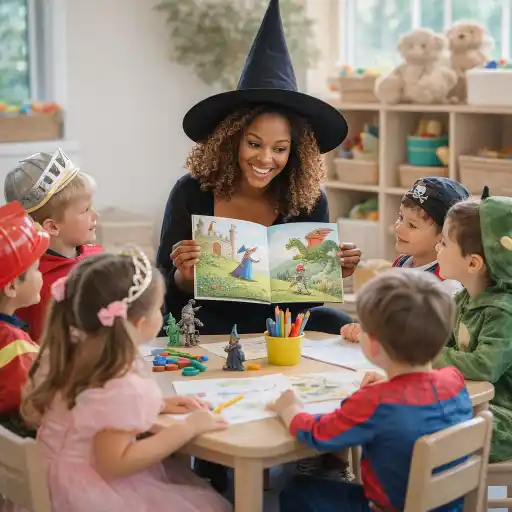
Intentionally chosen materials make pretend play richer and more developmentally valuable. Think open‑ended, durable, and diverse.
- Center ideas (rotate 3–4 stations):
- 🎭 Dramatic Play Stage: simple backdrops, trunk of mixed costumes, role cards, clipboards for "reports" (Power of Imagination).
- 🍽️ Community Corner: grocery, café, or clinic props to practice vocabulary and math through transactions (Center Ideas Buy Now $0.00).
- 🎨 Quiet Story & Costume Craft: reading nook with themed books and mask/cape craft supplies (Transform Reading Corner).
- Costume and prop guidance:
- Use open-ended pieces (scarves, hats, badges) instead of character-specific full uniforms.
- Provide a mix of culturally representative materials and many skin-tone art supplies (Diverse materials).
- Keep dress-up bins labeled and rotated—less is more to spark creativity.
- Accessibility & sensory supports:
- Offer soft, weighted capes or sensory-friendly versions of items for children who need them.
- Provide quiet zones and visual schedules to help with transitions (Bring Play into the Classroom).
4) How can staff scaffold learning, document outcomes, and engage families?
Adults are co‑players and scaffolds. Their role is to extend language, pose problems, and make learning visible.
- Before the day: quick team plan (3 bullets):
- Assign staff roles: launch, float, recorder, and family liaison.
- Create 2–3 scaffold prompts per center (e.g., "What is your mission?" "How will you share the cape?").
- Prep a simple observation sheet tied to learning goals.
- During play: observational scaffolds:
- 👓 Observe for 2–3 minutes, then join for a brief yes/no extension (model new vocabulary, suggest an obstacle to solve).
- 📋 Record child quotes, role decisions, and problem-solving moments—these become documentation for assessment and family communication.
- Family engagement & reflection:
- 📎 Send home a short mission report or photo (with permission) and one activity families can replicate.
- Invite family reflections: "What did your child tell you about being a _____?" Use responses to inform future themes (Family partnership ideas).
5) What common mistakes should we avoid, and how do we reflect for next time?
Knowing pitfalls helps you iterate and improve.
- Common mistakes and fixes:
- 🚫 Mistake: Overstuffed prop table that overwhelms play.
- Fix: Rotate two themed boxes and label materials by role.
- 🚫 Mistake: Allowing risky stunts or unsafe masks.
- Fix: Set clear physical rules, model safe alternatives, and use soft props (Superhero safety tips).
- 🚫 Mistake: One-off cultural displays that feel tokenistic.
- Fix: Center family voice, invite participation, and integrate culture across routines.
- 🚫 Mistake: Overstuffed prop table that overwhelms play.
- How to reflect and adapt (3 steps):
- Collect 5 observation notes and one artifact per classroom.
- Debrief as a team: What worked? Which children were left out? What safety or inclusion gaps appeared?
- Plan one simple change for the next event (rotate props differently, add quiet roles, change staffing).
FAQ
- Q: How long should centers run? A: 10–20 minutes per station for preschoolers; allow repeat cycles for deeper play.
- Q: Can children wear copyrighted character costumes? A: Avoid toy weapons and full-vision-obscuring masks; prefer generic or educator-provided pieces when copyright or safety is a concern.
- Q: What about children who opt out? A: Provide parallel roles (stage manager, costume designer, mission writer) so every child contributes.
- Q: Do we need extra staff for this day? A: Ideally, add 1 staff floater; state requirements vary - check your state licensing agency.
Conclusion
Costume & Character Day can be a powerful, developmentally rich event when it is intentionally planned around learning goals, safety, inclusion, and family partnership. Start small: choose 2–3 focused goals, prepare 3 centers, gather parental permissions, and document learning. Use your observations to refine the next celebration. For ready-made lesson ideas and training, explore ChildCareEd resources such as The Power of Imagination, How to Bring Play into the Classroom, and theme packs like Grandparents Day Activities Buy Now $0.00 to adapt for your needs. Happy planning — and enjoy watching children become storytellers, problem solvers, and confident playmakers.
- 45 Hour Child Growth and Development
- Character Development for Childcare Professionals
- Building Bridges for Dual Language Learners: For Workforce Solutions
- 45 Hour Preschool Methods and Materials
- From Tantrums to Triumphs: Equipping Preschoolers with Self-Regulation Skills
- 45 Hour Infant and Toddler Methods and Materials
- 45 Hour School Age Methods and Materials
- The Best Promotion is Play
- Texas Director Credential
- Montessori Cultural Activities: Exploring the World Through Play and Learning
- The power of Imagination: How to add it to your classroom
- CDA Certification en Español: Recursos y Consejos para Educadores Bilingües
- 📖 ¿Cómo puedo hacer que la hora del cuento sea la parte más poderosa de mi día?
- Recursos en Español sobre el Sueño Seguro del Bebé
- ¿Cuáles son las mejores actividades del Día de la Tierra para niños en casa o en el aula?
- ¿Cómo solicito la licencia para una guardería en California?
- Proporciones de Cuidado Infantil y Tamaños de Grupo por Edad en Maryland (Guía Rápida para Centros y Hogares)
- Proporciones de Cuidado Infantil y Tamaños de Grupo por Edad en Nueva Jersey (Guía Rápida para Centros y Hogares)
- Proporciones de Cuidado Infantil y Tamaños de Grupo por Edad en Virginia (Guía Rápida para Centros y Hogares)
- Lista para Guardería en Casa en Illinois: Cómo Iniciar una Guardería en el Hogar
- Por Qué la Supervisión Activa Es Clave para la Seguridad en el Cuidado Infantil
- Cómo Trabajar en el Cuidado Infantil en California: Requisitos y Pasos
- Capacitación CDA gratuita en Illinois
- Celebrando la amistad en el cuidado infantil durante el Día de los Mejores Amigos
- Canciones, juegos y preguntas de círculo para niños
- Cómo simplificar la capacitación para sus empleados de daycare
- How can we host a Costume & Character Day that truly builds imagination and learning?
- How can we create sensory-friendly costumes for every child?
- How can providers and families keep children safe while trick-or-treating?
- Rosh Hashanah Kindergarten Lesson Plans: 5 Days of Apples, Kindness, and New Beginnings
