Latest Blog & News in English

How Can Child Care Providers Help Children Set Simple Goals and Share Their Interests?
09/23/2026When children name something they hope to do and invite others into that excitement, they are practicing agency, communication, persistence, and belonging. Use the Supporting Social Learning: Creating Classrooms that Care course to strengthen the relationship-based strategies behind these moments an... How Can Child Care Providers Help Children Set Simple Goals and Share Their Interests?

How Can You Combine Counting and Coloring Without Turning Art into Busywork?
09/23/2026When a coloring page becomes a conversation about quantity, representation, and choice, art can support meaningful mathematics instead of becoming busywork. The Math Foundations in Early Childhood course can help providers strengthen these connections through hands-on, play-based strategies while ea... How Can You Combine Counting and Coloring Without Turning Art into Busywork?

How Can Child Care Providers Introduce Hypotheses, Observations, and Conclusions to Children?
09/23/2026Young children already investigate the world by noticing, wondering, testing, and revising their ideas. You can make those natural habits more visible with simple language, playful investigations, and the Building Early Science Foundations course, which helps providers strengthen developmentally app... How Can Child Care Providers Introduce Hypotheses, Observations, and Conclusions to Children?

What Should a Useful Early Childhood Lesson Plan Include?
09/23/2026A strong lesson plan gives educators direction without turning the classroom into a script. If you want a practical foundation for connecting goals, materials, activities, and reflection, explore Curriculum Planning; the course can strengthen your understanding of developmentally appropriate lesson ... What Should a Useful Early Childhood Lesson Plan Include?

How Can Child Care Providers Help School-Age Children Research a State Independently?
09/23/2026When school-age children investigate a state independently, they practice far more than memorizing facts—they learn how to ask questions, evaluate information, and communicate discoveries. Use the State Research Worksheet: Explore & Discover to give children an organized, hands-on starting... How Can Child Care Providers Help School-Age Children Research a State Independently?

How Do Classification Questions Build Marine Science Vocabulary?
09/23/2026When children ask, “Is this an ocean animal?” they are doing more than naming pictures—they are comparing evidence, building language, and beginning to think like scientists. Try Creating the Natural Outdoor Classroom to strengthen nature-based learning environments and gain practi... How Do Classification Questions Build Marine Science Vocabulary?

How Do Visual Routines Support Independence at Home?
09/23/2026When children repeatedly ask, “What happens next?” a simple visual routine can turn uncertainty into confidence and participation. Pairing Moving About the Classroom: Effective Transitions for Everyday with practical home supports helps providers strengthen transition practices, share co... How Do Visual Routines Support Independence at Home?
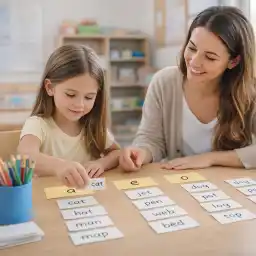
How Does Word Sorting Build Phonics and Vocabulary Skills?
09/23/2026How can a simple sorting activity help children notice sounds, understand word meanings, and use language more confidently? The Science of Reading Foundations in the Pre-K Classroom course gives providers a broader framework for connecting phonological awareness, vocabulary, print knowledge, and eme... How Does Word Sorting Build Phonics and Vocabulary Skills?

How Can Child Care Providers Help Children Understand How Community Helpers Contribute?
09/23/2026Children notice the people who deliver mail, prepare food, repair roads, teach, clean, transport, and care for others—but they need intentional experiences to connect those actions with community well-being. The Curriculum Planning course can help you turn children’s questions into devel... How Can Child Care Providers Help Children Understand How Community Helpers Contribute?

How Can Giving Children Real Choices Help Them Calm Down?
09/23/2026When children are overwhelmed, telling them to “calm down” rarely provides the skill or support they need. A carefully taught choice board can make regulation concrete while preserving children’s dignity and agency; for deeper strategies, explore Supporting Social Learning: Creatin... How Can Giving Children Real Choices Help Them Calm Down?
