Father’s Day can become a meaningful celebration of care, connection, and belonging when every child has a comfortable way to participate. Pair practical classroom ideas with Community and Family Engagement in Childcare  Buy Now $24.00 to strengthen your understanding of diverse families and build more responsive partnerships while pursuing relevant professional learning.
Why Do Inclusive Father’s Day Activities Matter?
Holiday activities communicate powerful messages about whose relationships count. A project labeled only for “Dad” may unintentionally exclude children who live with a grandparent, foster caregiver, two mothers, two fathers, a single parent, an adoptive family, or a trusted mentor. Inclusive planning does not diminish fathers; it expands the celebration so children can recognize the adults who provide love, guidance, protection, and care.
Young children are developing identity, language, empathy, and social understanding. When classroom experiences reflect their real lives, children are more likely to feel secure and participate authentically. The ZERO TO THREE guidance on inclusive Mother’s Day and Father’s Day practices emphasizes advance communication, flexible alternatives, and emotional sensitivity for children experiencing separation, grief, or family differences.
For directors, inclusive celebrations also support meaningful family and culture events. The goal is not to create a perfect activity for every household, but to remove unnecessary assumptions and offer genuine choices.
How Can We Use Language That Welcomes Every Family?
Language should honor the purpose of the holiday while allowing children and families to define their relationships. Before planning, review invitations, labels, songs, worksheets, and display titles. Replace narrow wording with terms such as “special grown-up,” “caring adult,” “father figure,” or “important person.” A program might call the event “Father’s Day and Special Grown-Ups” or “A Day to Celebrate Caring Adults.”
Ask families privately about preferred names and participation options rather than guessing. A short message might say: “We are preparing a Father’s Day activity. Who would your child like to celebrate, and would you prefer an in-class project or a take-home option?” This question provides information without requiring families to explain personal circumstances publicly.
- Invite children to create something for any person who cares for them.
- Use “the people who care for you” instead of requiring a mother-and-father family drawing.
- Avoid asking children to explain divorce, adoption, foster care, loss, or parental absence.
- Provide translations or interpretation when needed, and protect family privacy.
- Correct exclusionary comments calmly: “Families can look different, and every family deserves respect.”
Inclusive language is most effective when it is used throughout the year, not only during holidays. It should appear in enrollment forms, classroom books, dramatic play, family communications, and learning documentation.
Which Activities Adapt Well to Diverse Family Structures?
Choose open-ended activities that let children decide whom they want to honor and how they want to represent that relationship. The classroom-ready Tie-rific Father’s Day Buy Now $0.25 resource is especially adaptable: children can decorate a tie with colors, patterns, words, or pictures for a father, grandfather, uncle, stepfather, mentor, or another special adult. Its simple format supports fine-motor practice, creative expression, and individualized meaning. Providers can adapt these flexible keepsake ideas for National Grandparents’ Day, too, with activities that help children celebrate meaningful grandparent relationships.
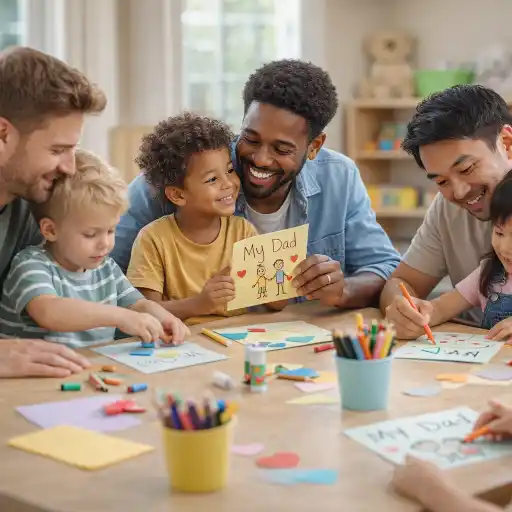
Other flexible options include:
- “You’re Ties-pecial” card: Children draw or dictate a message for a chosen caring adult.
- Appreciation coupon book: Include coupons for reading together, a hug, helping, a game, or shared conversation.
- Family portrait collage: Offer varied figures, pets, homes, and relationship words so children can create their own household story.
- Memory or gratitude box: Children add drawings, notes, or photographs with caregiver permission.
- Father-figure appreciation wall: Display child-created artwork only with consent and use first names or relationship titles as families prefer.
Adapt expectations by age and ability. Infants and toddlers may explore washable crayons, stickers, or textured paper with close supervision. Preschoolers can dictate messages, select colors, and make representational choices. School-age children may write stories, design coupons, or interview a caring adult about a favorite shared activity.
Offer multiple ways to participate, including drawing, dictation, collage, movement, storytelling, or simply observing. Choice supports #belonging and honors children who may not want to discuss family relationships.
How Can We Invite Families Without Creating Pressure?
Attendance is not the measure of family commitment. Work schedules, transportation, custody arrangements, health needs, language differences, and emotional circumstances can affect participation. A respectful invitation makes participation possible without making it obligatory.
Consider a short drop-in window, a take-home kit, or a classroom gallery that families may view at pickup. Provide a clear description of the activity, expected time, accessibility information, and alternatives. For example: “Children will decorate a keepsake for a special adult. Families may attend between 4:00 and 5:00 p.m., send a message for the display, or complete the project at home.”
- 📋 Offer a 20–40 minute event or several brief participation windows.
- Provide take-home materials for families who cannot attend.
- Invite adults to read one book, help at a craft station, or simply observe.
- Make food, photographs, purchases, and public displays optional.
- Provide quiet seating and a low-stimulation alternative for children who need a break.
Directors should brief staff on confidentiality and consistent language. No child should be left alone during an event because a family member could not attend; assign a familiar educator to support children who participate differently. Inclusive family event planning recommends gathering family input early and offering flexible scheduling, accessibility, and communication choices.
What Common Mistakes Should Providers Avoid?
Even well-intended activities can cause harm when they rely on assumptions. The most common mistake is treating one household pattern as universal. A second is equating attendance, photographs, or purchased gifts with family engagement. Meaningful engagement is reciprocal: families share preferences and educators respond respectfully.
- Assumption: “Every child has a dad.” Better: Invite a father, father figure, or special grown-up chosen by the child.
- Public disclosure: Asking a child why a parent is absent. Better: Offer private choices and never require explanation.
- Gender stereotypes: Designing only “masculine” crafts or activities. Better: Offer varied colors, materials, roles, and interests.
- One-size-fits-all participation: Requiring an event visit. Better: Provide in-class, take-home, recorded, and display options.
- Tokenism: Treating diversity as a single holiday lesson. Better: Represent varied families throughout the curriculum.
- Privacy oversights: Posting names or photos without permission. Better: Obtain consent and provide private alternatives.
After the celebration, ask one or two questions: “What worked for your child?” and “What would make future family activities more welcoming?” Review participation patterns without ranking families. Look for evidence of comfort, child engagement, and improved communication rather than attendance alone. Remember that state requirements vary - check your state licensing agency when planning visitors, food, photos, records, or family events.
How Can Directors Turn One Celebration Into Stronger Family Engagement?
A Father’s Day activity can be a small entry point to broader relationship-building. Use the planning process to learn how families define important relationships, what communication methods work best, and which barriers make participation difficult. Document preferences in a secure, appropriate way so future invitations are more accurate and respectful.
Invite staff to reflect on representation in books, dolls, dramatic-play materials, forms, and bulletin boards. Ask whether children can recognize their family structures in ordinary classroom life—not only during a special event. The ChildCareEd overview of family engagement strategies emphasizes respect, reciprocity, consistent communication, shared goals, cultural responsiveness, and flexibility.
For deeper professional development, consider these related ChildCareEd courses:
- Community and Family Engagement in Childcare Buy Now $24.00 — explores the value diverse families bring to early childhood programs.
- Family Voices Matter: Tools for Meaningful Collaboration Buy Now $55.00 — develops culturally and linguistically responsive partnership strategies.
- Family Connections: Creating Inclusive Relationships Buy Now $55.00 — focuses on strengths-based, culturally responsive relationships and inclusive environments.
- Bridging Cultures: Family Communication & Collaboration Buy Now $55.00 — supports communication across languages, cultures, and family expectations.
- Diversity, Equity, and Inclusion in Education Buy Now $16.00 — encourages reflection on bias and culturally responsive classroom practice.
Conclusion
Inclusive Father’s Day activities answer a simple but significant question: Who does this child want to celebrate? When providers use flexible language, invite family input, offer adaptable keepsakes such as Tie-rific Father’s Day Buy Now $0.25, and provide participation choices, every child can experience recognition without being asked to explain or defend their family.
Keep the celebration short, optional, developmentally appropriate, and relationship-centered. Most importantly, carry the same respect into everyday practice. When children see their families represented and valued, the classroom becomes a stronger community for everyone.
- Roots & Resilience: Understanding What Shapes a Child
- Family Connections: Creating Inclusive Relationships
- Bienvenido! Welcoming All Families
- Pediatric RSV First Aid & CPR/AED
- Creating Engaging and Meaningful Learning Experiences
- Connections That Count: Building Relationships in Child Care
- Texas Director Credential
- Building Bridges for Dual Language Learners
- Wellness in Action: Teaching Healthy Habits to Children
- Bridging Cultures: Family Communication & Collaboration
- CDA Certification en Español: Recursos y Consejos para Educadores Bilingües
- 💛🧩 ¿Cómo puedo hacer que mi enseñanza sea inclusiva para los niños con autismo?
- ¿Cómo solicito la licencia para una guardería en California?
- Proporciones de Cuidado Infantil y Tamaños de Grupo por Edad en Maryland (Guía Rápida para Centros y Hogares)
- Proporciones de Cuidado Infantil y Tamaños de Grupo por Edad en Virginia (Guía Rápida para Centros y Hogares)
- Lista para Guardería en Casa en California: Cómo Iniciar una Guardería en el Hogar
- Cómo Trabajar en el Cuidado Infantil en California: Requisitos y Pasos
- Cómo Trabajar en el Cuidado Infantil en Wisconsin: Requisitos y Pasos
- Cómo Trabajar en el Cuidado Infantil en Virginia: Requisitos y Pasos
- Requisitos para Guarderías en Casa en Georgia
- Father’s Day School Event Ideas for Early Childhood
- Celebrando la amistad en el cuidado infantil durante el Día de los Mejores Amigos
- Canciones, juegos y preguntas de círculo para niños
- How Can Child Care Providers Respect Different Family Structures?
- How Can We Celebrate Every Family and Create a Classroom Where Everyone Is Represented?
- How Can Handmade Gifts Help Children Express Appreciation?
- How Can Child Care Providers Create Inclusive Father’s Day Activities for Diverse Family Structures?
- How Can Writing and Art Activities Help Children Name What They Appreciate?
- How Can Child Care Providers Make Family-Themed Writing Activities More Inclusive?
- How Can Child Care Programs Plan Appreciation Activities When Families Use Different Names for Caregivers?
