Educators looking to strengthen their approach can explore ChildCareEd’s Building Early Science Foundations  Buy Now $16.00 and Enhancing STEM Education for Infants and Toddlers Buy Now $16.00 courses; both connect to supporting young children’s science and STEM learning.
This observance commemorates the Apollo 11 mission, during which astronauts from the United States became the first humans to land on the Moon. It also recognizes the scientific inquiry, engineering, and collaboration behind human space exploration.
When Is Space Exploration Day, and What Does It Commemorate?
Space Exploration Day, also called Moon Day, is observed on July 20, the date Apollo 11 landed on the Moon in 1969. The observance offers a way to revisit a consequential event in human spaceflight and consider how exploration depends on scientific inquiry, engineering, collaboration, and sustained effort. For the date and a concise explanation of the observance, see Time and Date’s overview of Space Exploration Day.
For young children, the historical account can be presented accurately without expecting them to absorb technical details. Explain that astronauts traveled to the Moon in a spacecraft, while many people on Earth planned, built, tested, and supported the mission. Use a globe or a simple Moon image to locate Earth and the Moon, and invite children to describe what they notice. When questions exceed what you can confidently answer, model how to look for trustworthy information together rather than guessing.
Why Does Space Exploration Day Matter to Children?
The observance can make abstract concepts—curiosity, evidence, cooperation, and problem-solving—concrete through an event children may already find fascinating. It also broadens the story of exploration beyond astronauts. Engineers, scientists, technicians, mission controllers, and many other specialists contribute to spaceflight. Recognizing those roles helps children understand that science and technology rely on diverse forms of expertise and coordinated teamwork.
Keep the discussion open and inclusive: children do not need to choose a future career to benefit from exploring space. Ask what they wonder about, accept different ideas, and distinguish imaginative play from factual claims. The goal is not to promise that a themed lesson will determine a child’s career path, but to nurture confidence in asking questions and exploring possible explanations. For related approaches to curiosity-led learning, see how child care providers can encourage preschoolers’ curiosity and ways to help preschoolers ask questions and make predictions.
How Can Educators Explore Space Through Hands-On STEM?
Plan a short investigation around a question children can observe or test. For example, provide blocks and invite small groups to design a stable landing platform for a toy spacecraft. Ask children to predict which base will stay upright, test their designs, and describe what they might change. This simple engineering challenge invites children to plan, compare outcomes, persist through difficulty, and solve problems collaboratively without specialized equipment.
For a sensory and science connection, offer a tray of clean sand or another safe, familiar material and let children make tracks with different objects. Invite them to compare the marks, notice which objects leave deeper impressions, and explain their observations. Establish clear boundaries about keeping materials out of mouths and eyes, supervise closely, and adapt materials for children’s ages, abilities, and sensory needs. Educators can find additional ideas in activities that explore sand, space, and science and a galaxy-making activity.
Extend the investigation with drawing, construction, or storytelling. Children might sketch a spacecraft they designed, dictate a description, or use loose parts to represent a crater or planet. Open-ended materials let children communicate their thinking in different ways, while educators can introduce vocabulary such as observe, compare, test, and revise. For further classroom strategies, explore STEAM learning in early childhood classrooms and simple STEM activities for early learners.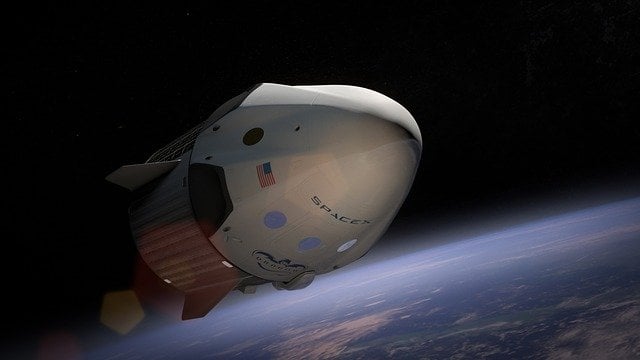
How Can Teachers Make a Space-Themed Lesson Developmentally Appropriate?
Begin with children’s interests and developmental capacities rather than a predetermined craft or factual quiz. Infants and toddlers can look at high-contrast pictures, explore safe textured objects, and hear simple descriptive language during responsive interactions. Preschoolers may sort images, build structures, compare shadows, or dictate questions for a classroom investigation. Older children can collaborate on a design challenge, record predictions, and revisit results. Across ages, provide accessible materials, adapt participation to individual needs, and allow children to observe before joining.
Use discussion prompts that invite reasoning rather than a single expected answer: “What do you notice?”, “What do you think might happen?”, and “How could we find out?” Record children’s words and return to them after testing. This makes their thinking visible and supports oral language alongside early science practices. Connect the lesson to children’s everyday experiences—looking at the Moon, noticing shadows, or building with blocks—so the topic does not depend on expensive supplies or prior knowledge.
Choose information and images with care, and be transparent when a demonstration is a model rather than a literal representation of space. A ball and a lamp, for instance, can help children discuss light and shadow, but they do not reproduce every feature of the Earth–Moon system. Naming what a model shows and what it leaves out helps build early habits of careful observation and evidence-based explanation.
How Can Space Exploration Day Inspire Continued Learning?
Use the observance as a starting point, not a one-day performance. Keep a question board where children and families can add space-related questions, revisit the questions during later science experiences, and document what children discover. Share a brief note with families describing the investigation and invite them to talk about what children noticed at home, without requiring families to purchase materials or complete a project.
Educators who want to strengthen their science practice can explore ChildCareEd’s Montessori Cultural Activities: Exploring the World Through Play and Learning Buy Now $24.00 course. Course participation is professional learning; it does not by itself establish that a course meets a particular state, employer, or registry requirement. Confirm any applicable eligibility or approval with the relevant agency or program.
What Is the Takeaway from Space Exploration Day?
Space Exploration Day commemorates the Apollo 11 Moon landing and offers child care professionals a meaningful context for #science, #engineering, history, and collaborative learning. With accurate explanations, accessible materials, open-ended questions, and careful supervision, educators can turn children’s interest in space into opportunities to observe, predict, test, and communicate. The most lasting invitation is simple: stay #curious, work together, and keep asking how we can learn more about #space and #learning.
It honors those who have worked in space #exploration.
It inspires students to explore jobs in #space.
This day not only acknowledges and honors the work that astronauts, scientists, engineers, and others in the area have done in the past, but it also helps pave the way for future interest in the #future. Because of all the awareness activities that are associated with Space Exploration Day, the day will encourage a greater number of children to pursue occupations that are linked to space.
Do you want to add more #science to your early childhood classroom, but don't know where to start? Here are some classes to help you get started on your way to becoming a scientist with your students and exploring #STEM!
- Creating Safe & Healthy Child Care Environments
- Building Early Science Foundations
- Birth to Five CDA Credential with Portfolio Review
- The Science of Growing Up: Typical and Atypical Development
- CDA Bridge Bundle: Family Child Care without Portfolio Review
- CDA Bridge Bundle: Infant/Toddler without Portfolio Review
- CDA Bridge Bundle: Preschool without Portfolio Review
- Texas Director Credential
- Building Bridges for Dual Language Learners
- Montessori Cultural Activities: Exploring the World Through Play and Learning
- Today Is Earth Day!
- National Eat Your Vegetables Day June 17
- Creating Your Own Galaxies
- Tiny Tinkerers: How Messy Play Today Could Lead to Tomorrow’s Top Inventors
- Normas de Licenciamiento de Cuidado Infantil en Virginia para Centros Diurnos Infantiles y Hogares Diurnos Familiares
- How to Celebrate National Ice Cream Day in Your Center
- How can we teach children through play?
- Celebrando la amistad en el cuidado infantil durante el Día de los Mejores Amigos
- Diversión fresca de verano: actividades del Día Nacional del Helado para niños
- How can we help children reach new heights—from the Space Needle to the preschool classroom?
- How can I build gross motor skills indoors and outdoors for the children in my program?
- How can we encourage curiosity instead of simply giving answers?
- How can preschool programs intentionally support early math skills every day?
- Snip, Stick, Celebrate! What Easy Labor Day Crafts Can Toddlers Make?
- Made by Me! Labor Day Crafts for Preschoolers That Celebrate Hard Work
- Why Do Toddlers Keep Asking Where Their Belongings Go?
- How Can Child Care Providers Keep Indoor Play Manageable When Rain Lasts All Week?
- Why Can a Child Match a Shape but Struggle to Rebuild It with Pieces?
- How Can You Plan October Classroom Activities for Children Who Do Not Celebrate Halloween?
