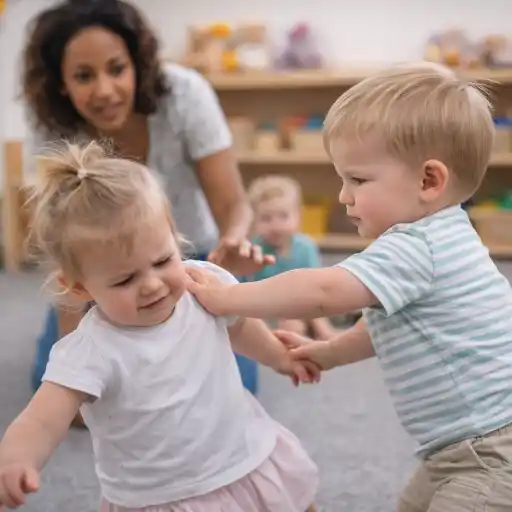
When a toddler pushes, the action can feel sudden and alarming—but it often communicates a need, feeling, or missing skill rather than deliberate cruelty. Providers can protect children while teaching safer ways to communicate, and the Ouch! Biting & Hitting Hurts Buy Now $35.00 course offers focused professional learning on developmental reasons, positive guidance, and practical responses. For a broader framework, consider The ABCs of Behavior: Turning Challenges into Learning Opportunities  Buy Now
 $55.00$45.00, which helps providers analyze patterns and strengthen classroom practice.
Why does a toddler push another child?
Pushing is common during toddlerhood because children are developing autonomy, language, empathy, and impulse control at the same time. A toddler may know that pushing hurts and still be unable to stop the action when frustration or excitement rises. The behavior is unacceptable because it can injure others, but it is not proof that the child is “bad.” It is information about a developmental need or an environmental demand that exceeds the child’s current skills.
Common reasons include:
- Wanting a toy, space, or adult attention
- Trying to enter play without knowing what to say
- Feeling crowded, tired, hungry, frightened, or overstimulated
- Reacting to a transition or a long wait
- Communicating “stop,” “move,” “my turn,” or “help” without sufficient words
- Exploring cause and effect or imitating behavior observed elsewhere
ZERO TO THREE explains that toddlers often rely on physical actions when language and self-regulation are still emerging. Head Start likewise emphasizes that learning for infants and toddlers occurs within responsive relationships and emotionally secure environments. Seeing pushing as communication does not mean permitting it; it helps providers choose a response that teaches.
Why does the provider’s response matter?
The adult response becomes part of the learning experience. A calm, predictable intervention communicates two truths: everyone deserves safety, and the child who pushed remains worthy of care and belonging. NAEYC’s guidance approach emphasizes teaching children what they have not yet learned rather than using humiliation or punishment.
Immediate intervention is especially important because toddlers cannot reliably regulate themselves during intense emotion. Long explanations, public reprimands, or demands for an apology may increase distress rather than build skill. First help the child become calm; then teach and practice the replacement behavior.
Strong responses also protect the group’s emotional climate. Other children are watching how adults handle conflict. When providers use steady language, attend to the hurt child, and guide repair without shame, they model #safety, empathy, and problem-solving for everyone.
What should providers do immediately after a push?
Use a brief sequence that all staff can remember. Move close, block further contact, and separate the children as needed. Keep your voice low and your words simple.
- 🛡️ Protect: Position your body between children and stop additional pushing without frightening or roughly handling the child.
- Check the injured child: Offer comfort, assess for injury, and follow first-aid and incident-reporting procedures.
- State the limit: “I won’t let you push. Pushing hurts.”
- Support regulation: Reduce noise, create space, and stay nearby while the child calms.
- Teach one replacement: “Say, ‘My turn,’” “Show me stop,” or “Ask for help.”
- Document facts: Record what happened, where, when, what came before it, and how adults responded.
Comforting the child who was hurt does not require shaming the child who pushed. Avoid labels such as “aggressive” or “mean.” Describe the action and its impact: “You pushed Maya. Maya fell and was hurt.” If the child is calm and receptive, invite simple repair, such as bringing a tissue, helping rebuild materials, or practicing gentle hands. Do not force an apology that has no meaning for the child.
How can providers prevent pushing before it happens?
Prevention begins with observing patterns. Use an ABC record: identify the antecedent or event before the push, describe the observable behavior, and note the consequence or what happened afterward. This process can reveal that pushing occurs during cleanup, near a crowded block area, when a favorite toy is unavailable, or just before lunch.
Once a pattern appears, adjust the environment and schedule:
- Provide duplicates of highly desired toys when possible.
- Reduce crowding by limiting the number of children in popular centers.
- Use picture schedules, transition warnings, songs, timers, and first-then language.
- Shorten waiting periods and offer meaningful transition jobs.
- Position adults near predictable conflict areas.
- Offer movement, quiet, or sensory breaks before escalation.
- Monitor hunger, fatigue, illness, and changes in family routines.
Prevention is not “giving in.” It is thoughtful classroom design that allows toddlers to practice emerging skills successfully. Providers should also teach expectations when children are calm through puppets, books, role-play, and brief rehearsals of asking for a turn or moving away.
How can toddlers learn safer replacement skills?
A replacement skill should be concrete, quick, and useful. “Use self-control” is too abstract for a toddler, while “say help,” “give me space,” or “touch the turn card” can be practiced. Select one skill at a time and use the same words across the teaching team.
Teach the skill in short, playful moments:
- Model “stop,” “my turn,” “help,” and “move please” with gestures.
- Practice gentle touch with stuffed animals or dolls.
- Use puppets to act out a toy conflict and brainstorm alternatives.
- Offer visual cards or signs for children with limited speech.
- Praise the replacement immediately and specifically: “You asked for a turn. I heard you.”
Providers can also coach emotional language: “You wanted the truck. You were frustrated.” Naming feelings does not excuse pushing; it gives the child vocabulary for future communication. When the child begins to escalate, prompt the replacement before the push occurs. Over time, repeated practice, warm relationships, and consistent reinforcement help the safer behavior become more efficient than using the body.
Common mistakes include lengthy lectures during distress, inconsistent staff responses, public shame, and focusing only on stopping behavior without teaching what to do instead. State requirements vary - check your state licensing agency.
When should providers seek additional support?
Occasional pushing can be developmentally expected, particularly during periods of fatigue, frustration, or major transition. Additional support is appropriate when pushing is frequent, intense, injurious, increasing, or interfering substantially with relationships and learning. Also pay attention when the child cannot calm with consistent adult support, shows significant changes in sleep or mood, or the behavior occurs across settings despite prevention and teaching.
Begin with collaborative problem-solving rather than diagnosis. Review objective observations with the director and family, identify strengths, and create a short plan with one to three prevention strategies, one replacement skill, staff responsibilities, and a review date. Ask families what they observe at home, which words or gestures the child uses, and what helps during frustration. Protect privacy by never naming another child involved.
When needed, follow program procedures for consultation or referral to early intervention, a mental health consultant, pediatrician, or other qualified professional. Providers should not diagnose based on pushing alone. Persistent behavior may reflect communication differences, stress, sensory needs, developmental variation, or other factors requiring individualized support.
Directors can strengthen consistency through staff role-play, shared scripts, ABC data reviews, and coaching after incidents. Courses such as Mysteries of Challenging Behavior Solved Buy Now $24.00$18.00, Social Foundations and Responsive Classrooms Buy Now $24.00, and Viewing Guidance in a Positive Light Buy Now $24.00 can support ongoing professional learning in behavior guidance, relationships, and responsive classroom practice.
Conclusion: Why do toddlers push, and what should providers do?
Toddlers push because they are still learning to communicate, regulate emotion, navigate space, enter play, wait, and solve conflicts. The behavior requires a firm safety boundary, but it also calls for curiosity and teaching. Providers should intervene immediately, comfort the child who was hurt, state a short limit, help the child regulate, teach one replacement skill, and study patterns that may guide prevention.
The most effective plan is consistent rather than dramatic. Predictable routines, intentional room arrangement, warm relationships, specific praise, family partnership, and objective documentation create conditions in which toddlers can learn safer ways to express powerful feelings. With patient guidance, pushing can become not a defining label, but a moment that helps a child build communication, empathy, and self-regulation.
- 45 Hour Child Growth and Development
- CDA Home Visitor Subject Area 3 Part 3 Birth to 5
- Bienvenido! Welcoming All Families
- 45 Hour Infant and Toddler Methods and Materials
- Pediatric RSV First Aid & CPR/AED
- 45 Hour School Age Methods and Materials
- 45-Hour Infant and Toddler Curriculum
- Texas Director Credential
- Cross-Cultural Toilet Training Practices
- 😫🧸 ¿Qué hacer cuando un bebé no quiere dormir la siesta en el aula?
- Understanding Sensory Processing in Young Children
- Recursos en Español sobre el Sueño Seguro del Bebé
- Capacitación en Salud y Seguridad Preventiva en Línea para Proveedores de Cuidado Infantil
- Proporciones de Cuidado Infantil y Tamaños de Grupo por Edad en Maryland (Guía Rápida para Centros y Hogares)
- Lista para Guardería en Casa en Texas: Cómo Iniciar una Guardería en el Hogar
- Capacitación Previa al Servicio para Proveedores de Cuidado Infantil en Dakota del Norte
- Too Wiggly to Sit? Fall Movement Activities Toddlers Will Love
- Crunch, Stomp, Scoop! Fall Activities Toddlers Can’t Resist
- Big Feelings, Busy Bodies: Self-Control Activities for Toddlers
- Dump It, Stack It, Build It! Open-Ended Activities for Curious Toddlers
- How Can Child Care Providers Understand and Support Infant Milestones?
- How Can Child Care Providers Support Healthy Toddler Development?
- How Can Transition Routines Keep Toddlers Engaged Between Activities?
- Why Do Toddlers Push Other Children? What Should Providers Know?
- How Should Providers Review Loose Parts Before They Enter a Toddler Play Area?
- How Can You Support Safe Transporting Play Without Losing Your Learning Center?
- How Can Toddler Sensory Play Become a Science Investigation?
