Open-ended materials can give toddlers plenty to explore, but every item needs a safety review before it reaches curious hands and mouths. As part of that review, use the Daily Toy Inspection Checklist for Child Care Buy Now $1.49 to record material condition and flag items that need cleaning, repair, replacement, or closer attention. The Intentional Safety for Infants/Toddlers  Buy Now $24.00 course can help you strengthen your hazard-prevention knowledge, while Playful Spaces for Infants & Toddlers Buy Now $24.00 offers a deeper look at age-appropriate materials and play-space design. Read on for a screening process to help you decide which loose parts belong in your toddler play area.
Why review loose parts before offering them?
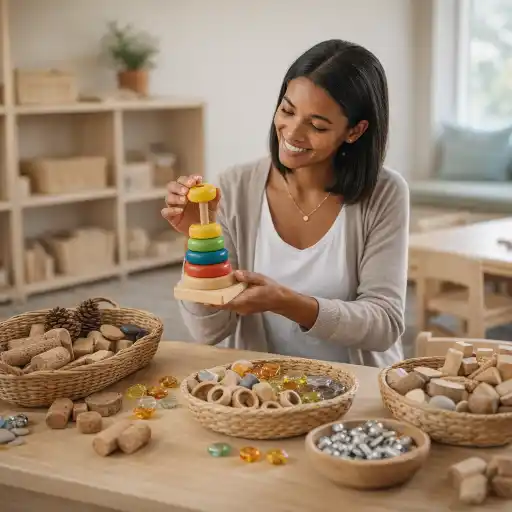
Loose parts are materials children can move, combine, redesign, and use in many ways. Their open-ended nature supports curiosity, symbolic play, problem-solving, movement, and communication. A fabric square might become a blanket or a cape; a large container can invite filling, carrying, and dumping. The child’s ideas—not a toy’s prescribed function—shape the play.
For toddlers, that freedom must be paired with careful preparation. Children in this age group commonly mouth, drop, bang, pull, and combine objects. A material that seems harmless on a shelf may crack into sharp pieces, shed a small component, or create a choking, pinching, or entanglement hazard once play begins. Reviewing an item is not about eliminating exploration; it is about making exploration safer and more intentional.
Thoughtful preparation also helps providers select materials that match children’s development and classroom context. Consider the children’s ages, mouthing behavior, motor skills, sensory preferences, and any individualized support needs. In mixed-age settings, assess whether infants or younger toddlers can reach the materials, not only whether the intended toddler group can use them safely. Penn State Better Kid Care’s guide to loose parts and safe, healthy materials emphasizes adult preparation, supervision, and developmental appropriateness.
- Keep the purpose clear: offer materials for exploration, not as a substitute for supervision.
- Use a consistent review routine so that donated, recycled, natural, and purchased items receive the same scrutiny.
- Remember that state requirements vary - check your state licensing agency.
How should you screen size and choking risks?
Begin with size, because toddlers explore with their mouths and small parts can block an airway. Use a commercially manufactured small-parts tester when your program has one, and follow applicable safety guidance. A component that fits entirely inside a small-parts cylinder—approximately 1¼ inches (3 centimeters) in diameter and 2¼ inches (6 centimeters) long—should not be accessible to children under three. A clean cardboard tube can provide a preliminary screen, but it is not a complete safety test.
Test the whole object and any part that could detach. Examine it in different orientations without forcing it into the tester; a narrow piece may fit when turned diagonally. Consider how the material may change after repeated pulling, twisting, dropping, chewing, or washing. A large toy is not automatically safe if it has removable eyes, loose fasteners, a brittle handle, or a component that can break off.
Keep magnets, button batteries, coins, marbles, small balls, balloons and balloon fragments, and other small hazardous items away from toddlers. Small-part screening also has limits: passing a size test does not assess cords, sharp edges, toxic substances, battery access, or durability. Use the ChildCareEd small-parts and choke-tube guide alongside current product instructions and program policy.
- Test detachable pieces separately, including decorative parts and wheels.
- Do not rely on age labels alone; consider actual developmental behavior and who can access the play area.
- When an item’s size or composition is uncertain, set it aside until you can verify its safety.
What should you inspect about the material itself?
After screening size, inspect the material’s condition, composition, and likely use. Run your hands and eyes over it for splinters, cracks, sharp points, rough seams, exposed wire, rust, peeling coatings, loose fibers, and pinch points. Ask whether it can withstand the actions toddlers are likely to try: chewing, bending, banging, pulling, stacking, and carrying. “Natural” and “recycled” do not automatically mean safe; a pinecone, shell, container, or household object still needs individual assessment.
Consider hygiene and cleaning as part of the review. Choose items that can be cleaned according to their material and your program’s procedures. Materials that absorb moisture, trap dirt, or cannot be cleaned effectively may not be practical for shared toddler play. Follow the product label and local procedures for cleaning and sanitizing. CDC guidance distinguishes cleaning from sanitizing and advises cleaning items before sanitizing them; toys and surfaces children may mouth require particular attention under applicable guidance (CDC: cleaning and disinfecting early care settings).
- 🔍 Look for damage, loose components, sharp edges, splinters, and possible toxic residues.
- Check cords, ribbons, loops, and strings for entanglement concerns; avoid offering them casually to toddlers.
- Verify that containers have no sharp rims, trapped-finger gaps, or lids that create a hazard.
- Check recall information and remove items with unknown safety histories or unverified repairs.
How can you assess the play space and supervision plan?
A safe material can become a poor choice when the surrounding space or available supervision cannot support its use. Before setting out loose parts, check the floor for slipping or tripping risks, pathways for clear access, and shelves or furniture for stability. Make sure children can reach materials without climbing and that adults have clear sightlines across the play area. Provide enough room for children to carry, place, and explore objects without crowding one another.
Think through foreseeable play, not only the activity you have imagined. Toddlers may fill and dump containers, carry items across the room, mouth objects, throw materials, or use them in symbolic ways. Decide which actions are acceptable, what adult positioning is needed, and when a material should be removed or the play adjusted. Active supervision means watching, listening, anticipating, and moving close enough to respond—not simply being present in the room. NAEYC’s discussion of repurposed materials and loose parts in toddler learning spaces shows how educators can follow children’s interests while thoughtfully preparing the environment.
- Set out a manageable quantity rather than filling the play area with too many choices.
- Store materials that are unsuitable for toddlers in closed, clearly identified containers out of reach.
- Adjust access and setup for children’s mobility, sensory, communication, or motor needs.
- Plan a cleanup sweep so stray pieces do not remain when younger children enter the area.
How can a team make screening consistent and practical?
A shared procedure makes screening more dependable than relying on one educator’s memory. Directors can establish a brief pre-use review and explain it during staff orientation. Apply it whenever the program receives a donation, introduces a new purchase, rotates materials, or moves items between classrooms. Include substitutes and volunteers in the same expectations.
A simple record can support follow-through without creating excessive paperwork. Note the item, date, classroom, concern identified, action taken, and staff initials. If an item is questionable, remove it from circulation and place it in a designated “hold for review” area. Do not return it to the shelf until a responsible staff member has decided whether it can be repaired, reassigned to an age-appropriate space, or discarded.
- Review: Check age guidance, size, construction, condition, cleaning needs, and foreseeable use.
- Decide: Approve, adapt, restrict access, or remove the item based on the children and supervision available.
- Prepare: Arrange materials and pathways, and clarify staff positioning and expectations.
- Observe: Watch how children actually use the materials and respond when risk changes.
- Recheck: Inspect after heavy use, cleaning, storage, and transitions between groups.
Use team reflection to review patterns: Are certain items repeatedly damaged? Are toddlers using them in unexpected ways? Does a material offer enough play value to justify the supervision it requires? Pairing those conversations with Effective Supervision in Child Care Buy Now $25.00 can help staff strengthen their active-supervision strategies.
What common screening mistakes should providers avoid?
Even experienced educators can overlook hazards when a material looks familiar, has been used for years, or arrives as a well-intentioned donation. A short pause before play can prevent routine assumptions from replacing careful judgment.
- “It is large, so it cannot be a choking risk.” Inspect detachable parts and consider whether wear or force could create smaller pieces.
- “It passed a size test, so it is safe.” Size screening does not assess sharpness, toxicity, cords, batteries, magnets, breakage, or cleanliness.
- “It is natural, so it is safe.” Check natural items for splinters, sharp edges, small components, contamination, and deterioration.
- “The age label settles the question.” Labels are useful guidance, but classroom access, developmental behavior, and mixed-age enrollment also matter.
- “We inspected it when it was new.” Recheck regularly; repeated use, washing, and storage can change an item’s condition.
Families can be partners in building a thoughtful collection. Explain that the program welcomes only materials that staff can review for size, condition, cleanability, and age suitability. When declining an item, describe the safety reason respectfully and suggest a safer alternative if appropriate. This keeps the focus on shared care rather than criticism.
Most importantly, do not let uncertainty push the team toward either extreme: offering a questionable item or eliminating all open-ended play. Choose a different material, modify the setup, or wait until the concern is resolved. A thoughtful review protects both children’s exploration and their opportunity to engage in meaningful play.
Conclusion: What is the essential review routine?
Before loose parts enter a toddler play area, assess the whole item and anything that could detach; screen for choking hazards; inspect durability, sharpness, cords, batteries, toxicity, and cleanability; and consider how the material will be used in the actual space. Then confirm that the setup supports clear sightlines, active supervision, accessible pathways, and safe storage for materials toddlers should not reach.
Keep the process consistent and responsive. Review new and familiar materials, document decisions when useful, involve the whole team, and observe children’s real interactions so you can adjust when a risk changes. State requirements vary - check your state licensing agency. Careful screening does not diminish loose-parts play; it helps create conditions where toddlers can explore, imagine, and learn with greater confidence.
For additional professional learning related to this work, consider these English-language ChildCareEd courses:
- Intentional Safety for Infants/Toddlers Buy Now $24.00
- Playful Spaces for Infants & Toddlers Buy Now $24.00
- Using Toys to Support Learning Buy Now $16.00
- Effective Supervision in Child Care Buy Now $25.00
- Expect the Unexpected: Infants and Toddlers Buy Now $24.00
Review course details and confirm whether a course meets your individual professional-development goals or local requirements.
- 45 Hour Child Growth and Development
- CDA Infant/Toddler Credential
- Birth to Five CDA Credential with Portfolio Review
- Pediatric RSV First Aid & CPR/AED
- CDA Infant/Toddler Credential with Portfolio Review
- CDA Bridge Bundle: Family Child Care without Portfolio Review
- CDA Bridge Bundle: Infant/Toddler without Portfolio Review
- CDA Bridge Bundle: Preschool without Portfolio Review
- CDA Bridge Bundle: Infant/Toddler
- 😫🧸 ¿Qué hacer cuando un bebé no quiere dormir la siesta en el aula?
- 🚨 Reporte Obligatorio en Nevada
- CDA GRATIS
- Clases de CDA en español gratis
- Recursos en Español sobre el Sueño Seguro del Bebé
- Proceso CDA: Entrenamiento, Portafolio, Examen y Visita de Verificació
- Cómo usar tu certificación de 90 horas en Maryland para completar tu CDA
- 45 horas para infantes y niños pequeños: cómo certificarse en línea
- ¿Cómo pueden los equipos de cuidado infantil practicar habilidades rápidas de primeros auxilios en situaciones reales?
- 10 Ejemplos de Cómo la Cultura Influye en el Desarrollo Infantil
- Proporciones de Cuidado Infantil y Tamaños de Grupo por Edad en Maryland (Guía Rápida para Centros y Hogares)
- Lista para Guardería en Casa en California: Cómo Iniciar una Guardería en el Hogar
- Consejos de Supervisión Activa para Salones de Preescolar y el Juego al Aire Libre
- Canciones, juegos y preguntas de círculo para niños
- Home Daycare Ideas That Make Your Space Feel Safe, Fun, and Professional
- Dump It, Stack It, Build It! Open-Ended Activities for Curious Toddlers
- How Should Providers Review Loose Parts Before They Enter a Toddler Play Area?
- What Are Loose Parts, and How Can Teachers Use Them Safely?
- How Can You Safely Check a Classroom After Moving Furniture for Indoor Movement Activities?
