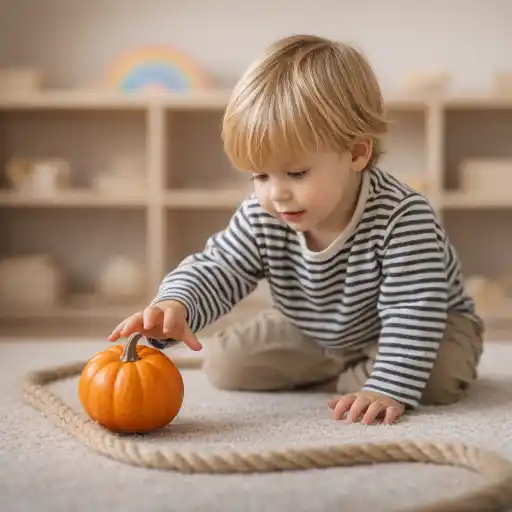
A toddler rolls a pumpkin, watches it escape, and brings it back—again and again. That simple loop can become rich learning when you follow the child’s idea rather than rushing to redirect it. The Playing with a Purpose: Infant/Toddler Lesson Planning  Buy Now $24.00 course helps providers plan age-appropriate experiences from children’s interests, while Playful Learning: Infant & Toddler Activities Buy Now $25.00 offers further guidance on individualizing activities for young learners.
For a ready-to-use starting point, the Roll, Stop, and Try Again Toddler Play Mats resource can help turn a rolling game into an inviting, repeatable play experience. The mat is a prompt—not a script: children’s choices, pauses, and unexpected discoveries should shape what happens next.
Why does following a toddler’s idea matter?
Toddlers learn through active exploration, repetition, and responsive relationships. When a child chooses to roll a pumpkin, notices where it stops, and tries again, the child is directing attention and testing an idea. An educator who observes first can discover what the child finds compelling: movement, speed, the sound of the pumpkin, retrieving it, or playing alongside a peer.
Following a child’s lead does not mean abandoning intentional teaching. It means starting with the child’s interest and adding support thoughtfully. A comment such as “It rolled all the way to the edge” gives language to the action without taking control. A gentle prompt—“Where should it go next?”—can open another possibility while leaving the child free to decide. This balances child-led exploration with adult guidance, an approach explored in NAEYC’s discussion of guided play with babies and toddlers.
This matters because meaningful play is not measured by how closely children follow an adult’s plan. A child may repeat the same action many times, shift the goal, or simply watch for a while. Those choices are valuable information. When educators treat children’s ideas as a foundation for planning, they support agency, engagement, communication, and a sense of belonging.
How can you set up a safe, inviting rolling activity?
Begin with a clear, uncluttered space and a few sturdy materials. A play mat can mark the route and suggest places to roll, pause, or try again. Add a soft ball or a lightweight, age-appropriate pumpkin prop; do not assume a real pumpkin is suitable for every toddler. Choose materials based on children’s ages, mouthing behaviors, mobility, and individual needs. Inspect items before play and maintain close, active supervision.
Keep the invitation open-ended. You might place the mat and one rolling object where children can reach them, then wait to see what they do. If children are unsure, model one slow roll and pause. Avoid demonstrating a single “correct” way to use the mat; the child may choose a different direction, invent a stopping point, or turn the pumpkin into something else in pretend play.
- Position the mat on a stable, nonslip surface away from busy traffic.
- Offer one or two objects at first; add choices when children show interest.
- Make room for seated, standing, crawling, and observing participation.
- Use simple action words such as “roll,” “stop,” “near,” “far,” and “again.”
- 🍂 If the pumpkin travels off the mat, treat the surprise as a new idea—not a problem to correct immediately.
Short turns and repetition are often more useful than a long, tightly structured activity. Follow children’s cues about when to continue, pause, or move on.
What learning can emerge from rolling, stopping, and trying again?
A rolling game can bring together several areas of development without requiring a formal lesson. As children release, chase, retrieve, and reposition an object, they practice coordination and movement. They also encounter early ideas about cause and effect: the pumpkin moves after a push, travels differently on another surface, or stops when it reaches an edge. An educator can make these discoveries visible through calm narration: “You pushed it, and it rolled toward the basket.”
Language grows when adults describe what children are already doing and give them time to respond. A toddler may answer with a word, gesture, gaze, sound, or another roll. Simple choices can invite communication: “Should we roll it to the basket or to the blue spot?” Children can also practice turn-taking with a peer, though parallel play—each child rolling an object nearby—is equally valid.
Movement experiences such as rolling a ball back and forth can support gross- and fine-motor practice, as described in Michigan State University Extension’s infant and toddler activity page. Keep expectations individual: a child’s way of participating may be to watch closely, reach toward the object, direct an adult, or repeat a familiar movement. These are all meaningful forms of engagement.
Notice and name what happens without turning play into a quiz. Instead of asking a rapid series of questions, offer a descriptive comment, then leave space for the child to continue.
How can educators extend the play without taking over?
First, observe the child’s focus. If the toddler keeps rolling the pumpkin toward the edge, you might add a soft barrier or a basket nearby. If the child is interested in speed, use a gentle incline only when it can be set up securely and safely. If the child enjoys retrieving the object, place a second target a short distance away. Change one feature at a time when you want to help children notice what makes the experience different.
Questions work best when they are brief, genuine, and suited to the child’s communication. Try “What happened?” “Where did it stop?” or “Would you like to try again?” Then wait. A pause gives the child time to think, act, or communicate in their own way. Child-led play guidance similarly recommends noticing the child’s interest, joining without taking over, and following the child if the play changes (Raising Children Network).
- Describe an action: “You rolled it toward the picture.”
- Offer a choice rather than a command: “Would you like the ball or the pumpkin?”
- Model a small variation, then return control to the child.
- Extend the play through a peer, a new target, or a familiar song if the child welcomes it.
A useful planning cycle is: observe, reflect, offer one extension, and observe again. The goal is not to make the game more complicated; it is to deepen the child’s own line of exploration.
How can you adapt the activity and document what you notice?
Plan several ways to join in so the activity is welcoming to children with different strengths, mobility, sensory preferences, and communication styles. A child may roll independently, push with support, point to where the object should go, watch a peer, or use a picture choice. Offer an accessible surface and enough room to move. Consider whether the mat’s colors, images, or texture are comfortable and clear for the children using it; provide a simpler alternative if needed.
Documentation can be brief and objective. Record what you saw and heard rather than assigning a trait or guessing at motivation. For example: “Milo pushed the soft pumpkin toward the green circle, watched it stop, then crawled over and rolled it back.” This note is more useful than “Milo was determined” because it describes the behavior and suggests a possible next step.
- Include the context, material, and child’s observable action.
- Capture gestures, repeated actions, peer interactions, and spoken words when relevant.
- Use notes to plan a small follow-up, not to compare children.
- Follow program privacy and consent procedures for photographs or recordings.
Consider common pitfalls: directing every move, expecting every child to participate in the same way, or treating repetition as a lack of progress. Instead, reflect on what the child may be exploring and what support would make the next attempt accessible. State requirements vary - check your state licensing agency.
How can this idea become a responsive lesson plan?
A responsive plan can stay simple while still giving educators a clear purpose. Start with what children have shown you, select one possible learning focus, and prepare a flexible invitation. For a rolling-pumpkin experience, the focus might be movement, coordination, communication, or cause and effect. The activity can remain open-ended; the focus helps staff decide what to notice, not what children must produce.
A brief plan might include:
- Observation: Several toddlers have been rolling objects across the room.
- Invitation: Place a play mat, soft rolling objects, and a basket in an accessible area.
- Educator role: Stay nearby, describe actions, and follow children’s cues.
- Possible extension: Add a target, a new safe surface, or a peer turn if children show interest.
- Reflection: Note what held attention and what adaptation may support another child.
This approach links planning to real play rather than relying on elaborate materials or a fixed sequence. For a deeper framework for creating age-appropriate activities from birth through age three, explore ChildCareEd’s Playing with a Purpose: Infant/Toddler Lesson Planning Buy Now $24.00. It can help providers build practical planning knowledge they can use across everyday classroom experiences.
Conclusion: How does a rolling pumpkin become meaningful play?
A rolling pumpkin becomes a meaningful learning opportunity when educators notice the toddler’s idea, provide a safe and flexible environment, and respond without taking over. Repetition, unexpected movement, pauses, and changes in direction all offer clues about what the child is exploring. A mat or other prompt can help launch the play, but the child’s interest should guide its development.
- Begin with observation and a simple, accessible invitation.
- Use narration and open prompts to support language and inquiry.
- Adapt materials and participation so each toddler can engage in their own way.
- Document concrete actions and use them to plan a thoughtful next step.
When the pumpkin rolls away, the learning does not have to stop. Follow the child’s attention, offer just enough support, and leave room for another try.
Related ChildCareEd courses:
- Playing with a Purpose: Infant/Toddler Lesson Planning Buy Now $24.00
- Playful Learning: Infant & Toddler Activities Buy Now $25.00
- Baby Play: Planning Infant and Toddler Activities Buy Now $16.00
- Tomorrow’s Einsteins: Infant and Toddler Science Buy Now $16.00
- Early Learning with Infants and Toddlers Buy Now $24.00
- 45 Hour Child Growth and Development
- Toddlers and Theories
- 45 Hour Infant and Toddler Methods and Materials
- CDA Bridge Bundle: Infant/Toddler without Portfolio Review
- CDA Bridge Bundle: Infant/Toddler
- CDA Infant/Toddler Credential with Portfolio Review
- Texas Director Credential
- 45-Hour Infant and Toddler Curriculum
- Meaningful Lesson Planning for Infants/Toddlers
- CDA Certification en Español: Recursos y Consejos para Educadores Bilingües
- 🪁¿Cómo puede el juego apoyar de manera poderosa a los niños con autismo?🧩
- Juegos de Motricidad Gruesa
- Gobble, Wobble, Go! Thanksgiving Games for Toddlers & Preschoolers
- Curso de Comunicación de 9 Horas de Maryland
- ¿Cómo puedo usar escenarios de juego de roles de primeros auxilios en mi aula?
- 10 Ejemplos de Cómo la Cultura Influye en el Desarrollo Infantil
- Proporciones de Cuidado Infantil y Tamaños de Grupo por Edad en Virginia (Guía Rápida para Centros y Hogares)
- Actividades de Otoño Fáciles para Preescolares esta Temporada
- Cómo Trabajar en el Cuidado Infantil en Carolina del Norte: Requisitos y Pasos
- Calabazas, hojas y manzanas: actividades de otoño para preescolares
- Celebrando la amistad en el cuidado infantil durante el Día de los Mejores Amigos
- Canciones, juegos y preguntas de círculo para niños
- Too Wiggly to Sit? Fall Movement Activities Toddlers Will Love
- How Can You Repeat a Toddler Activity Without Repeating the Exact Same Lesson?
- How Can Simple Fall Activities Support Kindergarten Readiness Through Play?
- How Can You Observe Persistence While Children Build Pumpkin Ramps?
- How Can a Pumpkin Delivery Game Turn Fall Movement Into Real Problem-Solving?
- How Can a Rolling Pumpkin Turn a Toddler’s Idea Into Meaningful Play?
- How Can a Fall Repair Shop Turn Broken Pretend Props Into Preschool Problem-Solving?
