Preschoolers can recite “wash your hands” and still skip soap, rush the scrub, or leave their hands wet—because knowing a rule is different from managing a multi-step habit independently. Consistent visuals, patient adult modeling, and repeated practice help children connect the steps with everyday moments at school and home. For deeper professional learning on hygiene and infection prevention, explore Shoo, Germs! Don’t Bother Me!  Buy Now $24.00; and, for a focused review of infection-control practices, consider Prevention and Control of Infectious Diseases Buy Now $16.00.
Why does handwashing remain hard even after children have been taught?
Handwashing is not one action but a chain: notice the need, move to the sink, manage water and soap, scrub all surfaces long enough, rinse, and dry. Preschoolers are still developing memory, attention, motor coordination, impulse control, and the ability to follow multi-step directions. A child may understand “wash hands” but lose track of the next step as soon as the faucet or nearby play captures attention.
Young children also learn through concrete experience. Germs are invisible, and the reason to wash may not feel urgent when a child is eager to return to blocks or join snack. Education about germs can help, but information alone is unlikely to create a durable habit. Research on handwashing interventions indicates that instruction works better when paired with modeling, reminders, and feedback; a study of child-focused educational resources also found improvements in children’s understanding and observed handwashing behavior.
These delays are not evidence that a child is being defiant or that teaching has failed. They signal that the routine still needs scaffolding. Treat each wash as a chance to build #independence, not as a test the child should already pass.
How do visual reminders and repeated practice support memory?
A picture sequence makes the routine visible at the moment children need it. Place a simple, eye-level cue beside the sink and use the same short language each time: wet, soap, scrub, rinse, dry. A child can glance at the next image instead of relying on memory or waiting for an adult to narrate every step. The CDC recommends visual cues in early care settings, alongside routine handwashing opportunities and supervision or assistance when needed.
Repetition helps children anticipate what comes next. Link handwashing to predictable events—arrival, before meals, after toileting, after outdoor play, and after wiping a nose. Keep the cue consistent across these moments. A song, rhyme, or count can help make the recommended 20-second scrub concrete without turning the routine into a lecture.
- Post clear pictures showing the steps in order, at children’s eye level.
- Use one brief prompt: “Check the pictures—what comes next?”
- Practice outside rushed transitions, including pretend washing at group time.
- Allow enough time for each child to complete the sequence.
Visuals are supports, not substitutes for teaching. Adults can point, pause, and let a child try before stepping in. Repeated, calm opportunities help the habit become familiar in both the #classroom and home.
What does effective adult modeling look like?
Children learn by watching trusted adults perform the routine, not only by hearing instructions. Wash alongside children when practical, narrating the key actions: “I’m rubbing the backs of my hands and between my fingers.” Demonstrate the whole sequence, including drying. This shows both the technique and the expectation that handwashing is a shared act of caring for oneself and others.
Keep guidance specific and encouraging. Instead of calling across a busy room, stay nearby and offer a short cue such as, “Soap first,” or “Let’s scrub until the song ends.” Notice the action the child has completed: “You remembered your thumbs.” If a step is missed, model it again without shame. Evidence reviewed in child handwashing research suggests that modeling and prompting can help improve practice, especially when combined rather than used as a single, one-time lesson.
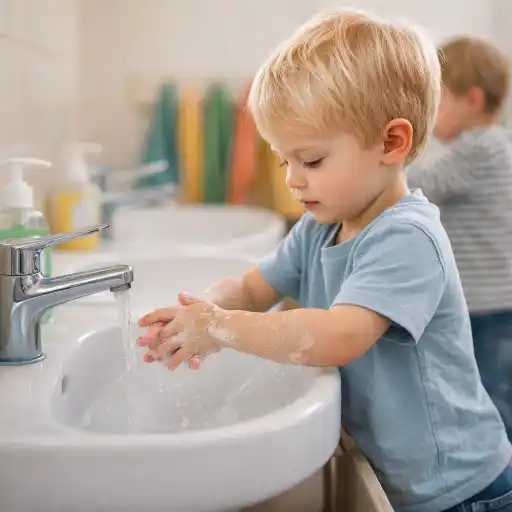
Support can be gradually reduced as skills grow. Begin with demonstration and direct reminders; later, point to the poster, wait, and let the child continue. Some children will need ongoing support because of developmental, physical, language, or sensory needs. Adjust assistance to the individual rather than assuming one age or one practice session guarantees readiness.
Adults’ consistency matters too. When staff use the same sequence and demonstrate it at key times, children encounter a dependable routine rather than mixed messages. Calm modeling communicates: “This is what we do to care for our community.”
How can providers make the sink routine accessible and engaging?
Even a well-taught routine can break down when a child cannot reach the faucet, operate the soap pump, or access a towel. Check the handwashing area from a child’s perspective. Keep soap and drying materials within reach, provide a stable step stool if needed, and post visuals where children can see them. The CDC notes that access to hand hygiene supplies and a way to dry hands supports participation; the Edutopia preschool guidance likewise recommends child-accessible equipment and clear visual cues.
Play can make practice memorable while keeping the purpose clear. Use a familiar song or count for the scrub, sequence picture cards, or invite children to teach a doll the steps. A carefully supervised pretend-germ demonstration can help children see how material transfers between surfaces, but keep the message reassuring: washing is a way to care for our bodies and friends, not a reason to fear germs.
- 🎵 Choose a consistent song or rhyme that helps mark the scrub time.
- Let children put step cards in order, then practice at the sink.
- Offer a simple choice, such as which accessible sink to use.
- Check that water, soap, and drying supplies are ready before transitions.
For good hand hygiene, teach wet, soap, scrub all hand surfaces for at least 20 seconds, rinse, and dry. Soap and water are preferred, particularly when hands are visibly dirty and after toileting. If sanitizer is used when a sink is unavailable, follow program policy and public-health guidance; supervise young children and store sanitizer safely.
How can families and staff build the same habit across settings?
Children may perform a routine in one place but not automatically transfer it elsewhere. The sink, soap dispenser, words, and timing may differ at home and school. Family partnership can create a bridge: share the same short script, a copy of the picture sequence, and the routine’s key moments. The resource Handwashing for kids: fun ways to teach it offers additional activity ideas, and families can use a consistent visual guide such as the ChildCareEd handwashing routine guidance.
Keep communication practical and strengths-based. Let families know what the child is learning and invite them to use similar cues at home, while recognizing that household routines and resources differ. A brief note can include the steps, a song, and reminders to wash before eating and after bathroom use or outdoor play. Avoid framing differences between home and school as a failure; focus on helping children practice across contexts.
Directors can support consistency by orienting staff to the same routine, checking that each sink is stocked, and discussing what reminders help individual children. Observe where children get stuck—starting, using soap, scrubbing, or drying—and adjust the cue or environment accordingly. State requirements vary - check your state licensing agency.
Conclusion: What helps preschoolers remember to wash properly?
Preschoolers forget because handwashing requires several developing skills and because the purpose and steps are not yet automatic. Repeated visual reminders, predictable timing, hands-on practice, accessible supplies, and adults who model the routine help children gradually take ownership. Teach a clear sequence—wet, soap, scrub for at least 20 seconds, rinse, and dry—and supervise or assist according to each child’s needs.
Keep the tone calm and caring, coordinate familiar cues with families, and treat missed steps as information about what support is needed next. With consistent practice at school and home, children can move from relying on reminders toward a useful, lasting self-care habit.
Explore related ChildCareEd courses
- Shoo, Germs! Don’t Bother Me! Buy Now $24.00
- Prevention and Control of Infectious Diseases Buy Now $16.00
- How To Keep A Healthy Class: Six Tips for Germ Control Buy Now $24.00
- Everyday Safety: Creating Healthy Environments Buy Now
$55.00$45.00 - How To Keep A Healthy Class for Infants/Toddlers Buy Now $32.00
- 18-Hour Train the Trainer
- Birth to Five CDA Credential with Portfolio Review
- CDA Infant/Toddler: Parent Relationships
- Creating Environments that Nurture Growth and Community
- Texas Director Credential
- 40-Hour Director's Course
- Injury Prevention: Their Safety Is In Your Hands
- 45-Hour Infant and Toddler Curriculum
- Every Moment Matters: Schedules and Transitions
- Stay Alert! Steps to Emergency Prep Online Version
- Qué capacitación se requiere para ser director de cuidado infantil en Texas?
- ¿Cómo puedo usar escenarios de juego de roles de primeros auxilios en mi aula?
- Actividades de Motricidad Gruesa que Desarrollan el Equilibrio, la Coordinación y la Fuerza
- Capacitación en Salud y Seguridad Preventiva en Línea para Proveedores de Cuidado Infantil
- Actividades de Otoño Fáciles para Preescolares esta Temporada
- Lista para Guardería en Casa en Illinois: Cómo Iniciar una Guardería en el Hogar
- Lista para Guardería en Casa en Texas: Cómo Iniciar una Guardería en el Hogar
- Ejemplos de Crianza Respetuosa vs. Crianza Permisiva
- Capacitación Previa al Servicio para Proveedores de Cuidado Infantil en Dakota del Norte
- Cómo Ser Maestra de Preescolar en Virginia
- How can DC child care programs keep kids safe outdoors from insects, wildlife, and bites?
- Celebrando la amistad en el cuidado infantil durante el Día de los Mejores Amigos
- Cómo simplificar la capacitación para sus empleados de daycare
- How can child care programs use safe diapering and toileting procedures to protect children and stay compliant?
- How Can Child Care Programs Build Effective Sun Safety Practices for Children?
- What Should You Do After a Child Puts a Shared Toy in Their Mouth?
- How Can Bathroom Signs Make Handwashing and Bathroom Routines Easier for Preschoolers?
- How Can Fun Classroom Activities Teach Preschoolers to Cover Their Coughs and Sneezes?
- Why Do Preschoolers Still Forget to Wash Their Hands Properly?
- How Can District of Columbia Child Care Providers Build Better Handwashing Habits?
