When children can manage handwashing with fewer reminders, daily transitions become calmer and self-care becomes a meaningful part of learning. Begin with the practical strategies below, and consider Supporting Children’s Independence  Buy Now $24.00 to strengthen your understanding of scaffolding, self-regulation, and age-appropriate independence. Educators can also reinforce these routines with the Handwashing Steps Poster: Wet, Soap, Scrub, Rinse and Dry Buy Now $55.00, giving children a clear visual reminder they can follow more independently throughout the day. For broader infection-prevention training that can support staff practice, explore Prevention and Control of Infectious Diseases Buy Now $16.00.
Why does independent handwashing matter in early childhood?
Handwashing is both a health practice and a developmental opportunity. In group care, children share materials, tables, bathrooms, and learning spaces; consistent hand hygiene helps interrupt the movement of germs between people and surfaces. The CDC notes that ECE programs promoting hand hygiene may experience less gastrointestinal and respiratory illness and fewer missed days. Review the CDC guidance for schools and early care settings when developing program procedures.
Independence does not mean expecting children to succeed without support. It means arranging the environment, language, and practice opportunities so children gradually assume responsibility. This reflects developmentally appropriate practice: observe what a child can do, provide a cue or model, and reduce assistance as competence grows. NAEYC’s developmentally appropriate teaching strategies emphasize modeling, demonstration, encouragement, specific feedback, and carefully matched assistance.
- It protects children, educators, and families.
- It builds confidence in practical self-care.
- It supports smoother transitions before meals, after toileting, and following play.
- It gives educators observable skills to teach, coach, and document.
State requirements vary - check your state licensing agency before changing written policies, equipment, or supervision expectations.
What five-step routine should children learn?
Use the same short script every time: wet, soap, scrub, rinse, dry. The CDC recommends washing with soap and running water for at least 20 seconds, covering all hand surfaces, then rinsing and drying completely.
- Wet: Turn on the water and wet both hands.
- Soap: Pump or apply enough liquid soap to make a lather.
- Scrub: Rub palms, backs of hands, between fingers, thumbs, wrists, and under nails for about 20 seconds.
- Rinse: Remove all soap under running water.
- Dry: Dry thoroughly with a clean paper towel or functioning hand dryer, then dispose of the towel appropriately.
Keep the words and sequence stable. A short song, rhyme, timer, or sink-side story can mark the scrubbing period. The goal is not to require one particular song; the goal is to provide a predictable cue children can recognize. A visual sequence, such as ChildCareEd’s Handwashing Steps Poster Buy Now $0.99, can reduce reliance on adult verbal reminders.
Teach when to wash by connecting the routine to existing events: arrival, before and after eating or food preparation, after toileting or diapering, after outdoor or sensory play, after coughing or wiping a nose, and whenever hands are visibly dirty.
How can the sink area make independence easier?
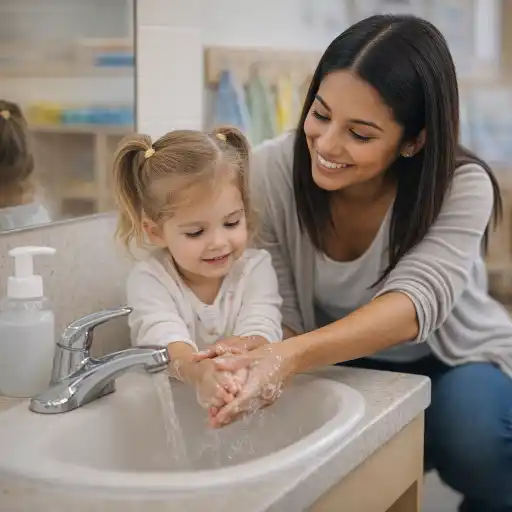 Children are more likely to complete a routine when the environment removes unnecessary barriers. Before teaching the sequence, assess the sink from a child’s perspective. Can the child safely reach the water, soap, and drying materials? Can the child see the visual cue? Is there enough space to wait without crowding?
- Provide a stable step stool when needed.
- Use liquid soap pumps that are easy for small hands to operate.
- Place paper towels or a working hand dryer within reach.
- Keep a trash can near the sink.
- Post picture cues at children’s eye level.
- Check water temperature, faucet function, and supply levels daily.
Accessibility must be individualized. Some children may need a different stool, an adapted faucet, additional time, larger images, or hand-over-hand assistance. For a child with sensory sensitivities, consider reducing crowding, offering advance notice, and acknowledging discomfort without abandoning the health expectation. For a child who is learning English, picture cues and gestures can communicate the sequence while vocabulary develops.
Visuals should be simple rather than decorative. Use one image per step and place the cards in the same order as the physical actions. Invite children to point to the next card, then gradually encourage them to check the sequence independently. A “first wash, then snack” statement also gives the routine a clear purpose without making it punitive.
How should educators teach, prompt, and fade support?
Begin with explicit modeling. Stand where children can see, narrate each action, and demonstrate the details that are easy to miss: rubbing between fingers, cleaning thumbs, and drying completely. Then invite children to practice while you observe. Specific feedback is more useful than general praise: “You put soap on before scrubbing,” or “You remembered to wash your thumbs.”
Use a hierarchy of support, moving from least assistance to more direct help when necessary:
- Point to the visual step.
- Give a brief verbal cue: “What comes after soap?”
- Model the action again.
- Offer a choice: “Would you like to start with this sink or that sink?”
- Provide physical assistance when safety or developmental needs require it.
Fade prompts deliberately. If a child completes the routine after a verbal reminder, try pointing next time. If pointing works, pause and allow the child to consult the poster. This gradual release helps children experience ownership rather than dependence on an adult’s running commentary.
Stay close enough to supervise, especially with toddlers, children who need additional support, or children using sanitizer. Soap and water are preferred when hands are dirty, after toileting or diapering, and after handling waste. If sanitizer is used when a sink is unavailable, CDC guidance recommends at least 60% alcohol and adult supervision for young children; store it up, away, and out of sight.
Which playful activities help the routine stick?
Playful teaching makes an invisible process concrete, but activities should reinforce—not replace—the actual routine. Keep demonstrations brief and repeat them periodically rather than turning handwashing into a one-time lesson.
- 🔬 Glitter germ demonstration: Use a small amount of glitter lotion as pretend “germs.” Let children observe how it travels to objects, then compare a rushed wash with a complete wash.
- Step-card sequencing: Mix picture cards for wet, soap, scrub, rinse, and dry. Invite children to place them in order before visiting the sink.
- Song or micro-story: Tell a 20-second story while children scrub, ending with “Now rinse.”
- Sink helper roles: Rotate roles such as Soap Helper or Poster Checker, while ensuring the child remains responsible for their own hands.
- Mirror practice: Use a mirror so children can notice whether they are covering the backs of their hands and spaces between fingers.
Avoid framing germs as frightening or dirty people as bad. Use caring language: “We wash to take care of our bodies and our friends.” Praise effort, persistence, and remembered steps. If a child refuses, offer a calm choice and restate the sequence: “You may use this sink or that sink. First wash, then playground.”
Families can reinforce the same learning by receiving the five-step script, key washing times, and the class song or visual. Consistent language across home and program helps children transfer the routine to new settings.
What common mistakes can prevent independence?
Several well-intentioned practices can unintentionally make handwashing harder. The first is giving long explanations during a rushed transition. Children usually benefit more from one short cue and a visible sequence. The second is changing the wording, song, or order frequently. Variation may be engaging for adults, but predictability supports young children’s memory and confidence.
- Rushing the scrub: Use one consistent 20-second cue.
- Doing every step for the child: Demonstrate, then pause and allow participation.
- Expecting unsupported independence: Provide stools, visuals, supervision, and accommodations.
- Using handwashing as punishment: Keep the tone neutral, caring, and connected to health.
- Ignoring drying: Make drying part of the posted sequence.
- Relying on sanitizer inappropriately: Prioritize soap and water when hands are visibly dirty or after toileting, diapering, or waste handling.
Directors can support consistency through staff orientation, sink checklists, brief observations, and reflective coaching. Ask: Which step is most difficult for this child? Is the barrier motor, sensory, language-based, environmental, or simply a lack of practice? This question shifts the focus from blame to problem-solving.
Documenting patterns can also guide improvement. For one week, note whether children need prompts at soap, scrubbing, rinsing, or drying. Then adjust the environment or teaching strategy rather than adding more verbal reminders.
Conclusion: How can young children follow handwashing independently?
Teach a consistent five-step routine—wet, soap, scrub for 20 seconds, rinse, and dry—then make success visible and attainable. Accessible supplies, picture cues, playful practice, specific feedback, and gradual fading of adult prompts help children move from participation to genuine independence.
Remember that independence is developed, not demanded. Children may need different levels of modeling, supervision, physical assistance, or environmental adaptation. When educators respond with patience and consistency, handwashing becomes more than a compliance task: it becomes a predictable act of self-care, responsibility, and respect for the classroom community.
- 45 Hour Child Growth and Development
- Teacher-Child Interactions for Stronger CLASS® Outcomes
- Moving About the Classroom: Effective Transitions for Everyday
- Texas Director Credential
- Every Moment Matters: Schedules and Transitions
- Everyday Safety: Creating Healthy Environments
- Spicing Up the Classroom: Learning Centers
- Moving About the Classroom: Effective Transitions for Everyday
- Supporting Children's Independence
- 💛🧩 ¿Cómo puedo hacer que mi enseñanza sea inclusiva para los niños con autismo?
- Proporciones de Cuidado Infantil y Tamaños de Grupo por Edad en Nueva Jersey (Guía Rápida para Centros y Hogares)
- Proporciones de Cuidado Infantil y Tamaños de Grupo por Edad en Virginia (Guía Rápida para Centros y Hogares)
- Cómo Trabajar en el Cuidado Infantil en Carolina del Norte: Requisitos y Pasos
- Celebrando la amistad en el cuidado infantil durante el Día de los Mejores Amigos
- Canciones, juegos y preguntas de círculo para niños
- How Can Minnesota Child Care Programs Build A Strong Handwashing And Hygiene Routine?
- Which Handwashing Activities Best Help Young Children Build Healthy Habits?
- How can child care programs use safe diapering and toileting procedures to protect children and stay compliant?
- How Can Child Care Providers Turn Everyday Routines into Learning Opportunities?
- When a Favorite Teacher Is Absent, How Can Child Care Providers Support Children Through the Change?
- How Can Printable Routines Turn Morning Chaos into Classroom Calm?
- How Can Providers Build Strong Routines That Reduce Challenging Behavior?
- How Can Child Care Providers Help Young Children Follow Directions?
- How Can Child Care Providers Document Learning During Ordinary Routines?
- How Can You Teach a Handwashing Routine Young Children Can Follow Independently?
- How Do Consistent Daily Schedules Reduce Stress in Early Childhood Classrooms?
- How Can You Turn Everyday Classroom Routines Into Learning Opportunities?
- Classroom Aide Duties: Which Tasks Need a Teacher’s Direction?
- How Can Child Care Providers Help Autistic Children Follow Routines Without Spoken Answers?
