Fall painting can spark joyful creativity—and the cleanup can become a small, meaningful conservation lesson. Try the steps below to help children clean brushes effectively with less running water, and explore ChildCareEd’s Autumn Texture Investigation Guide Buy Now $1.75 for another way to connect seasonal art and observation; for deeper science-planning support, the Basic Science in Early Childhood course Buy Now $25.00 helps educators build inquiry into everyday classroom experiences.
Why make brushwashing a conservation routine?
After a fall art project, a running faucet can quietly use much more water than the children need to rinse their brushes. A shallow basin or sturdy container provides enough water for the job while giving preschoolers a concrete way to see that resources can be used thoughtfully. The Melbourne Water school activity specifically recommends washing brushes in a bucket or container rather than under a running tap.
The routine also connects art to early science and social responsibility. Children can observe how paint clouds water, compare a clean rinse with a muddy one, and think about how much water is “enough.” These experiences make an abstract idea—conservation—visible and actionable. A classroom’s small daily practice is not a substitute for broader water management, but it is a valuable place to build awareness and habits.
Keep the message positive and realistic: we use water when it helps us clean, stay healthy, and care for living things; we try not to let it run when we do not need it. This framing supports children’s agency without suggesting that they alone are responsible for environmental challenges. Add #water conservation to regular classroom conversations through short, familiar routines rather than a one-time lecture.
How should educators set up a low-water paint station?
Preparation makes conservation easier than asking children to improvise at the sink. Before painting, place a basin with a small amount of water near the art area, along with a second container for used rinse water, a drying rack, and washable cloths or paper towels for blotting. Use containers that are stable, easy to reach, and appropriate for the children’s age and abilities.
- Set out only the brushes and colors needed for the activity.
- Use a shallow amount of water; refill in small increments if necessary.
- Provide a designated container for brushes awaiting a wash and another for rinsing.
- Keep the floor clear and wipe spills promptly to reduce slipping risks.
- Supervise closely and follow your program’s rules for handling and disposing of paint water.
Explain the sequence before children begin: “We paint, blot, swish, and put the brush away.” Visual picture cues can help children remember each step. The purpose is not to make the process rigid; it is to make the resource-saving choice the easiest choice. If the group is large, clean brushes in small batches with an adult nearby, rather than crowding children around a sink.
What steps help children wash brushes effectively?
Begin by scraping or blotting excess paint onto scrap paper or a designated palette. This reduces the amount of pigment entering the rinse water and can extend the useful life of the water. Invite children to dip and gently swish the brush in the basin, then wipe it on a cloth or paper towel. Repeat only if paint remains, and place the clean brush bristles-up or flat on a drying surface, as appropriate for the brush type.
For a small group, an educator can model the sequence once, then coach children as they take turns. Short, concrete language works well: “Blot first. Swish gently. Is the water still very colorful?” Encourage children to notice the result rather than race through the cleanup. This turns a practical task into an observation opportunity and reinforces #science skills such as predicting, comparing, and describing.
- Use a separate rinse container for light and dark colors when that helps keep water usable longer.
- Replace the water when it is too muddy to clean brushes effectively; conservation should not mean ineffective cleaning.
- Never leave a faucet running while children wait, and make sure children can reach the materials safely.
Check paint labels and your setting’s procedures before deciding how to dispose of rinse water. Do not assume paint water is appropriate for gardens or storm drains. A simple rule for children is: “We ask a grown-up where used art water goes.”
How can the routine become a preschool science investigation?
Invite children to make a simple prediction: “Will one brush rinse make the water clearer or cloudier?” Use a clear container so the group can observe the water before painting, after the first brush, and after several brushes. Children can draw what they notice, compare containers, or count how many brushes were cleaned before the water needed changing. Keep the investigation brief and focused on visible evidence.
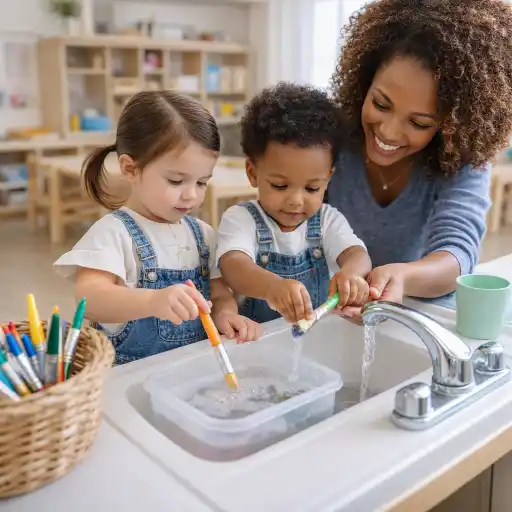
These questions encourage curiosity without requiring children to grasp complex water systems: What changed? Which brush left more color? What helped the water stay usable? What might we do differently next time? Build vocabulary through words such as rinse, cloudy, clear, less, more, reuse, and conserve. Documentation can be as simple as children’s drawings or a teacher’s notes about their comments.
Connect the experiment to a broader study of water: people use water at school and home, water supports plants and animals, and thoughtful routines can reduce unnecessary use. A project approach—following children’s questions, offering materials, and revisiting observations—can support meaningful connections across science, language, art, and group responsibility. You can extend the activity by making a classroom picture reminder together. Let children suggest the images and words so the sign feels like a shared solution, not an adult command.
What common mistakes should providers avoid?
One common pitfall is treating conservation as “use as little water as possible,” even when brushes remain dirty or classroom hygiene is compromised. The goal is sensible use, not withholding water needed for effective cleaning. Keep the basin clean enough to do its job, and follow product directions, health practices, and program policies.
Another mistake is overcomplicating the lesson. Preschoolers do not need frightening messages about scarcity or a lengthy explanation of water infrastructure. They benefit from concrete, hopeful language and chances to participate. Avoid blaming children for waste they cannot control; adults are responsible for setting up the environment and monitoring the faucet.
- Do not let children share dirty rinse water for handwashing or drinking.
- Do not pour paint water into a garden or drain unless your program’s disposal guidance allows it.
- Do not leave an open, unstable container where it could spill or create a hazard.
- Do not prioritize water savings over safe supervision, clean hands, or effective brush care.
Finally, adapt the routine for children’s motor skills and access needs. Larger-handled brushes, lighter containers, picture cues, or adult-supported turns can make participation more inclusive. If a child needs direct assistance, narrate the steps and offer a meaningful choice, such as choosing which brush to rinse first.
How can programs keep the conservation habit going?
Consistency matters more than a perfect one-day activity. Use the same routine for watercolor, tempera, and other suitable classroom art materials, adjusting the washing method to the material and its directions. Assign a rotating “water helper” role only when it fits children’s abilities and does not reduce adult supervision. Celebrate careful choices with specific feedback: “You turned the tap off while you waited,” or “You blotted the extra paint before rinsing.”
Directors can support teachers by making containers easy to find, agreeing on safe disposal practices, and reviewing whether sinks and faucets are functioning properly. If a tap leaks, report it through the program’s maintenance process rather than asking children to solve it. State requirements vary—check your state licensing agency and your program’s health and safety policies when establishing cleanup procedures.
Invite families to share simple water-wise routines they use, while recognizing that households have different circumstances and resources. The Melbourne Water school-saving activity offers additional ideas such as turning taps off after use and checking for leaks. Small, repeated practices can help a class build care, cooperation, and practical understanding of how resources are used.
What should educators remember about washing fall paintbrushes?
Preschoolers can clean fall paintbrushes without leaving the tap running: blot excess paint, rinse in a small basin, use only as much fresh water as needed, and follow safe disposal procedures. Prepare the station in advance, model the routine, and keep cleaning effective, sanitary, and well supervised.
Most of all, treat cleanup as part of the learning rather than an interruption to it. Children can observe color in water, practice turn-taking, build vocabulary, and contribute to a classroom habit that values care over waste. When providers connect the routine to genuine inquiry, even a few minutes at the art sink can help children see themselves as capable participants in caring for their classroom and the world around them.
For additional structured support, the ChildCareEd Basic Science in Early Childhood Buy Now $25.00 training focuses on meaningful exploration, questioning, and investigation in the classroom.
Explore related ChildCareEd learning
- Basic Science in Early Childhood Buy Now $25.00 — a two-hour training on planning science experiences that support children’s reasoning.
- Safe Autumn Walk Teaching Guide and Checklist Buy Now $1.75 — seasonal nature exploration and outdoor safety guidance.
- Building Early Science Foundations
 Buy Now $16.00 — strategies for encouraging young children’s exploration and discovery.
- Tomorrow’s Einsteins: Infant and Toddler Science Buy Now $16.00 — science learning approaches for infants and toddlers.
- Enhancing STEM Education for Infants and Toddlers Buy Now $16.00 — ways to foster early STEM exploration with young learners.
- 45 Hour Child Growth and Development
- Birth to Five CDA Credential with Portfolio Review
- CDA Bridge Bundle: Preschool
- CDA Bridge Bundle: Family Child Care without Portfolio Review
- CDA Bridge Bundle: Infant/Toddler without Portfolio Review
- CDA Bridge Bundle: Preschool without Portfolio Review
- Lesson Planning for Preschoolers
- Texas Director Credential
- IEPs and IFSPs in Family Child Care
- CDA Certification en Español: Recursos y Consejos para Educadores Bilingües
- 💛🧩 ¿Cómo puedo hacer que mi enseñanza sea inclusiva para los niños con autismo?
- 👶 ¿Cuáles son las proporciones y grupos requeridos en Dakota del Norte? 🏫
- Actividades de Motricidad Gruesa que Desarrollan el Equilibrio, la Coordinación y la Fuerza
- 10 Ejemplos de Cómo la Cultura Influye en el Desarrollo Infantil
- Proporciones de Cuidado Infantil y Tamaños de Grupo por Edad en Maryland (Guía Rápida para Centros y Hogares)
- Proporciones de Cuidado Infantil y Tamaños de Grupo por Edad en Nueva Jersey (Guía Rápida para Centros y Hogares)
- Proporciones de Cuidado Infantil y Tamaños de Grupo por Edad en Virginia (Guía Rápida para Centros y Hogares)
- ¿Cuál es la Diferencia Entre la Crianza Respetuosa y la Crianza Permisiva?
- Actividades de Otoño Fáciles para Preescolares esta Temporada
- Cómo Trabajar en el Cuidado Infantil en Carolina del Norte: Requisitos y Pasos
- Cómo Ser Maestra de Preescolar en Virginia
- Autumn Activities for Toddlers and Preschoolers
- Fall Sensory Activities for Toddlers and Preschoolers
- Calabazas, hojas y manzanas: actividades de otoño para preescolares
- Celebrando la amistad en el cuidado infantil durante el Día de los Mejores Amigos
- Canciones, juegos y preguntas de círculo para niños
- Cómo simplificar la capacitación para sus empleados de daycare
- What’s Happening Outside? Fall Science Adventures for Preschoolers
- How Can Preschoolers Wash Fall Paintbrushes Without Wasting Water?
