Outdoor play supports children’s physical health, curiosity, and emotional well-being—but young children need thoughtful protection from ultraviolet radiation and heat. A reliable sun-safety plan helps providers preserve joyful outdoor learning while strengthening daily health practices; Preventative Health and Safety  Buy Now $24.00 can extend this learning with practical strategies for identifying outdoor risks, supporting active supervision, and creating safer routines.
Why Does Sun Safety Matter in Early Care and Education?
Children depend on adults to organize environments in which healthy choices are predictable and accessible. Sun exposure can damage skin and eyes, and sunburn during childhood contributes to later skin-cancer risk. The CDC explains that ultraviolet rays can reach children on cloudy or cool days and reflect from water, pavement, sand, and snow (CDC Sun Safety Facts).
Sun protection is not a reason to eliminate outdoor play. Rather, it is an environmental and pedagogical responsibility: programs can preserve movement, exploration, and appropriate risk-taking while reducing preventable exposure. A layered approach is especially valuable because no single strategy—shade, clothing, or sunscreen—provides complete protection.
Strong routines also support equity and trust. When expectations are clearly communicated, families understand what to send, staff know what to do, and children experience consistent care across classrooms. Federal requirements address health and safety practices in licensed child care, including medication administration and outdoor hazards (ChildCare.gov health and safety requirements). State requirements vary - check your state licensing agency.
What Should a Daily Sun-Safety Routine Include?
A dependable routine should be brief enough to use every day and specific enough that substitute staff can follow it. Consider placing a laminated checklist near the exit.
- ☀️ Check conditions: Review the forecast, UV Index, heat, and air quality before outdoor time.
- Plan timing: When possible, schedule vigorous play outside the strongest sun period, generally 10 a.m. to 4 p.m.
- Prepare protection: Confirm that shade, hats, water, and approved sunscreen are available.
- Conduct a child check: Look for hats, protective clothing, and signs of discomfort before leaving the classroom.
- Reassess outdoors: Offer shade, water, and rest breaks while maintaining active supervision.
The CFOC sun-safety guidance recommends keeping infants younger than six months out of direct sunlight, providing shade, limiting exposure during peak hours, and obtaining written permission before applying sunscreen. Caregivers should wash their hands before and after applying sunscreen to each child.
Programs can make the routine developmentally meaningful by using a short phrase such as “Hat, shade, water, play.” Children can practice putting hats on dolls, searching for shaded areas, or identifying whether a character in a story is making a safe choice. These activities turn #sun #safety into habits without creating fear.
How Should Programs Use Shade, Clothing, and Sunscreen Together?
Layered protection begins with the physical environment. Shade may come from trees, covered structures, umbrellas, shade sails, or stroller canopies. Directors should observe the playground at different times of day because a shaded area in the morning may be exposed by afternoon. Place high-interest activities—such as books, sensory play, and waiting areas—where shade is dependable and easy for children to reach.
Clothing provides another important layer. Encourage lightweight garments that cover the arms and legs when practical, tightly woven fabrics, wide-brimmed hats, and sunglasses that provide UV protection. Baseball caps leave the ears and neck exposed, so children wearing them may need additional clothing, shade, or sunscreen. Staff should model protective behavior; children are more likely to accept a routine when trusted adults participate.
Sunscreen should complement—not replace—shade and clothing. Guidance from NAEYC recommends broad-spectrum sunscreen, application 15 to 30 minutes before outdoor play, coverage of exposed skin, and reapplication every two hours or after swimming (NAEYC sun-safety tips). Follow the product label and program policy, particularly for water play, sweating, sensitive skin, and allergies.
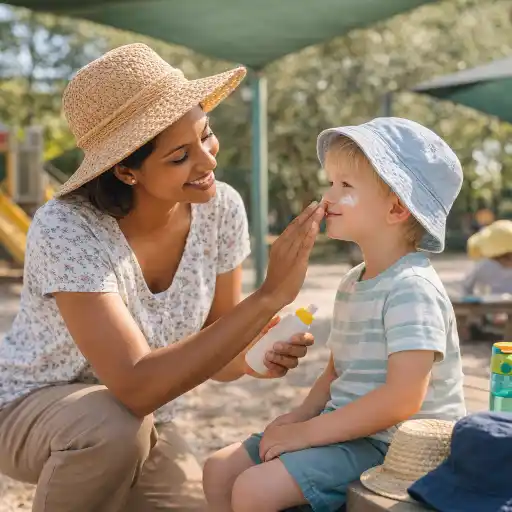 For infants younger than six months, prioritize shade and protective clothing. If a medical professional or family plan indicates sunscreen is needed on a small exposed area, document and follow the program’s requirements carefully.
What Policies and Documentation Make Sunscreen Application Safer?
Because sunscreen is applied to a child’s body, programs should integrate it into their medication or topical-product procedures. Written permission should identify the child, product, SPF, relevant allergies, and parent or guardian authorization. Sunscreen supplied for one child should remain in its original container and be labeled with the child’s first and last name.
Staff should apply sunscreen according to the label and program policy. For hygiene and privacy, wash hands before and after each application, avoid the eyes and mouth, and apply the product in a manner consistent with the child’s developmental needs and family expectations. Keep sunscreen inaccessible to children when it is not being used.
A simple log can record:
- the date and approximate application time;
- the staff member’s initials;
- the product used, if the program supplies it;
- reapplication after water play or extended outdoor time; and
- any observed irritation, refusal, or family communication.
Documentation is not merely paperwork. It helps a team notice missed steps, communicate accurately with families, and demonstrate that the program’s policy is practiced consistently. Directors should review forms annually and whenever licensing guidance changes. The ChildCareEd sun-safety routine guide offers additional ideas for permissions, application logs, staff orientation, and family partnership.
How Can Programs Reduce Heat Risk While Preserving Outdoor Learning?
Sun safety and heat safety overlap, but they are not identical. A shaded area may still be hot if it lacks airflow, and a cloudy day may still have substantial UV exposure. Directors should combine weather monitoring with observations of children’s behavior, activity level, clothing, and hydration.
- Offer water before outdoor play, at regular intervals during active play, and after coming inside. Infants require age-appropriate feeding guidance; water is not routinely recommended for infants younger than six months.
- Use shorter outdoor blocks, especially during heat events, and alternate active play with quieter shaded experiences.
- Check hot surfaces such as slides, metal rails, rubber surfacing, and plastic equipment before children use them.
- Watch for unusual fatigue, headache, dizziness, nausea, weakness, confusion, or changes in behavior.
- Move a child who appears ill to a cooler shaded or indoor area, follow emergency procedures, and seek medical assistance when symptoms are serious or do not improve promptly.
The CDC recommends lightweight, loose-fitting clothing, regular fluids, shade, breaks, and adjustment of outdoor schedules during hot conditions (CDC outdoor play and safety guidance). Use local heat and air-quality tools when available. Staff should also know that water play introduces additional risks: children require constant, close supervision near water, and drowning can occur quickly and quietly.
When conditions are unsuitable, indoor alternatives should still promote movement and investigation. Water-free sensory bins, dance, large-motor circuits, nature observation through windows, and collaborative art can preserve learning goals without asking children to remain outdoors in unsafe conditions.
What Common Mistakes Should Directors Help Staff Avoid?
Sun-safety problems often arise from inconsistent systems rather than lack of commitment. A supportive review focuses on improving the system, not blaming individuals.
- Relying on sunscreen alone: Combine sunscreen with shade, clothing, hats, scheduling, and supervision.
- Applying sunscreen too late: Build application into the transition before outdoor play, allowing the product’s recommended lead time.
- Using inconsistent permission procedures: Keep current forms in each child’s file and train every staff member on the same process.
- Forgetting reapplication: Assign responsibility and use a timer or outdoor log when children remain outside for extended periods.
- Ignoring staff protection: Encourage employees to use hats, shade, water, and sunscreen; adult modeling strengthens children’s learning.
- Overlooking access concerns: Work respectfully with families who cannot provide hats, sunscreen, or protective clothing, and identify community or program resources.
Directors can use a five-minute seasonal huddle to review the policy, demonstrate application procedures, identify shade locations, and discuss heat-illness response. Invite staff to name barriers—for example, limited shade during transitions or insufficient time for application—and solve those barriers collaboratively. This approach recognizes providers’ expertise while making the safe practice easier to complete.
How Can Families and Children Become Partners in Sun Safety?
Family communication is most effective when it is specific, respectful, and repeated before high-exposure seasons. Share the program’s expectations at enrollment and provide reminders that list practical items: a labeled hat, lightweight clothing, water bottle, and approved sunscreen when permission has been granted. Ask families about allergies, skin sensitivities, cultural preferences, and medical guidance.
Children can learn sun protection through play rather than lectures. Try:
- a “shade detective” walk to find comfortable areas;
- role-play with dolls and pretend sunscreen containers;
- songs or chants about hats, shade, and water;
- art projects that design protective hats; and
- picture cards showing safe and unsafe outdoor choices.
Use inclusive language: every skin tone and every child benefits from UV protection, although children may have different sensitivities and family needs. Adults should avoid presenting sunscreen or clothing as a judgment about appearance. Instead, frame protection as a way to care for our skin, eyes, comfort, and ability to keep playing.
Two relevant ChildCareEd options can support staff development: Preventative Health and Safety Buy Now $24.00 focuses on outdoor concerns, illness prevention, and active supervision, while CDA: Creating the Outdoor Classroom Buy Now $16.00 connects intentional outdoor design with children’s learning and development. Review course details and confirm whether training meets your state or employer requirements before enrolling.
Conclusion: What Is the Most Effective Sun-Safety Plan for Children?
The most effective plan is consistent, layered, and practical. Programs should begin with shade and thoughtful scheduling, add protective clothing and hats, use sunscreen only with appropriate permission and procedures, provide water and rest, monitor heat and UV conditions, and maintain active supervision. Documentation, staff modeling, family partnership, and child-friendly learning experiences make these practices sustainable.
Begin with one small improvement this week: create an exit-door checklist, map playground shade, update sunscreen permissions, or hold a brief staff practice. Reliable routines allow children to continue enjoying outdoor play while caregivers protect their health with confidence.
Frequently Asked Questions About Sun Safety in Child Care
Should children be kept indoors during sunny weather?
Usually not. Outdoor play has substantial developmental benefits. Use shade, protective clothing, sunscreen when authorized, hydration, scheduling, and weather monitoring to reduce risk.
Can sunscreen be applied without written family permission?
Follow your state regulations and program medication policy. Many programs require written permission, and CFOC guidance specifically recommends it.
What SPF should programs recommend?
Use a broad-spectrum product and follow current health guidance and the product label. Many early childhood resources commonly recommend SPF 30 or higher, while CDC guidance identifies SPF 15 or higher. Verify your program’s policy and state expectations.
What is safest for babies younger than six months?
Keep them out of direct sunlight and use shade, protective clothing, and a properly ventilated canopy. Consult the child’s health professional regarding any exceptional circumstance.
How often should sunscreen be reapplied?
Follow the label; general guidance commonly recommends every two hours and after swimming, sweating, or toweling off.
- Safe and Sound: Creating Healthy Environments for Every Child
- Emergent Learning & Development
- Basic Health & Safety and Breastfeeding Awareness
- Preventative Health and Safety
- Healthy Starts: Safety, Nutrition, and Wellness in Child Care
- Pediatric RSV First Aid & CPR/AED
- 24 Hour Texas Pre-Service
- Texas Director Credential
- CDA Infants/Toddlers: Lesson Planning Made Easy
- Family Child Care: Building, Premises, and Outdoor Safety
- Get Ready for Summer!
- CDA Certification en Español: Recursos y Consejos para Educadores Bilingües
- ☀️Sunny Side Up: Smart & Safe Summer Fun for Kids!
- Curso de Comunicación de 9 Horas de Maryland
- Normas de Licenciamiento de Cuidado Infantil en Virginia para Centros Diurnos Infantiles y Hogares Diurnos Familiares
- Proporciones de Cuidado Infantil y Tamaños de Grupo por Edad en Maryland (Guía Rápida para Centros y Hogares)
- Proporciones de Cuidado Infantil y Tamaños de Grupo por Edad en Virginia (Guía Rápida para Centros y Hogares)
- Consejos de Supervisión Activa para Salones de Preescolar y el Juego al Aire Libre
- How can New York early childhood programs use garden-based learning?
- How can New York childcare programs help children in the concrete jungle fall in love with nature?
- Cómo simplificar la capacitación para sus empleados de daycare
- How can SUN Meals and CACFP keep North Dakota children fed all summer?
- How can North Dakota child care programs protect young skin with simple sun-safety routines?
- How can child care programs prevent heat-related illness during outdoor play?
- How can child care programs keep playgrounds safe for infants through school-age children?
- How can child care programs build reliable sun safety routines with sunscreen, hats, and shade?
- How can I bring a Forest Preschool (nature-based learning) to my program?
- How Can Child Care Programs Make Nature-Based Learning Meaningful, Inclusive, and Safe?
- How Can Child Care Programs Build Effective Sun Safety Practices for Children?
- How Can Child Care Providers Teach Summer Safety Lessons Young Children Can Remember?
