When two preschoolers reach for the same truck, the conflict is rarely just about the truck—it is a fast-moving lesson in language, regulation, fairness, and relationships. Understanding the developmental reasons behind toy disputes can help providers respond with confidence; ChildCareEd’s You’re Not My Friend Anymore: Learning Conflict Resolution  Buy Now $16.00 offers focused professional learning to strengthen classroom practices and build children’s problem-solving skills.
Why do preschoolers fight over toys?
Preschoolers fight over toys because several developmental needs converge in one emotionally charged moment. A desired toy is concrete, visible, and immediately rewarding, while waiting, sharing, and considering another child’s perspective require self-regulation and cognitive flexibility that are still developing. The American Psychological Association identifies difficulty sharing, limited emotional control, emerging language, a desire for control, and difficulty understanding different perspectives as common contributors to toy conflicts.
Research also suggests that conflict changes as children mature. Younger preschoolers are more likely to argue about possession and distribution of resources, while older children increasingly disagree about play ideas, roles, rules, and relationships. The frequency of conflict may not disappear; rather, the subject of the conflict and children’s ability to resolve it gradually develop.
This perspective matters because it replaces labels such as “selfish” or “mean” with a more useful question: What skill is the child trying to use but does not yet possess? The answer may involve vocabulary, turn-taking, impulse control, sensory regulation, or entry into play.
What developmental skills are hidden inside a toy dispute?
A toy dispute is often a compressed social-learning event. Children are practicing ownership, fairness, negotiation, communication, emotional expression, and perspective-taking simultaneously. Preschoolers may know that another child has feelings, yet still be unable to coordinate those feelings with their own urgent desire.
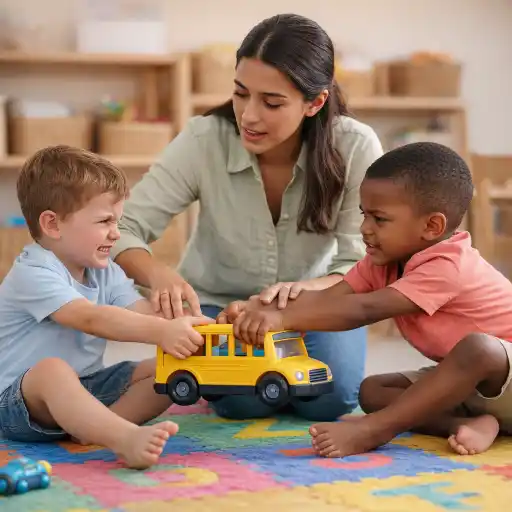
Language is especially significant. A child who cannot quickly say, “Can I have a turn when you’re finished?” may grab. A child who feels excluded from play may pull a toy rather than explain, “I want to be part of the game.” Adults can interpret these actions as communication attempts and teach a safer replacement.
- 💬 Teach short phrases: “My turn,” “Please stop,” “Help, please,” and “Can we trade?”
- Name emotions without excusing unsafe behavior: “You are frustrated because the truck is being used.”
- Explain the social impact: “Grabbing makes it hard for your friend to keep playing.”
- Offer two or three realistic solutions rather than demanding an instant apology.
NAEYC’s three-step approach is useful here: state what happened and identify emotions, explain the implications, and address the behavior by coaching an alternative. Repeated practice helps children move from adult-supported regulation toward independent problem-solving.
How can the classroom environment prevent toy conflicts?
Prevention begins before the disagreement. A crowded, unpredictable environment increases competition and makes it harder for children to see available choices. Thoughtful room design does not eliminate conflict, but it reduces unnecessary triggers and gives children clearer pathways to successful play.
- Provide duplicates of highly sought-after materials when possible.
- Rotate toys so the room contains enough variety without overwhelming children.
- Use low, organized shelves with picture labels so children can locate and return materials.
- Create defined play zones, including a quieter space for children who need a sensory break.
- Use visual schedules and transition warnings to reduce abrupt interruptions.
- Plan small-group activities that require cooperation, such as building a shared structure.
Observe when and where disputes occur. If arguments repeatedly happen at the block shelf after a transition, the problem may involve timing, crowding, insufficient materials, or unclear expectations rather than one “difficult” child. A simple record of the time, location, toy, participants, antecedent, and outcome can reveal patterns.
Directors can support consistency by helping staff agree on three or four shared phrases and response steps. State requirements vary - check your state licensing agency, particularly when documenting injuries, repeated aggression, or referrals for additional support.
What should teachers do when children begin fighting?
The first responsibility is safety. Move close, block hitting or grabbing calmly, and separate children only as much as needed. Use a low, steady voice; an adult’s urgency can intensify children’s arousal.
- Stop unsafe behavior: “I won’t let you hit. Hitting hurts.”
- Check for injury: Comfort and attend to the hurt child first.
- Describe the problem: “You both want the red truck.”
- Regulate: Offer a breath, quiet space, water, or brief pause until the children can listen.
- Coach language: “Tell your friend, ‘Can I have a turn?’”
- Offer solutions: Use a timer, trade, play together, or choose another material.
- Repair: Return materials, rebuild what was damaged, check on a peer, or practice the words again.
Avoid long lectures while emotions are high. The immediate message should be brief: unsafe actions stop, feelings are allowed, and a safer action is available. Afterward, revisit the event when both children are calm. Praise specific progress: “You waited while Maya finished, and then you asked with words.”
How can teachers teach sharing without forcing it?
Sharing is not a single moral behavior that children either possess or lack. It includes waiting, yielding, exchanging, coordinating use, and trusting that materials will remain available. Forced sharing may produce short-term compliance but does not necessarily build understanding or cooperation.
Teach turn-taking explicitly during calm periods. Use a sand timer, a visual card, or a predictable phrase such as, “You are using it now; Jordan is next.” Practice with puppets, songs, board games, and cooperative construction. When children can see what “next” means, waiting becomes more manageable.
- Model a request: “Can I use it when you’re done?”
- Practice a response: “Yes, you can be next.”
- Teach alternatives: trade, share parts, play beside one another, or select a similar toy.
- Accept culturally and linguistically familiar ways of expressing requests, supported by visuals and gestures.
- Notice effort, not perfection: “You held the block safely while you waited.”
Children also need opportunities to protect special belongings. In some settings, a child may keep one personal or classroom-designated item unavailable for group use, while other materials remain open to peers. This communicates that cooperation can include boundaries and consent.
When do repeated toy fights require additional support?
Occasional toy disputes are expected. Additional support may be appropriate when conflicts are unusually frequent, severe, persistent across settings, associated with repeated injury, or accompanied by significant communication, sensory, developmental, or emotional concerns. The goal is not to diagnose from classroom behavior but to respond thoughtfully and collaboratively.
Begin with observation. Record what happens before the conflict, the behavior itself, and what follows. Ask whether the child is seeking a toy, adult attention, escape from noise, access to play, or help communicating. Consider fatigue, hunger, transitions, group size, language access, and sensory demands.
Share strengths with families before discussing concerns. Explain the specific pattern, the strategies being tried, and the child’s progress. Invite families to describe successful approaches at home. If needed, consult administrators, early childhood mental health consultants, speech-language professionals, or other appropriate specialists according to program procedures.
Equity matters. Children should not be disproportionately removed from play or described with global labels. Adapt materials, visuals, language, peer groupings, and adult support so every child has a meaningful way to participate. Document objectively and protect confidentiality.
Conclusion: Why do preschoolers fight over toys?
Preschoolers fight over toys because possession, play, language, emotion, and social identity are developing at the same time. These conflicts are normal learning contexts, but unsafe behavior still requires a clear boundary. The most effective response combines prevention, calm intervention, emotional coaching, replacement language, fair choices, and opportunities for repair.
For a practical team checklist, ask: Are popular materials accessible? Do children know what to say? Are adults using consistent scripts? Have we observed patterns rather than assumed motives? When providers treat conflict as a teachable moment, children gradually learn #communication, #empathy, #selfregulation, #turntaking, and #problem-solving.
ChildCareEd offers additional professional learning for providers and directors, including Social Foundations and Responsive Classrooms Buy Now $24.00, From Tantrums to Triumphs: Equipping Preschoolers with Self-Regulation Skills Buy Now $25.00, The ABCs of Behavior: Turning Challenges into Learning Opportunities Buy Now $55.00, and Supporting Social Learning: Creating Classrooms that Care Buy Now $24.00. Together, these resources can help your team turn everyday toy disputes into safer, kinder learning experiences.
- Lesson Planning for Preschoolers
- The ABCs of Behavior: Turning Challenges into Learning Opportunities
- Moving About the Classroom: Effective Transitions for Everyday
- CDA Bridge Bundle: Family Child Care without Portfolio Review
- CDA Bridge Bundle: Infant/Toddler without Portfolio Review
- CDA Bridge Bundle: Preschool without Portfolio Review
- 45-Hour Infant and Toddler Curriculum
- Creating Environments that Nurture Growth and Community
- Texas Director Credential
- Moving About the Classroom: Effective Transitions for Everyday
- CDA Certification en Español: Recursos y Consejos para Educadores Bilingües
- Behavior Management Techniques That Align with Developmentally Appropriate Practice
- How can I reduce classroom conflicts among toddlers?
- Recursos en Español sobre el Sueño Seguro del Bebé
- Proporciones de Cuidado Infantil y Tamaños de Grupo por Edad en Maryland (Guía Rápida para Centros y Hogares)
- Lista para Guardería en Casa en Texas: Cómo Iniciar una Guardería en el Hogar
- Cómo Trabajar en el Cuidado Infantil en Carolina del Norte: Requisitos y Pasos
- How can Georgia preschool teachers use positive guidance to help preschoolers share during indoor play?
- How can preschool teachers use simple classroom management techniques that really work?
- Daycare Conflict Resolution: Helping Children Get Along
- How can we help children sleep better?
- How can positive guidance help preschoolers learn and behave well?
- How can New York preschool programs safely handle aggressive behavior?
- Celebrando la amistad en el cuidado infantil durante el Día de los Mejores Amigos
- Cooperative Play vs. Parallel Play: What’s the Difference?
- Cómo simplificar la capacitación para sus empleados de daycare
- What Can DC Child Care Providers Learn from the City’s Pay Equity Wage Fight?
- Why Do Open-Ended Toys Beat Battery-Powered Ones?
- How Can Waiting Time Be Meaningful Instead of Frustrating?
- Why Do Preschoolers Fight Over Toys—and How Can Teachers Help?
