When children struggle to wait, remember directions, or shift activities, the challenge is often a developing skill—not a lack of cooperation. Child care teams can strengthen #executivefunction through playful routines, responsive relationships, and intentional environments; From Tantrums to Triumphs: Equipping Preschoolers with Self-Regulation Skills Buy Now $25.00 can deepen staff knowledge while providing practical strategies for supporting emotional control and self-confidence. For educators seeking a broader foundation, The Best Promotion is Play Buy Now $35.00 connects purposeful play with cognitive, social, and self-regulatory development.
What is executive function, and why does it matter in child care?
Executive function is a group of interrelated mental processes that help children pursue goals. The core components are working memory, inhibitory control, and cognitive flexibility. Working memory helps a child remember a two-step direction; inhibitory control supports stopping, waiting, and resisting an immediate impulse; cognitive flexibility allows a child to shift attention, change strategies, or respond when a familiar rule changes.
These capacities develop gradually and are influenced by relationships, stress, language, sleep, culture, and the learning environment. They are not fixed traits or measures of character. A child who runs from circle time may be communicating that the task is too long, the instructions are unclear, or the environment is overwhelming. A supportive adult can reduce the demand, model the skill, and offer another opportunity.
Research summarized by NAEYC’s discussion of executive function through games connects playful, active learning with the development of attention, self-regulation, and goal-directed behavior. Harvard’s Brain-Building Through Play resources likewise emphasize that ordinary interactions and games can exercise focus, memory, and self-control.
- 🧠 Think of executive function as developing classroom equipment, not a compliance test.
- Use strengths, interests, and relationships as the starting point for practice.
- Expect uneven performance: children may manage a skill in play before they can use it during a stressful transition.
How can providers build working memory through everyday experiences?
Working memory allows children to hold information in mind long enough to use it. It is essential for following directions, participating in conversations, recalling game rules, and completing routines. The most effective practice is brief, meaningful, and connected to what children are already doing.
Begin with one action, then gradually add another. During cleanup, say, “Put the cars in the basket, then choose a book.” Once children are successful, add a third step or invite them to explain the sequence. Visual supports—photographs, object cues, picture schedules, and first-then cards—do not replace memory practice; they scaffold participation while the skill develops.
- Play “Copy My Pattern” with claps, taps, or movements. Add one element only after children are comfortable.
- Use story recall: ask children to remember one character, action, or detail before expecting a full retelling.
- Turn snack routines into sequence practice: “First napkin, next cup, then food.”
- Invite children to plan block construction or dramatic-play roles and revisit the plan afterward.
Keep language concise and pause long enough for processing. If a child forgets, avoid repeating a long lecture. Point to the visual, restate one step, and celebrate partial success: “You remembered the basket. Now let’s find the book.” Documentation can note the number of steps completed independently, the supports used, and the context in which success occurred.
Which activities strengthen inhibitory control and self-regulation?
Inhibitory control is the ability to pause or suppress an immediate response in favor of a goal. Young children need repeated, joyful opportunities to practice stopping their bodies, waiting for a cue, and recovering from disappointment. Games work best when adults teach the rule explicitly, model it, and keep the challenge within reach.
- “Red Light, Green Light” develops stop-go control. Add yellow for slow motion once the basic rule is familiar.
- “Freeze Dance” invites children to move freely and stop safely when the music pauses. Pair the freeze with one calm breath.
- “Simon Says” develops listening and response inhibition. Use short commands and avoid eliminating children who make mistakes.
- Timed turn-taking with a visual timer makes waiting concrete and predictable.
- Breathing, stretching, or pushing against a wall can provide a brief co-regulation reset.
Specific feedback is more useful than general praise. Say, “You wanted the truck, and you kept your hands safe while you waited,” rather than “Good job.” Practice regulation strategies when children are calm; introducing them for the first time during a meltdown places too much responsibility on a child whose system is already overloaded.
A calm space should be taught as a supportive choice, never as humiliation or punishment. The adult remains available, protects safety, and helps the child return to the group when ready. When behavior is unsafe or persistent, adjust the environment and collaborate with families and specialists rather than relying on increasingly severe consequences.
How can playful learning develop cognitive flexibility?
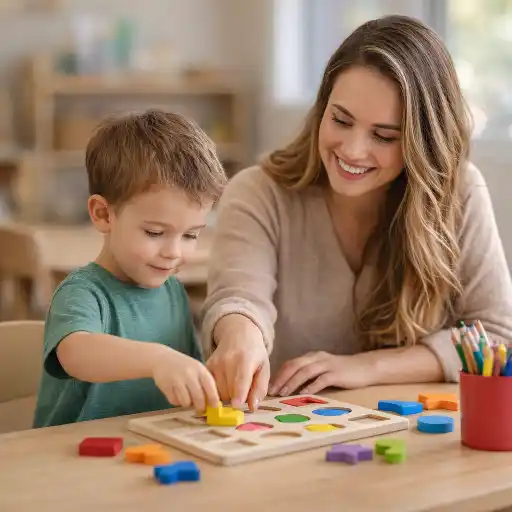
Cognitive flexibility helps children shift between rules, perspectives, activities, and solutions. It supports problem solving, peer negotiation, pretend play, and resilience when plans change. Flexibility does not mean expecting children to accept every transition without support; it means intentionally building their capacity to adapt while honoring the need for predictability.
Try “Opposite Day”: when the adult says “up,” children touch down; when the adult says “fast,” they move slowly. Begin with two opposing concepts and use gestures. In “Switch the Rule,” children sort objects by color, then shift to sorting by shape. Ask, “What changed? How did you figure out the new plan?” These reflective questions help children notice strategies instead of simply guessing.
- Change one predictable element in a familiar song or story and invite children to identify it.
- In dramatic play, switch roles so a cashier becomes a customer or a doctor becomes a patient.
- Present a low-stakes classroom problem, such as limited blocks, and gather several possible solutions.
- Build an obstacle course, then change one rule and support children in revising their plan.
Adults should distinguish flexibility from forced compliance. Give advance warnings, use visual transition cues, and offer bounded choices: “The block area is closing. Would you like to put away the long blocks or the small blocks first?” Children who are bilingual, neurodivergent, anxious, or processing sensory input may need additional time, visual information, or a quieter entry into the new expectation. Inclusive practice treats adaptation as a shared process.
How do environment, relationships, and routines make practice consistent?
Children use executive function more successfully when the setting reduces unnecessary cognitive load. Predictable room arrangements, labeled materials, accessible choices, and consistent signals allow children to devote attention to planning and problem solving rather than decoding the environment. The 2024 teacher study published by Frontiers in Education identified environment and activity structuring, autonomy, purposeful organization, sustained shared thinking, and intentional activities as practices teachers use to support executive functions.
Relationships are equally central. Responsive adults lend children their calm, language, and organization until children can increasingly manage these processes themselves. At arrival, a teacher might say, “You looked at the picture and found your cubby.” During conflict, the adult can narrate: “Your body wants the shovel. Let’s pause, use words, and make a plan.” Such language makes invisible thinking visible.
- Post a simple picture schedule at children’s eye level.
- Use the same start, stop, cleanup, and transition cues across classrooms.
- Protect an uninterrupted play period for sustained planning and shared thinking.
- Offer movement breaks before attention is depleted, not only after behavior escalates.
- Coach staff through brief cycles of observation, modeling, practice, and reflection.
Start with one routine rather than redesigning the entire program. A director might select cleanup for a two-week focus, agree on common language, collect brief observations, and review what helped. State requirements vary - check your state licensing agency before changing schedules, supervision procedures, or documentation systems.
How should programs individualize support and measure progress?
Effective assessment begins with curiosity and objective observation. Executive function varies by age, context, relationship, language, fatigue, and task demands. A child may wait successfully with a familiar teacher but need substantial support in a noisy group. Therefore, avoid labeling a child from one incident or comparing children publicly.
Select one or two observable targets. Examples include “follows a two-step direction with a picture cue,” “waits for 30 seconds with adult support,” or “tries a second strategy after a block structure falls.” Record the opportunity, the child’s response, the prompt provided, and what happened next. After a baseline period, review the notes weekly and adjust the challenge.
- Universal support: visual schedules, short games, movement, predictable routines, and co-regulation for everyone.
- Targeted support: shorter turns, reduced instructions, visual timers, practice with a peer, or a planned break.
- Collaborative support: family partnership, developmental screening, consultation, or referral when concerns persist.
Seek additional guidance when difficulties are frequent, intense, significantly interfere with participation, create safety concerns, or show little improvement despite consistent adaptations. Share strengths and concrete examples with families; avoid diagnostic language unless speaking within an appropriate professional role. Screening is not diagnosis, and referral decisions should follow local procedures.
Common mistakes include treating executive function as obedience, overloading children with words, using a calm area as punishment, and expecting rapid generalization from one game. Replace these practices with explicit modeling, manageable demands, repetition across contexts, and compassionate follow-through.
Conclusion: What is the most practical starting point?
Child care programs strengthen executive function when they make practice frequent, playful, relational, and developmentally responsive. The central question—how can providers help young children remember, pause, and adapt?—is answered through small actions repeated throughout the day: a picture-supported routine, a two-minute stop-and-go game, a movement reset, guided problem solving, and calm adult coaching.
This week, choose one target skill, one routine, and one short activity. Agree on a shared staff phrase, observe without judgment, and celebrate incremental progress. Invite families to try a familiar game at home, while recognizing that culture, language, temperament, and context shape how children demonstrate skills. With thoughtful scaffolding and consistent relationships, children gain not only smoother transitions but also stronger foundations for learning, participation, and belonging.
Additional ChildCareEd courses to explore:
- Early Childhood Education
 Buy Now $99.00—a broader foundation in guidance, observation, curriculum, and family partnerships.
 - Preschool Assessments & Observations Buy Now $24.00—practical support for objective observation and individualized planning.
- Environments That Inspire Independence and Exploration Buy Now $55.00—strategies for learning spaces that promote autonomy and engagement.
- 45 Hour Child Growth and Development
- Turning Behavior Around for Toddlers and Preschoolers
- Language Development in School Age
- 45 Hour Preschool Methods and Materials
- Family Voices Matter: Tools for Meaningful Collaboration
- The Best Promotion is Play
- Positive Attention: Interactions & Supervision for Infants & Toddlers
- Texas Director Credential
- CDA Certification en Español: Recursos y Consejos para Educadores Bilingües
- 🎈 Better Together: Why Little Friends Make a Big Difference in Early Childhood
- 🔍 ¿Qué ves cuando observas a un niño aprender?
- 10 Ejemplos de Cómo la Cultura Influye en el Desarrollo Infantil
- How can preschool programs keep kids cool and practice self-control with heat-safe indoor activities in Texas?
- Canciones, juegos y preguntas de círculo para niños
- How Does Play Support Children’s Physical, Cognitive, and Social Growth?
- How Can Child Care Providers Help Children Develop Memory and Attention Skills?
- How Can Child Care Programs Effectively Support Executive Function Skills in Young Children?
- How Can Preschool Teachers Help Children Build Problem-Solving Skills?
- How can childcare programs support homework without doing the work for children?
- What Is Executive Function and Which Simple Classroom Activities Build Memory, Self-Control, and Flexible Thinking?
- Why do children need more boredom and less constant entertainment?
- How can child care programs effectively support executive function skills in young children?
- How Can Child Care Programs Strengthen Executive Function in Young Children?
- How Can Child Care Providers Support Preschool Development Across the Whole Child?
- How Do Clip Cards Build Fine Motor Strength and Focus?
- How Do Children Learn Through Play?
- How Can Sorting Activities Strengthen Early Thinking Skills?
- How Do Mazes Strengthen Pencil Control and Problem-Solving in Preschool?
