Memory development shapes how children learn routines, language, relationships, and new concepts—and thoughtful daily interactions can strengthen it without turning play into drills. Build staff confidence with the CDA Subject Area 8  Buy Now $80.00 course, which explores child development, brain development, developmental variation, and culturally responsive care while providing professional learning that can support more intentional classroom practice.
Why does memory development matter in early childhood?
Memory is not a single ability. It includes sensory memory, working memory, implicit memory, and explicit memory, each developing on a different timetable. Infants can recognize familiar voices, faces, objects, and routines long before they can describe personal events verbally. Research summarized by the Encyclopedia on Early Childhood Development indicates that infants form memories during the first year of life, while recall becomes more reliable throughout the first and second years.
For child care providers, this means that repeated experiences are meaningful even when children cannot explain what they remember. A familiar song can prepare an infant for a diapering routine; a predictable cleanup sequence can help a toddler anticipate what comes next; and a preschooler can use remembered rules to participate in cooperative games.
Memory supports far more than academic learning. Children rely on it to:
- Follow directions and classroom expectations
- Recall vocabulary, stories, and social experiences
- Plan actions and solve problems
- Recognize trusted adults and familiar routines
- Build a coherent sense of identity and belonging
Memory is closely connected to attention and self-regulation. When children hold a rule in mind, resist an impulse, or shift from one activity to another, they are practicing executive functions. The goal is not to make every child remember in the same way. Rather, providers create supportive conditions in which each child can notice, connect, rehearse, and retrieve information.
How does memory develop from infancy through the preschool years?
Developmental progress is gradual, variable, and influenced by relationships and experiences. The Illinois Early Learning Project’s memory guidelines describe a useful progression: infants begin anticipating familiar events, toddlers remember people and routines, and older toddlers increasingly recall sequences and past experiences.
During infancy, responsive interaction is foundational. Peek-a-boo, hiding a toy beneath a cloth, and repeating a song help children notice continuity: people and objects continue to exist even when temporarily out of sight. By the toddler period, children may search for a favorite book in its usual location or move toward the table when they hear “snack time.” These are authentic demonstrations of #memory, not merely cute behaviors.
Between approximately two and three years, children increasingly remember the order of familiar events. They may know that washing hands comes before lunch or that a story follows rest time. Preschoolers gradually become better able to recall story events, reproduce patterns, describe past experiences, and use prior knowledge in new situations.
Providers should avoid treating age ranges as rigid deadlines. Language exposure, temperament, culture, disability, stress, sleep, health, and opportunities for interaction all affect performance. A child may demonstrate memory through movement, drawing, pretend play, gesture, home language, or behavior rather than through a verbal answer in English.
Observe what a child can do with support, across settings, and over time. Developmental milestones guide observation; they do not replace individualized understanding.
Which everyday teaching practices strengthen memory?
The strongest opportunities are embedded in ordinary classroom life. The Penn State Better Kid Care guidance on developing memory emphasizes responsive relationships, narration, meaningful conversation, clear directions, and consistent routines.
Start by reducing unnecessary cognitive load. Give one clear direction before adding another: “Please place the books on the shelf” is more useful than “Clean up everything.” Explain the purpose when appropriate, because understanding why a task matters helps children focus on the task itself.
- 🧭 Use picture schedules, object cues, gestures, and brief verbal reminders together.
- Break multi-step tasks into two or three visible steps.
- Repeat key words and routines without sounding punitive or impatient.
- Use “first, next, then, finally” during transitions and play.
- Invite children to predict what will happen next.
- Retell shared experiences using photographs, drawings, props, and children’s home languages.
Adult language is especially powerful. During block play, say, “You remembered that the wide block makes the bottom stronger.” During snack, ask, “What did we do before we sat down?” These comments connect present actions with prior knowledge and teach children that remembering is a strategy they can use.
Offer wait time after questions. Children may need several seconds to retrieve information, organize language, and decide how to respond. If a child does not answer, provide a visual or partial prompt rather than immediately supplying the solution.
How can play, movement, and storytelling make memory practice engaging?
Play gives children repeated practice with rules, sequences, turn-taking, and retrieval while preserving joy and agency. Harvard’s Brain-Building Through Play resources identify playful activities as opportunities to strengthen attention, working memory, and self-control.
Choose short activities and adjust the challenge. For infants, use peek-a-boo, repeated songs, and simple imitation. For toddlers, hide familiar objects, copy two-action patterns, or ask children to retrieve materials from a known location. For preschoolers, try:
- “Simon Says” for remembering rules and inhibiting an automatic response
- “Red Light, Green Light” for listening, stopping, and acting on remembered cues
- Freeze Dance for movement control and rule recall
- Clap-tap patterns that gradually increase from two to four actions
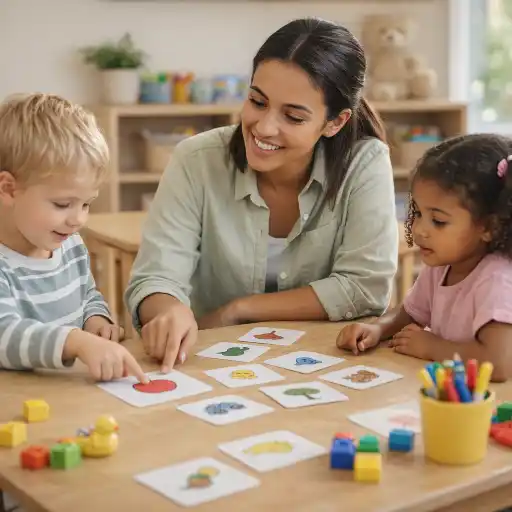
- Story sequencing with three picture cards
- “What is missing?” with a small collection of familiar objects
Movement can prepare children for memory tasks. A brief animal walk, marching pattern, or stretch-and-freeze sequence before group time may help children regulate arousal and focus. Combine physical action with cognitive demand: “Hop, turn, touch the cone, and freeze.” Then invite children to create a sequence for peers.
Storytelling is equally valuable. Read a familiar book, pause before a predictable phrase, and ask children to place events in order. Encourage multiple forms of retelling: words, drawings, puppets, dramatic play, or home-language narration. Avoid correcting every detail; focus first on meaning, sequence, and confidence.
How should providers adapt memory supports for individual children?
Children who struggle to remember directions are not necessarily unmotivated or inattentive. The message may be too long, the environment may be distracting, or the child may need a different way to encode and retrieve information. The AllPlay Learn educator strategies recommend gaining attention first, simplifying tasks, reducing background noise, varying communication formats, and gradually fading help.
Use a strengths-based, tiered approach:
- Universal supports: predictable routines, visual schedules, gestures, repetition, movement breaks, and short directions for everyone.
- Targeted supports: smaller groups, fewer steps, visual timers, individualized cue cards, extra processing time, and repeated practice across settings.
- Collaborative supports: family conversations, developmental screening, early intervention, special education consultation, or health care referral when concerns persist across contexts.
For multilingual children, distinguish memory difficulty from language-access difficulty. Use the child’s home language when possible, pair words with objects and pictures, and invite families to share familiar songs, routines, and storytelling traditions. For children with disabilities, follow individualized plans and consult the appropriate professionals rather than relying on assumptions.
Document observations objectively. Record the direction given, the support provided, the child’s response, and the context. For example: “After viewing a three-picture sequence, Maya placed two events in order independently and needed one verbal cue for the third.” This is more useful than “Maya has a poor memory.”
State requirements vary - check your state licensing agency regarding documentation, developmental screening, supervision, and referral procedures.
How can directors and teachers measure progress without overtesting?
Young children demonstrate memory in authentic activity, so assessment should be embedded in relationships, play, and routines. The Virtual Lab School guidance on cognitive development encourages developmentally appropriate, strengths-based observation and adaptations that honor individual differences.
Select one or two observable goals, such as remembering a two-step direction, recalling three story events, or completing a familiar routine with fewer prompts. Establish a simple baseline, then collect brief observations weekly. Consider tracking:
- Number of steps completed independently
- Type and frequency of prompts needed
- Length of time a child remains engaged
- Ability to recall information after a short delay
- Whether the skill transfers to another person, material, or setting
Review data with curiosity rather than judgment. A child may perform well in a quiet small group but not during a noisy transition. That difference provides information about environmental demands, not a fixed limitation. Share specific examples with families and ask what children remember and enjoy at home.
Common mistakes include giving too many directions at once, making memory practice feel like a test, expecting immediate transfer from a game to daily behavior, and confusing language differences with cognitive weakness. Avoid these pitfalls by shortening tasks, modeling first, practicing across contexts, and using multiple ways for children to respond.
Directors can support consistency by coaching staff, creating shared cue language, placing visual supports at child height, and discussing brief observation notes during team meetings. Professional learning such as the Early Childhood Education course Buy Now $99.00 can further strengthen staff knowledge in observation, curriculum, communication, and developmentally appropriate practice.
Conclusion: What is the most effective way to support memory development?
The most effective approach is not a worksheet or a high-tech program. It is a responsive environment in which children experience meaningful repetition, clear language, predictable routines, movement, storytelling, and playful challenges. Memory develops through relationships and participation: children remember what they understand, what they practice, and what carries personal meaning.
Tomorrow, choose one routine to make more predictable, one visual cue to add, and one brief game or story activity to repeat. Observe small changes, celebrate effort, and adjust the level of challenge. Partner with families, honor culture and language, and seek additional support when concerns persist. With intentional yet joyful practice, child care providers can make memory development part of every day.
For continued professional growth, explore the Role of Play in Learning Buy Now $16.00 course to deepen understanding of how play supports cognitive development, learning, and responsive classroom practice.
- 45 Hour Child Growth and Development
- Positive Attention: Interactions and Supervision of Infants and Toddlers: For Workforce Solutions
- CDA Bridge Bundle: Family Child Care without Portfolio Review
- CDA Bridge Bundle: Infant/Toddler without Portfolio Review
- CDA Bridge Bundle: Preschool without Portfolio Review
- Positive Attention: Interactions & Supervision for Infants & Toddlers
- Texas Director Credential
- Every Moment Matters: Schedules and Transitions
- Supporting Families and Caregivers in Language and Literacy
- CDA Certification en Español: Recursos y Consejos para Educadores Bilingües
- 🔍 ¿Qué ves cuando observas a un niño aprender?
- Proporciones de Cuidado Infantil y Tamaños de Grupo por Edad en Maryland (Guía Rápida para Centros y Hogares)
- Proporciones de Cuidado Infantil y Tamaños de Grupo por Edad en Virginia (Guía Rápida para Centros y Hogares)
- How Do Art Activities Support Cognitive Growth in North Dakota Preschoolers?
- Canciones, juegos y preguntas de círculo para niños
- Is This Development Typical? When Child Care Providers Should Watch, Document, or Refer
- How Can Child Care Providers Support Healthy Brain Development in Young Children?
- How Can Child Care Programs Strengthen Executive Function in Young Children?
- How Can Child Care Providers Support Young Children’s Attention Span?
- How Can Child Care Providers Support Memory Development in Young Children?
- How Can Child Care Providers Recognize and Support Developmental Delays?
- How Can Child Care Providers Support Infant Development?
- How Can Child Care Providers Support Healthy Toddler Development?
- How Can Child Care Providers Support Preschool Development Across the Whole Child?
- How Can Child Care Providers Support Healthy Child Growth and Development?
- Why Does Sensory Play Matter for Brain Development?
- How Can Juneteenth Symbols Build Visual Memory in Young Children?
- How Can Providers Notice Developmental Progress Hidden in an Infant’s Daily Routine?
